


Euphorbia Neriifolia, Linn. Sun. Euphorbia Liqularia. Roxb. Sans
Description
This section is from the book "The Materia Medica Of The Hindus", by Udoy Chand Dutt. Also available from Amazon: The Materia Medica Of The Hindus.
Euphorbia Neriifolia, Linn. Sun. Euphorbia Liqularia. Roxb. Sans

Snuhi,

Vajri,

Sehunda.
Vern. Mansάsij. Beng. Sehund, Thohar. Hind.
This prickly shrub is sacred to Mansa the goddess of serpents. On the fifth day after full moon of the month of Sravana (July, August) it is planted in the court-yard of Hindu houses and worshipped as the representative of Mansa the goddess of serpents. Euphorbia antiquorum, called tekάtά sij in Bengali on account of its triangular stem, is probably alluded to by some Sanskrit writers under the name of vajri, which is explained as a variety of snuhi. This plant is supposed to ward off lightening strokes and is generally kept in tubs or pots on the roofs or other exposed parts of native houses. Its popular medicinal uses are like those of Euphorbia neriifolia.
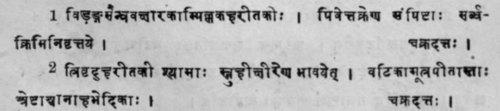
The milky juice of Euphorbia neriifolia is considered purgative and rubefacient. As a purgative it is generally used in combination with other medicines which are steeped in it. Che-bulic myrobalan, long pepper, trivrit root, etc., are thus treated and administered as drastic purgatives, in ascites, anasarca and tympanitis.2 It enters into the composition of several compound prescriptions of a drastic character as for example, the Mahana-racha rasa described under Croton Tiglium, and Vindu ghrita a preparation with clarified butter, of similar composition.
Turmeric powder mixed with the milky juice of Euphorbia neriifolia is recommended to be applied to piles.1 Thread steeped in the above mentioned mixture is used in ligaturing external haemorrhoids.2 The powdered wood of Berberis Asiatica (dάruhari-drά) is steeped in the milky juice of snuhi and of Calotropis gigantea (arka), and made into tents for introduction into the tracks of fistula in ano and other sinuses.3
Continue to:


My Books

