


Mercury. Sans. Part 2
Description
This section is from the book "The Materia Medica Of The Hindus", by Udoy Chand Dutt. Also available from Amazon: The Materia Medica Of The Hindus.
Mercury. Sans. Part 2
The four preparations of mercury above mentioned, though described in most works on metalic medicines, are not, practically used in the treatment of disease under these names. In the present day the yellow preparation is not in use. The white form called Rasaharpura is now prepared, not according to the processes described in Sanskrit works, but by subliming the black sulphide of mercury with common or rock salt. In this form it is largely manufactured and sold in all the bazars. The red preparation is better known as Rasa sindura; and the black one as Rasa parpati. In fact, practically, prepared mercury means the red preparation or Rasa sindura and this is the form in which it is largely used. Besides this, the black and red sulphides of mercury are also used internally. The black sulphide is prepared by rubbing together equal parts of sulphur and mercury till the globules disappear. It is called Kajjali.1 The red sulphide or cinnabar is called hingula. These four preparations, namely, cinnabar, the black sulphide called Kajjali, the red preparation called Rasasindura, and the Rasakarpura of the bazar, nre the four principal forms in which mercury is used in Hindu medicine; that is, they constitute the basis of all the formulas containing mercury.
Mercury is said to be imbued with the six tastes, and capable of removing derangements of all the humours. It is the first of alterative tonics. Combined with other appropriate medicines it cures all diseases, acts as a powerful tonic and improves the vision and complexion.
In fevers of all descriptions, mercury is extensively used in combination with aconite, croton seed, datura, and other medicines. The following are a few illustrations.
Hingulesvara. Take of cinnabar, aconite, and long pepper, equal parts, rub together in a mortar and make into pills about four grains each. They are given, beaten up with a little honey, in ordinary remittent fever.1

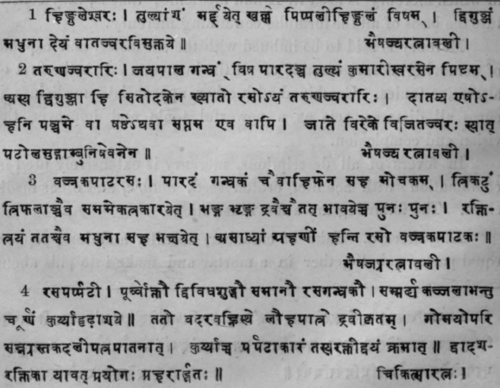
Taruna jvarάri.2 Take of mercury, sulphur, aconite and croton seeds, equal parts, rub together with the juice of Aloe Indica and make into four grain pills. These pills act on the bowels and relieve fever. They are administered with sugar and water.
In diarrhoea and dysentery, mercury is used in a great variety of forms. The following are a few examples.
Vajrakapάta rasa.3 Take of mercury, sulphur, opium, mocha-rasa, (gum of Bombax Malabaricum), the three myrobalans, ginger, black pepper, and long pepper, in equal parts, powder and mix. Soak the powder in the juice of the leaves of Cannabis sativa (Vijaya) and Verbesina calendulacea {bhringaraja) seven times and make into six grain pills. This medicine is administered with honey in obstinate chronic diarrhoea. Dose grains four to twenty-four.
Rasa parpati4 This is prepared by melting together a mixture of equal parts of sulphur and mercury in an iron ladle, smeared with ghee (clarified butter). The melted fluid is poured on a piece of plantain leaf, placed on a ball of cowdung. It is then pressed by another ball of cowdung, enclosed in plantain leaf. When cool, the black sulphide of mercury is obtained in the shape of round disks. It is much used alone, or with the addition of other medicines, in chronic diarrhoea. Other varieties of Parpati or mercurial preparations in shape of disks are prepared with the addition of iron, gold, copper etc, and used in this complaint, as for example, Svarna parpati, Panchάmrita parpati etc. The preparation of the former will be described under the head gold. The latter is thus prepared.
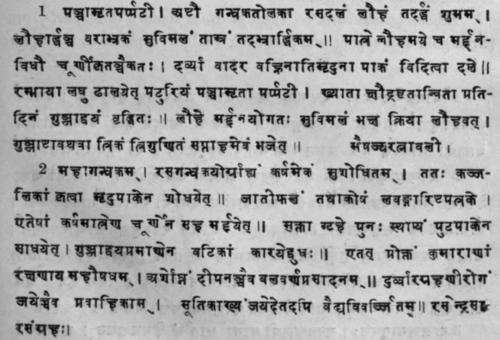
Panchάmrita parpati.1 Take of sulphur eight tolas, mercury four tolas, prepared iron two tolas, prepared talc one tola, prepared copper half a tola. Rub together in an iron mortar, melt in an iron ladle and prepare disks like those of Rasa parpati, above described. Dose four grains with honey and ghee, to be gradually increased to sixteen or eighteen grains. Parpatis of different sorts when given in cases of diarrhoea with anasarca are conjoined with a milk diet, water and salt being prohibited.
Mahάgandha rasa.2 Take of mercury and sulphur each two tolas, and make a Parpati as before described. Take of nutmegs, mace, cloves, and nim leaves, each two tolas, powder them well, mix together, and inclose the mixture within bi-valve shells. Cover the shells with a layer of clay and roast in fire. When cool, extract the medicine from the shells. It is administered in doses of abont four grains in the acute diarrhoea of children.
Pάndusudana rasa.1 In jaundice, mercury is used along with other alteratives and purgatives, as in the following, called Pandusudana rasa. Take of mercury, sulphur, prepared copper, croton seeds and bdellium, equal parts, rub them together with ghee and make into two-grain pills. They are given with the juice of nim bark and honey in jaundice. Acids and cold water for drinking should be avoided.
In affections of the lungs mercury is used in a variety of combinations. The following are a few illustrations.
Rasendra gudikά.2 Take of purified mercury two tolas. Add to it one tola of the juice of jayanti leaves (Sesbania AEgyptica) and of fresh ginger, rub together till the mixture thickens, then soak it in the juice of Jussicea repens (kanchata) and Solanum Indicum (vrihati) respectively for twenty-four hours. Take of purified sulphur eight tolas and soak in the juice of Verbesina calendulacea (bhringarάja). When dry, mix the sulphur with the mercury, and rub together with sixteen tolas of goat-milk till the mass is fit for being made into pills. Dose about four grains, to be taken with goat-milk and juice of ginger. This pill is useful in bronchitis and cough generally.
Continue to:


My Books

