


Nat. Order. Reutaceae. Citrus
Description
This section is from the book "The Materia Medica Of The Hindus", by Udoy Chand Dutt. Also available from Amazon: The Materia Medica Of The Hindus.
Nat. Order. Reutaceae. Citrus
The different species of Citrus described by Sanskrit writers are as follows.

Jambira. Vern. Gorάnebu, Beng. Citrus acida. Roxb. Var. 3

Limpάka. Vern. Patinebu, Beng. do, do, 1

Nimbuka. Vern. Kagujinebu, Beng. do. do. 2

Vijawra. Vern. Tabanebu, Beng. do. do. 7

Madhukarkatikά, Vern. Mithanebu, Beng. do. do. 9

Matulunga. Vern. Chholonga nebu, Beng. Citrus medica.

Karunά, Sans, and Beng. Citrus medica, variety of.

Nάgaranga. Vern. Kamlάnebu, Beng. C. Aurantium.
The variety of Citrus acida* called Jambira, yields the lemon juice used in medicine. Limpaka or pάti nebu is much used as a sauce by the natives. The fruits are cut vertically into two pieces, and the fresh juice, squeezed out with the fingers, is sprinkled on soup, dal, curry etc. to which it imparts a pleasant acid taste and agreeable flavour. A pickle of pati nebu, in its own juice and salt is a popular and effectual medicine for indigestion brought on by excess in eating, or by undigestible articles of diet. The fruits are first rubbed over a stone, or their rind scraped a little so as to thin it. They are then steeped in juice obtained from other fruits of the sort, and exposed to the sun for a few days with the addition of common salt. When crisp and of a brown colour, they are preserved in porcelain vessels or glass jars. This preparation is called Jάrak nebu (that is digestive lemon) in the vernacular.
* Citrus acida is itself a variety of the Citrus medica of Linnaeus to which species C. Limonum, C. Limetta and C. Lumia are also reduced.
The variety of Citrus acida called kaguji nebu has larger fruits than that of pάti nebu, and is also used as sauce like the latter, but its flavour and the fragrance of the essential oil in its rind is not so delicious.
Citrus Aurantium, or the sweet orange, comes from the valleys of the Khasia Hills and of the eastern Himalaya. It is called kamlά nebu in Bengali. The variety grown in the plains has an acid taste and is called narenga in the vernacular.
The Sanskrit term karunά nimbu is variously translated by different authorities. Wilson in his Sanskrit dictionary calls it Citrus decumana. In the Hortus Benoralensis it is translated into Citrus medica, while Drury and other Madras authorities make the variety Citrus Limonum. The Sabdakalpadruma does not give any synonym or vernacular term for it, so that it is difficult to say, what form it really meant. In the vernacular the term karuna is applied to a variety of Citrus medica.
Citrus decumana has I believe no Sanskrit name. In the vernacular it is called Bάtavi nebu, from its having been originally brought from Batavia. It is now much cultivated in gardens and is one of the common edible fruits of the country. Some varieties of the fruit have a pleasant taste and aroma, with little or no acidity.
Madhukarkatika. This variety of Citrus medica is probably the one described by Roxburgh as Mithά nebu, that is sweet lemon. The variety of Citrus which has very large oblong fruits, almost equal in size to the shaddock, and the thick spongy rind of which constitutes the largest portion of the fruit, was shewn to me by a gardener in Malda, under the name of madhukarkati. The pulp of this variety is very limited in quantity, of a bland sweetish taste and without any aroma or acidity.
Lemon juice is considered cooling, refrigerant stomachic and useful in indigestion, dyspepsia, vomiting of meals, thirst, burning of the body, intoxication from spiritious drinks or narcotics, etc. Fresh lemon juice is recommended to be taken in the evening, for the relief of dyspepsia with vomiting of meals.1 It enters into the composition of several carminative medicines for dyspepsia, Such as the Hingvάshtaka (see Assafoetida), Kravyάdi churna etc.
In rheumatic affections such as pleurodynia, sciatica, lumbago, pain in the hip joints etc., Sarangadhara recommends the administration of lemon juice with the addition of yavakshara (impure carbonate of potash) and honey.2
Rasayάnάmrita lauha.3 Take of long pepper, black pepper, ginger, the three myrobalans, bάberung seeds, cumin and nigella seeds, ajowan and the seeds of Cnidium difusum (vanajamάni), chiretta, trivrit, root of Baliospermum montanum (danti), nim bark, and rock salt, each two tolas, prepared iron sixteen tolas, sugar two seers, decoction of the three myrobalans four seers, and lemon juice two seers. Boil all these ingredients together till the watery portion is evaporated, lastly add clarified butter, half a seer and prepare a confection. Dose one to two tolas, in enlargements of the abdominal viscera, anaemia, jaundice, anasarca and chronic fever.
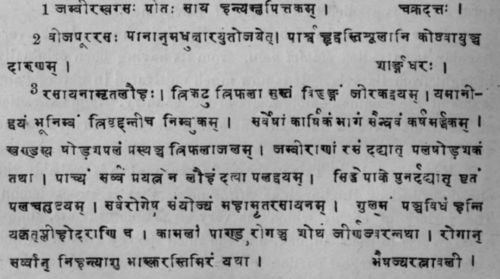
In fever complicated with pain in the head, throat and chest, the following mixture is directed to be used as a snuff for promoting discharge of phlegm. Take of lemon juice, ginger juice, rock salt, black salt, and sonchal salt, equal parts, and mix. The mixture should be warmed a little before use.
The root of the variety of Citrus acida, called limpaka constitutes one of the principal ingredients in the composition of a medicine called Yakridari lauha, described under Iron.
Continue to:


My Books

