


Ether. Continued
Description
This section is from the book "Materia Medica: Pharmacology: Therapeutics Prescription Writing For Students and Practitioners", by Walter A. Bastedo. Also available from Amazon: Materia Medica: Pharmacology: Therapeutics: Prescription Writing for Students and Practitioners.
Ether. Continued
After absorption it acts as a direct cerebral depressant or sedative, depressing the intellectual centers and the motor areas. Hence small amounts may be hypnotic, and large amounts will induce coma, as in anesthesia.
For the nervous structures themselves it has a special affinity, and after an ether death more ether is found in the brain than in any other organ. There are several theories to account for this accumulation in the central nervous system, and the production of narcosis by ether, chloroform, and similar substances. We shall speak of them later.
In poisoning by ether there is a progressive depression of the central nervous system. The higher cerebral functions, those involving intellectual processes, as self-control, judgment, and reason, are the first to succumb, so that the emotions are freed from control. Then the emotions, the perceptions, the motor functions, and coordination by the cerebellum are depressed. Then there is abolition of the spinal reflexes, and finally depression of the vital medullary centers. Sensory centers are affected before motor, so complete insensitiveness to the surroundings and to pain, i. e., complete abolition of the perceptions, precedes complete muscular relaxation. The action of ether upon the brain and spinal cord is directly antagonistic to that of caffeine and strychnine. The sensory nerve-endings are also somewhat depressed.
Eye
As affected in the production of anesthesia, the pupil is at first dilated reflexly, either from excitement, from irritation of the nose and throat, or from pain. It has the usual sensitiveness to light. In the stage of stupor it contracts as in sleep and is still quite sensitive to light. In the stage of complete anesthesia it is in mid-dilatation (Hewitt says 3.5 to 4.5 mm. in diameter) and almost insensitive to light. This is due to depression of the third nerve center, which in the light reflex controls the constrictor muscle of the iris. In the stage of collapse the pupil is dilated and insensitive to light, owing to the paralysis of this center.
Muscle
In perfusion of a limb there is no weakening of the muscle unless the ether concentration is high.
Temperature
From large doses the temperature tends to fall, both because of a striking diminution in the production of heat on account of the diminished muscular activity and loss of tone, and of increased dissipation of heat through wide dilatation of the cutaneous vessels and sweating. The fall in temperature will be increased by exposure during an operation.
Elimination is rapid and essentially by the lungs; it is probable that in prolonged anesthesia some passes out in the urine.
Kidneys
During anesthesia there is inhibition of urine formation, owing to contraction of the arterioles; after the anesthesia there is diuresis (Hawk). After anesthesia the excretion of phenolsulphonephthalein is often considerably retarded and there may be other evidences of kidney retention, notably hyperglycemia without glycosuria. Rarely there is glycosuria, Albuminuria is frequently noticed, perhaps in one-fourth of the cases, the statistics in published reports varying from 5 to 36 per cent. The condition is usually transitory, but occasionally it goes on to an acute nephritis, with albumin and blood in the urine. This would seem to indicate direct irritation of the kidney cells by the ether, but it is a result that may be due to the local contraction of the renal vessels, to partial asphyxia, or to acidosis. Acetone is also frequently found in the urine for one or two days after the anesthesia.
Skin
From moderate doses there are flushing of face and neck and a tendency to sweating. From anesthetic amounts there is usually flushing of the whole skin with profuse sweating; and sometimes mottling of the skin or a general erythema of transitory nature - the so-called "ether rash."
The ether habit is sometimes encountered, the devotee inhaling frequently through the nostrils or swallowing the diluted drug.
Therapeutics of ether when not employed as a general anesthetic. Externally and Locally. - It is used to cleanse the skin preparatory to operations, small or large. It has been employed for peritoneal lavage in tuberculous and purulent peritonitis. (It does not irritate the peritoneum.)
Internally
It is employed in the form of Hoffmann's anodyne. Though the taste is rank and unpleasant, this is one of our most powerful carminatives. On account of the volatility, eructations may keep bringing this taste back into the mouth.
The therapeutic uses of Hoffmann's anodyne are:
1. As carminative and reflex stimulant - in flatulence, and especially in faintness or fainting following distention of the stomach.
2. To relieve angina pectoris and allied cardiac disturbances. It acts by relieving stomach distention and by its reflex effect upon the circulation.
3. To relieve dyspnea (bronchial, cardiac, or that due to a much-distended stomach).
4. To relieve spasm - as in intestinal colic, spasmodic asthma, and hiccup.
5. To allay hysteria and states of nervous instability. Because of the bad taste and eructations it is sometimes mixed with ichthyol and the tinctures of valerian and asafetida to form the "bum mixture," a preparation which is given to hospital bums when they come in on various pretexts of illness merely to get a bed and meals. The repeated gas eructations caused by the ether keep the taste of this mixture in the mouth, and the result is the willing departure of the patient from the hospital.
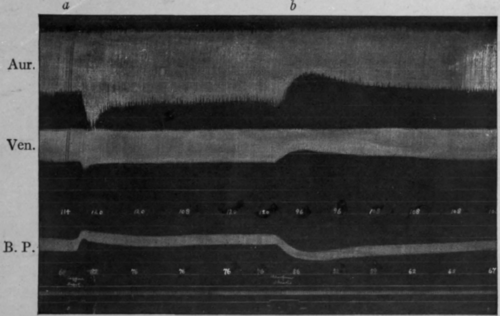
Fig. 38. - Chloroform, 10 breaths, (b) diminished the contractility of both auricle and ventricle, and caused a fall in blood-pressure from 76 to 56 mm. Caffeine, 5 mg. per kilo, (a) resulted in increased contractility of auricle and ventricle (down-stroke), and a rise in blood-pressure from 68 to 82 mm. The effect was somewhat lasting. (Tracing made by Dr. C. C. Lieb.)
Continue to:


My Books

