


Ampoules
Description
This section is from the book "The Art Of Dispensing", by Peter MacEwan. See also: Calculation of Drug Dosages.
Ampoules
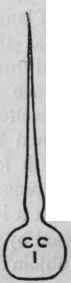
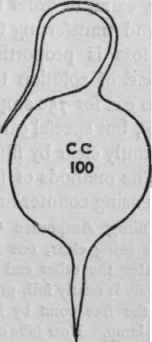
Ampoules are small glass vessels which can be hermetically sealed, and are used for storing sterilised solutions for hypodermic injection. They were first used as flasks by Pasteur, in the course of his researches on bacteria, for absolutely sterile media and to preserve the cultures from contamination by extraneous organisms. Thirty years ago M. Limousin, a Paris pharmacien, introduced the ampoule as a convenient method of preserving hypodermic solutions. The use of ampoules is now general. Either white or coloured glass may be employed for ampoules, amber glass being very convenient for those substances affected by light. The empty ampoules are readily obtainable. The shapes vary greatly. Fig. 1, which is simply a tube drawn out to a point at each end, is largely used, but the phial-shapes (figs. 2 and 3) have much to recommend them. They can be stood upright, and have not the tendency to roll which those of tube-shape have. In fig. 2 the constriction is found to facilitate breaking off the tip, and on this account it is sometimes preferred by physicians. Ampoules are made of 1 c.c. capacity for hypodermic solutions; but larger sizes, such as 2 c.c, 3 c.c, 4 c.c, 5 c.c, and 10 c.c, are also obtainable. For such liquids as saline solution the shape exhibited in fig. 4 is employed.
The series in this shape comprises ampoules of 20 c.c, 50 c.c, 100 c.c, 250 c.c, and 500 c.c. capacity.


Ampoules must be made of neutral glass- i.e., one which does not yield alkali to or cause a turbidity in solution kept in it. The following equations show the reaction that occurs when saline solution is boiled in lime or lead glass:
CaO.Si02 | + | 2NaCl | CaCL | + | Na2.OSiO, |
Lime silicate | Sodium chloride | Calcium chloride | Sodium silicate | ||
PbOSi02 | + | 2NaCl | PbCl2 | + | Na2OSiO2 |
Lead silicate | Sodium chloride | Lead chloride | Sodium silicate | ||
To test for alkali in glass, fill an ampoule with solution of morphine hydrochloride and another with normal saline solution (7 in 1,000) and maintain at 100° C, by steam, for an hour, or at 1200 C. for half an hour. If neither turbidity nor small crystals are shown in this time the glass is of the proper quality. The importance of using neutral glass cannot be exaggerated, as the stability of the solutions and success of the method depend entirely on this factor. It is also important to verify the capacity of ampoules. It is best to use them of a size a fourth larger than would do for the purpose, so that they need not be quite filled, and risk of breakage during sterilisation is thus diminished. It is better to put in an excess of the solution rather than too little, as there is generally a slight loss in using it, and the physician alwaystakes out the dose with a graduated hypodermic syringe, so that if there is a slight excess it gives him the opportunity of increasing the dose by one or two minims if he so desires.
The dispensing of ampoules may be conveniently divided into four operations :(i) Preparing the solution, (2) filling the ampoules, (3) sterilising the filled ampoules, (4) labelling and packing. The dispenser must employ only sterile menstrua. The distilled water should have been sterilised by steam at 1200 C.; olive oil or other vegetable oil used as a solvent must be washed by shaking with 90-per-cent. alcohol for four or five days, decanting, and sterilising at 1250 C. ; liquid petroleum, soft paraffin, or lanoline should be sterilised at 1250 C. Chemicals are generally aseptic, and do not need to be sterilised before use. In making a solution it is necessary to prepare one-quarter or three-tenths more than the total quantity required. If, for example, the physician prescribes six 1-c.c. ampoules of strychnine hydrochloride (1 in 1,000) or morphine hydrochloride (1 in 100)', the dispenser must prepare about 2 c.c. extra, in order to balance the loss which occurs in filtering and transferring to the containers. With larger ampoules the loss is proportionately less. It is necessary to make 200 c.c. of solution to fill 150 to 160 ampoules (1-c.c), and 1,000 c.c. for 750 ampoules.
The solution is made up secundum artem, but special care must be taken to see that it is rendered brilliantly clear by filtration.
The methods of filling ampoules which can be used at the dispensing-counter are as follows :
Filling Ampoules Open at Both Ends {e.g., fig 1) -The two points being clear, one is dipped into the solution while the dispenser aspirates the other end through a piece of rubber tubing. When the ampoule is nearly full, press the rubber so as to prevent access of air, and seal the free point by holding it in the flame of a Bunsen burner or spirit-lamp. Now take off the rubber tubing and seal the other end. This method is fairly rapid, but strict aseptic conditions may demand that precautions should be taken to prevent the possibility of contamination by the breath. In this case between the body of the ampoule and the point a slight swelling is provided in which is placed- not too tightly- a tiny plug of sterile cotton-wool. If large quantities have to be filled this is not a convenient method, but the dispenser can use one or other of the following processes.
Continue to:


My Books

