


Filling Ampoules Having One Opening
Description
This section is from the book "The Art Of Dispensing", by Peter MacEwan. See also: Calculation of Drug Dosages.
Filling Ampoules Having One Opening
There are several ways of filling the phial-shaped ampoules or tubes which have a closed end, viz. :
I. The Vacuum System. - The apparatus devised by M. Eury for sterilising and filling ampoules is shown in fig. 5. It consists of a bell-jar, A, on a ground-glass plate, d, the neck of the jar being closed by a rubber stopper perforated to allow of the passage of two glass tubes. One of these glass tubes reaches half-way down the inside of the bell-jar, and the other end is joined by rubber tubing to a filter-candle standing in the beaker, M.
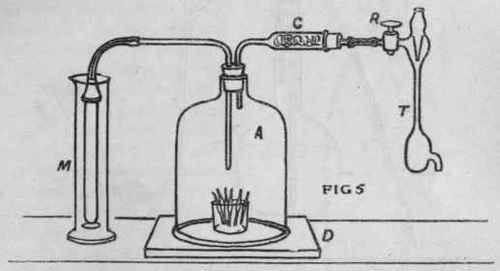
The second tube is bent at right angles, fitted with a receptacle, c, in which cotton-wool is placed, and further connected, by means of the stopcock, R, with a vacuum pump, T. The various parts of the apparatus are sterilised before use. A Bohemian glass beaker is filled with empty ampoules, open end downwards, and placed under the bell-jar. The required solution is placed in the glass jar M, and a vacuum made by means of the pump. The liquid then forces its way through the filter-candle into the beaker under the bell-jar, and is sucked up by the ampoules. When sufficient liquid has passed to fill the ampoules the tap at R is turned on so as to stop the flow of water in the pump and let the air slowly into the bell-jar. The ampoules are now removed and quickly sealed. This method is a good one for such drugs as may be injured by steam sterilisation, but when the latter is admissible simpler processes suffice.
2. Pressure System. - The apparatus needed is that shown in fig. 6. Put the solution into the flask, and into the neck of the flask fit a cork perforated to take two bent glass tubes. One of the tubes reaches to the bottom of the flask, and is provided at the free end with a hypodermic needle 5 cm. long. The second tube is shorter and is connected with the bellows. The hypodermic needle is placed in the open end of an ampoule, and the liquid forced into the ampoule by a slight manipulation of the bellows. This process answers well for filling large ampoules of saline solution, but a needle is not then necessary, the rubber tube being con-nected directly with one of the open ends of the ampoule.

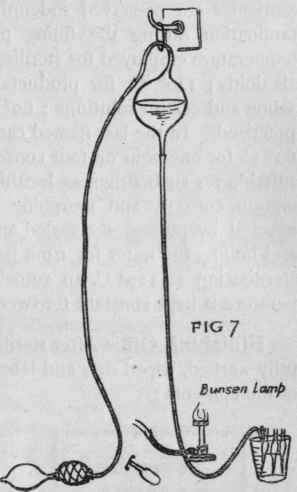
3. Atmospheric-pressure System. - This is the method which can be recommended. Fill an ampoule of a capacity of from four to eight ounces with the liquid and fix it one metre above the dispensing-counter, as shown in fig. 7. The straight point of this reservoir is connected with a rubber tube at the end of which is a platinum hypodermic needle 5 cm. long. The flow of the liquid is regulated by a Mohr's clip such as is used for burettes in volumetric work. As in the case of oily liquids, where it is desired to have more control over the fluid, a spray bellows can be connected to the bent end of the large ampoule, in which case the Mohr's clip is not needed. The ampoules to be filled are placed in a small beaker, and as soon as filled are sealed by means of the Bunsen flame.
The foregoing are the methods described by Dr. G. Pegurier in The Chemist and Druggist, 1909, 1. 170. Others similar are in use. The following observations by Mr. Thomas Stephenson (C. & D. 1910, 11. 209) may in many cases prove of service:
In preparing ampoules to prescription an ordinary hypodermic syringe is all that is necessary. The syringe should first be sterilised in the usual way. Then an ampoule is taken and the pointed end removed, as near the point as possible, by snipping sharply with scissors (holding the point downwards), or by scratching with a file and breaking off. The necessary quantity of solution, plus one or two minims to allow for loss in removal, is then drawn into the syringe, the needle inserted at the open end of the ampoule and pushed well down to prevent the liquid collecting in the neck, and the solution injected into the bulb. A little extra solution is always desirable, for the reason stated ; indeed, there is no objection to a slight excess over the required dose, as the physician will withdraw the required quantity into a measured syringe- a much easier matter when there is a slight excess of solution. An ordinary pessary-mould forms a useful stand for the ampoules during the process of filling, when these are of the tubular shape. The ampoule has now to be sealed. This is done by holding for a moment or two in a Bunsen flame.
If held too long in the flame, the liquid is liable to become volatilised, with the result that a bubble is blown in the end, which will not be air-tight.
With a little care, however, the sealing can be effected rapidly and securely.
When the ampoules contain a solution that is not injured by heat, they should be finally sterilised after sealing. This is accomplished by placing in a beaker of water and heating this in a pan of boiling water for an hour.
Should a higher temperature than that of boiling water be required, suitable means can easily be adopted. The water in the beaker should be coloured with aniline blue. Should any ampoule be imperfectly sealed, the blue colour will then penetrate into the interior and colour the solution.
For this reason, and to allow for accidental breakage during the final sterilisation, it is well to prepare a few ampoules more than are actually required. An ampoule should never be filled more than two-thirds full, in order to allow some elasticity for the contents during sterilisation.
Sterilisation
The finished ampoules are sterilised by steam in all cases where the composition of the contents admits it, otherwise filling under aseptic conditions must suffice. The advantages of steam sterilisation are that the contents of the ampoules are preserved indefinitely, and any accidental contamination during the filling process is neutralised. The temperature employed for sterilisation is 100° C. in the case of alkaloids; 1200 C. for products unaltered by heat, such as saline and gelatin solutions; 6o° C. when Tyndall's method is practised. In the last-named case the ampoules are heated to 6o° C. for one hour on four consecutive days, the method being suitable for such drugs as lecithin, calcium glycerophosphate, ergotin, cocaine, and morphine. Sterilisation at 100° C. is effected by putting the sealed ampoules into a vessel of water and boiling the water for from half an hour to one hour. For sterilisation at 1200 C. an autoclave is needed, and the temperature is kept constant for twenty minutes.
Finishing Off
After sterilisation the ampoules are carefully washed, wiped dry, and labelled with an exact statement of the contents :
Morphine Hydrochloride 1 c.c. = 0.01 Gm.
Strychnine Sulphate mxx. = gr. 1/30
They are then placed in boxes made to hold six, ten, or twelve, with space for a small steel file, with which to cut off the points before use. For ampoules of saline solution card boxes of a suitable shape are supplied.
Continue to:


My Books

