


How To Weigh
Description
This section is from the book "The Art Of Dispensing", by Peter MacEwan. See also: Calculation of Drug Dosages.
How To Weigh
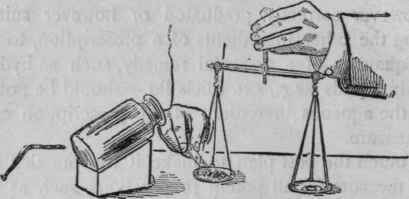
The late Mr. Joseph Ince, in one of the dispensing aphorisms which have become familiar to many dispensers, said: 'Hold the scales firmly by the left hand.' Many wonder what that means; so we may explain that up to about fifty years ago the scales solely used in dispensing were apothecaries' scales, kept in a box, and held up by the hand when weighing. They are still used in some pharmacies. The first illustration on page 30 is reproduced from Mr. E. W. Lucas's 'Pharmacy' (published by Messrs. J. & A. Churchill), and shows how such weighing is done. These old-fashioned scales are now generally replaced by more accurate scales suspended from a pillar, or by delicate chemical balances.
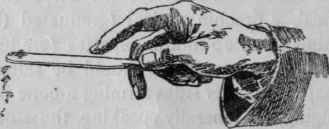
In using dispensing scales and balances the weights are put into the left-hand pan, the bottle, if desired, may be held in the left hand, and the powder be taken out with a spatula held in the right hand in the manner shown in the subjoined sketch; the forefinger being left free to tap the spatula, so that minute quantities may fall into the scale-pan when the desired weight is almost obtained. Such substances as solid extracts are usually weighed on a tared piece of paper or on a tared watchglass.
Carelessness in Weighing or Measuring is not to be tolerated. There should be if possible- and there generally is in good pharmacies- a balance for weighing small quantities of alkaloids and other strong remedies. In no case should guesswork occur at the dispensing-counter. With mixtures or solutions generally there is little fear that such a course will be adopted; but we have seen doses of powdered opium guessed at by the spatula, and so dispensed. We have seen more than once a definite weighed quantity of a compound powder subsequently divided without weighing into the prescribed number of powders. All good dispensers strongly condemn this or any other methods which court danger, and pharmaceutical examiners show their appreciation of it by rejecting candidates who do such things. It is generally safe to give minims when guttae are ordered, because drops vary in size according to the nature of the liquid, the lip of the bottle, the quantity in the bottle, temperature, etc.
In some cases it is desirable to weigh rather than measure a liquid- for example, in the case of a dozen minims of croton oil ordered for pills. Here it is practically impossible to get 12 minims of the oil out of a measure once it is in, but it may be weighed on the glass scale-pan upon some inert powder, such as soap, previously weighed. It should be remembered that a minim of anything lighter than water weighs less than one grain, or more than a grain if the liquid is heavier than water. The average specific gravity of croton oil is 0.950, and the weight of a minim of water is 0.9114 grain, so that 0.950 x 0.9114 x 12 = 10.42 (say, 10 1/2 grains), the weight of 12 minims of croton oil. Similar calculations may be made in respect to other things.
Fractions of a Grain are frequently ordered- for example, twenty pills each containing 1/24 grain of strychnine. In this case weigh 1 grain of alkaloid and triturate it with 11 grains of sugar of milk (which thoroughly divides it), and take 10 grains of the mixture for the twenty pills. A difficulty sometimes is found when fractions of minims are ordered- for example, two pills are ordered each to contain m 1/8 of croton oil and m 1/4 of peppermint oil. The best plan in this case is to rub up 1 grain of croton oil and 2 grains of peppermint oil with 10 grains of soap, and take a fourth part of the mixture for the pills.
Continue to:


My Books

