


Powders
Description
This section is from the book "The Art Of Dispensing", by Peter MacEwan. See also: Calculation of Drug Dosages.
Powders
There is a right and a wrong way in compounding powders, but fewer difficulties occur in this class of medicines than in any other, most likely on account of the fact that chemical solids do not interact readily until they are brought into solution. A list of solids which liquefy when mixed with each other is given on page 97, and dispensers should make themselves familiar with it.
In Mixing, the rule is to take the smallest or most potent ingredient first and triturate it in the powder-mortar with some other ingredient which will assist in comminuting it well, as in the following instance:
Morphinae hydrochloridi..... | gr. 1/12 |
Bismuthi subnitratis ..... | gr. v. |
Pepsini ........ | gr.ij. |
Fiat pulvis. Mitte tales duodecim.
Here we weigh the bismuth subnitrate and put a few grains of it in the mortar, then put on it the morphine hydrochloride, triturate lightly, add a little more bismuth subnitrate, triturate, and so on until half the bismuth subnitrate is used; then add half the pepsin, triturate, the rest of the bismuth subnitrate and pepsin, again triturate, and finally sift, or mix well on paper with a bone spatula.
Never rub so hard that the powder cakes; that is bad pharmacy. A glass mortar is used for the very reason that it suggests gentle trituration. Also note that friction induces electricity in many instances- so much so that when the spatula is put into the powder the metal gets a coating of the electrified powder, which is somewhat difficult to remove.1 Indiscriminate use of mortar and pestle is bad. Here, for example, is a prescription of the late Sir Morell Mackenzie's, which was in the first instance dispensed by a well-known West-end pharmacist, and gave satisfaction:
Bismuthi subnit. ...... | gr. 1/8 |
Pulv. catechu ....... | gr. 1/12 |
Morphinae hydrochlor. . . . | gr.1/16 |
Fiat pulvis. Mitte tales lxxij.
The powders were used for insufflation in a case of chronic sore-throat. The second pharmacist who dispensed the prescription was an ardent advocate of the mortar-and-pestle method, and he lost a customer by the practice of his principle. The third with his spatula mixed the powders on a powder-paper, and the patient no longer sent to London in order to get the prescription dispensed. The complaint made of the powders sent out by the second pharmacist was that they had a lumpy feeling in the throat, and did not adhere so kindly as those supplied by the first and third dispensers. No doubt the heat of friction had caused aggregation of the catechu with the other ingredients.
It has been shown by Mr. Boa, of Edinburgh, that the method of mixing materially affects the miscibility of powders. The general conclusion arrived at from Mr. Boa's experiments is that powders mixed on paper and sifted are more readily miscible in water than those which have been rubbed up in a mortar and sifted. We quote two instances in which this effect may be readily observed:
Pulv. rhei ....... | gr. x. |
Pulv. cinnamom. ...... | gr. vj. |
Magnes. levis....... | gr. xx. |
' If the spatula is dipped in powdered French chalk beforehand, the adhesion is reduced.
If these ingredients are rubbed up in a mortar the powder diffuses in water with exceeding difficulty, whereas when|mixed on paper it diffuses quickly.
Pepsin. ........ | gr. ij. |
Bismuth. alb....... | gr. v. |
Magnes. carb. ...... | gr. iij. |
Pulv. aromat. ...... | gr. j. |
When these are rubbed up in a mortar, and sifted, the powder can be mixed in water only with considerable difficulty, but when mixed on paper the difficulty is not experienced. The following powder is a distinct exception:
Sulphur, praecip. ................................................... | gr. xv. |
Guaiac. resin...................................................... | gr. x. |
Magnesiae...................................................... | gr.xx. |
The most readily miscible powder is here obtained by rubbing the guaiacum and magnesia well together before adding the sulphur. If the powders are mixed on paper they will scarcely diffuse in water.
It is quite evident that there is an art in powder-making, as there is in pill-making, the only difference being that in the former case dissatisfaction is experienced by the customer, in the latter by the dispenser- a sufficient reason, therefore, to call forth the care and ingenuity of the dispenser in mixing powders. In the great majority of cases, where limited quantities are ordered, say under 2 drachms- such, for example, as one or two dozen powders- no better or quicker method of mixing the powders can be adopted than the spatula and a sheet of white paper. The ingredients ordered in smallest quantity should be first thoroughly incorporated, and the larger quantities added gradually. It has been customary to condemn this method as bad compounding, but it is quite the contrary. Experiment has demonstrated that mixture in this way is the most perfect. This is now being generally recognised, and the use of a mortar as a means of mixing substances already in powder is rapidly being abandoned. Special spatulas are now being made for the purpose of mixing powders. In practice it is easier to wipe a spatula clean than to wash a mortar.
It is the only admissible plan in some cases, the paper-and-spatula mixing being followed by sifting through an extemporised sieve made by removing the bottom from a chip box, and securing a piece of muslin to it with the band of the lid as shown in the illustration. This is the method by which most powders containing potassium chlorate should be mixed, e.g.:
Pulv. potassii chloratis.......... | 3ij. |
Acidi tannici .................... | 3 j. |
Misce. Pro gargarisma.
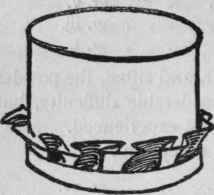
Sieve Extemporised From Muslin And Chip Box.
A dispenser triturated these in a mortar. There was a violent explosion, which does not happen when the chlorate is smoothed down on paper with a horn or bone spatula and the tannin then added and mixed.

Horn Spatula For Mixing Powders.
Continue to:


My Books

