


Capsules. Continued
Description
This section is from the book "The Art Of Dispensing", by Peter MacEwan. See also: Calculation of Drug Dosages.
Capsules. Continued
For dispensing-purposes moulds are made of brass and fixed to rods which screw into a disc of wood provided with a handle securely fixed into the centre of the reverse side. The moulds are made in sizes varying with the capacity of the capsules, and one dipper carries fifteen to sixty moulds according to size. The gelatin mass is generally kept ready for use, and when one has to make a batch of capsules the water-bath, with 2 to 2 1/2 inches of water in it, is put on the gas-furnace, the inner pan inserted, and some of the mass put into it. The moulds are now prepared by wiping them with an oily cloth. As soon as the mass is properly melted, the lid of the pan is removed and the dipper lowered into the pan, so that the moulds are immersed about an inch below the surface of the gelatin mixture. Care should be taken to remove skin or froth from the surface to the side before the dipper is put in. Once in, the dipper is rotated gently to ensure a uniform coat, and then it is slowly withdrawn ; the object of slow removal being to form a thin capsule, the excess of gelatin mixture being drawn off by the bulk through capillary attraction. If this is done well, no objectionable drop forms at the base of the capsule.
When the dipper is clear of the pan it is quickly turned upside down, so that the semi-fluid coating, which is now tending to form a drop at the base of the capsule, may spread "uniformly over the mould. In a few seconds the capsule 'sets,' and in a few minutes is easily removed with the fingers; it then looks like a or b in the annexed engraving.
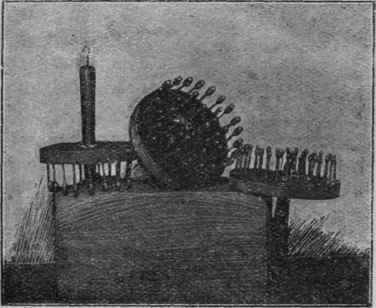
Set Of Brass Moulds Mounted On Dippers.
The ordinary narrow-mouthed capsule is either ovate (b) with the narrow end somewhat elongated, or oval (a), with a more or less distinct shoulder. In the former case it is difficult to know where the capsule ends and the neck begins; and as the part to be removed is practically cylindrical it may be cut off with scissors. The oval capsule, however, cannot be trimmed successfully with a straight-edged cutter; if it be cut through between shoulder and neck with a knife or scissors, the resulting 'mouth' is not round, but lipped (c). Such a capsule is difficult to fill, and the lips do not seal up neatly. A curved cutting edge is better, and we have this in the cutter figured, which has a flat surface immediately under a gouge-shaped knife fixed into the spring top-piece of the cutting-box, into which the 'cut-offs ' drop. After the ' tails' are removed the capsules are placed on suitable trays with holes. The old-fashioned dippers were used for this (see below), but it is better to have holders for the purpose made of wood, cardboard, or metal.

Some dispensers use a suppository-mould. Holders are included in the illustrations given on the following page.
For filling capsules many methods are in use. The French employ for liquids any convenient reservoir with a tap, heating the substance if it is too thick, as in the case of castor oil and copaiba. This is inadmissible. For limpid liquids such an arrangement as the gravitation filler is as good as any. The liquid is put into any convenient vessel (a funnel with narrow stem or a separating-funnel is suitable), an india-rubber tube is attached to the stem and fitted with a glass nozzle and spring clip to control the flow of the liquid. For filling a few capsules ordered by prescription, an ordinary glass syringe answers perfectly ; the nozzle being drawn out to the required calibre in a Bunsen or blowpipe flame, and the end cut off so as to leave a point of suitable size; the cut edge is then carefully fused by holding it for a second or two in the extreme edge of a small Bunsen flame. A more elaborate arrangement is that devised by Mr. J. A. Forret, of Edinburgh, which is excellent for viscous liquids, such as castor oil and cascara sagrada extract. This is a brass syringe with screwed piston-rod, which enables the operator to put strong pressure on the contents of the syringe.
In filling, care has to be taken that the liquid does not overflow - in fact, a fraction of a minim of space should be left in the capsule, otherwise the closing operation may be difficult.
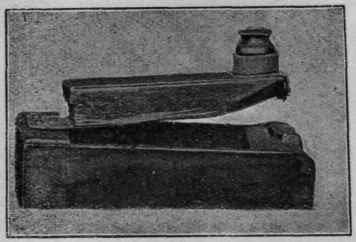
Capsuling Cutter And Box.
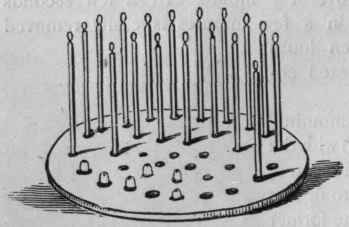
Old-Fashioned Dipper.
Closing is done by a brush or glass rod dipped in the melted gelatin mass, or by a small metal bolt applied hot to the neck of the capsule, or by a bolt dipped into the gelatin mass. The brush method does not make a secure joint ; with the hot, dry bolt one requires about 1/8 inch of neck to be left on the capsule, while in the third method we have the analogue of the soldering-bolt. An appliance for the last method is shown to the left of the syringe filler. It is a small brass vessel, similar to the tinned copper for the capsule-mass, suspended in a cylindrical tin. On one side of the tin is a hole to admit a small Bunsen burner, and round the top is a series of holes for ventilation; the tin is soldered to a heavy metal foot. The brass vessel carries an arm of stout wire with two loops projecting over the vessel. The bolt is made by soldering a capsule-mould into each end of a short length of brass tubing. A sufficient quantity of gelatin mass is melted by the Bunsen, and kept a trifle below boiling. The support of the bolts is so adjusted that the moulds are just under the surface of the gelatin.
The bolt thus acquires a sufficient temperature to fuse the mouth of the capsule on which it is allowed to press for a second or two, and carries with it sufficient material to close and give a rounded finish to both ends of the capsule. The second bolt is heating while the first is being used. When a dozen or two capsules are being made by prescription the glass-rod or brush method of closing suffices. In this case a better finish is given to the capsules by afterwards dipping the end of the capsule halfway up in the gelatin mixture and drying rapidly, but one must be an adept before this refinement is attempted.
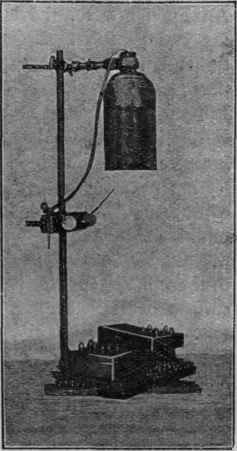
Gravitation Filler.
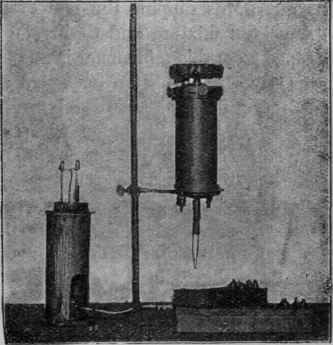
Forret's syringe filler.
Only a few drugs are capsuled as dry powder. The usual method of doing this is to weigh or divide as for powders, and fill through a small funnel with a suitable nozzle, fixed at a convenient height in the clamp of a retort-stand. The diameter of the nozzle is a trifle greater than the mouth of the capsule, but allows the latter to be readily slipped over the end. In some instances- e.g., Blaud's pill-mass - the powders are made into a thin paste with a suitable liquid medium and the paste is introduced by means of the pressure-syringe.
Continue to:


My Books

