


Capsules
Description
This section is from the book "The Art Of Dispensing", by Peter MacEwan. See also: Calculation of Drug Dosages.
Capsules
There was nothing about capsules in the earlier issues of the 'Art of Dispensing,' and the chapter introduced into the 1888 edition began with the remark that 'a growing disposition on the part of medical men to prescribe nauseous medicines in capsules makes it necessary for the dispenser to be acquainted with the details of the operations of capsule-making.' At that time one could count the capsule-makers in Great Britain on the fingers of one hand, and the chapter referred to was the first treatment of the subject in an English text-book. The gelatin capsule was invented by Mothes in 1833, and the French Academy of Medicine declared his invention to be an immense service to science and to humanity. (See The Chemist and Druggist, 1889, 11. 214.) The original capsule was hard, as gelatin, gum arabic, and refined sugar were its constituents : glycerin, then being unknown, was not an ingredient. There was a demand for capsules in England from the first, and they were spoken of by Cooley in 1843 as 'the common gelatine capsules.'Mr. John Warrick, of London, was agent for Mothes, and Messrs. Morgan Brothers later took up the agency for Denoual, of Paris. The manufacture was commenced in this country in the 'forties by Mr. Bateman and Mr. Turner, of London, but it was not until the 'eighties that prescribers began to order capsules as they do pills, and articles in The Chemist and Druggist urged the need for dispensers acquainting themselves with the methods of manufacture.
Now there are many makers of capsules in the wholesale way, and leading dispensing establishments have capsule-equipments so that they may compound any capsule-prescription which is presented to them.
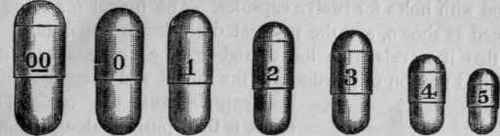
A form of capsule which is generally considered to be American in origin and comparatively new, is the empty gelatin one, here figured. These capsules are made of a thin and tough film of gelatin, and are provided with a lid which slips over the open end to close it. Perhaps they originated independently in the United States (their wholesale production certainly did), but at an evening meeting of the Pharmaceutical Society of Great Britain, held on October 12, 1842, such capsules were exhibited, and the following paragraph in respect to them is quoted from the Pharmaceutical Journal, ii. 343 :
Some Gelatine Capsules, contrived by Mr. Chaston, of Walton, in Norfolk, for administering fluid medicines to Horses and Dogs, were exhibited to the meeting. They were open at one extremity, which required a covering of skin, after the introduction of the fluid. It is scarcely necessary to add that, if water be introduced, they should be administered in the course of a few minutes; but they are chiefly adapted for the administration of spirit of turpentine, or any other substance in which gelatine is insoluble. The horse-capsules are about the size of an ordinary horse-ball, and when wrapped up in paper in the usual way have a similar appearance.
A French capsule-maker named Planten, who settled in New York in 1836, and whose business is still carried on by his successors, is said to have brought this idea into the market in the early years of his residence there, but it was not until 1860 to 1863 that empty capsules began to be appreciated in the United States, when they were re-introduced. In his interesting history of this subject {Proceedings of the American Pharmaceutical Association, 1896) Dr. Alpers does not mention Chaston's early effort.
The empty capsules now obtainable are chiefly used for dispensing powders and pill-masses, although globular and oval capsules for liquids are also obtainable. The capsules are filled by means of such an apparatus as the 'Acme,' which consists of a nickelled metal case into which slides a block of wood with holes for twelve capsules. The funnel for filling is placed as shown, and the perforated block is inserted under it, so that it travels from left to right. The dispenser puts the weighed portion of powder into the funnel and presses it into the capsule with the rod. The block is then pushed along a hole. At the right-hand side of the figure a projection will be noticed : this is a wedge-shaped slip of wood, which pushes the filled capsules out of the holes automaticallv in order that the lids may be added. The margin of the capsule is generally wetted before the lid is put on. When the medicine is massed like a pill, the mass is divided on the pill-machine by pressing the pipe on the cutter to form cylinders, and each of these is inserted into a capsule of suitable size.
Empty capsules are also made with a pointed lid for use as suppositories.
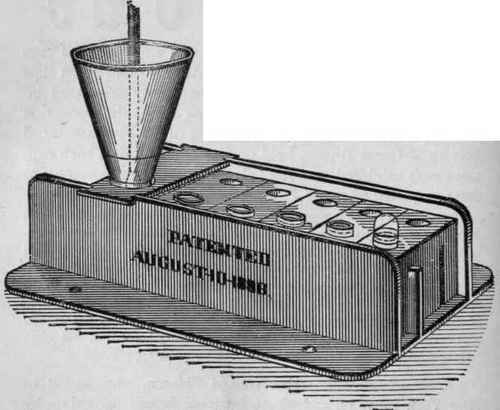
'Acme' Capsule-Filler.
For Extemporaneous Production of capsules the first requisite is the gelatin mass. As already stated, capsules are either hard or soft. The former were the first introduced, but the latter are now deservedly the more popular, for they are more easily swallowed. The mass for hard capsules is made according to the following formula:
Gelatin ....... | 6 oz. |
Gum acacia ....... | 1 oz. |
Powdered sugar ...... | 1oz. |
Water ........ | 5 oz. |
Steep the gelatin in the water, when soft add the gum and sugar, and heat until dissolved, removing any scum which rises to the surface.
Various forms have been proposed for the soft capsules, and the following has been found to give a good flexible mass which provides a capsule practically unalterable in most atmospheric conditions:
Gelatin ....... | 30 oz. |
Glycerin ....... | 15 oz. |
Mucilage of acacia ..... | 71/2 oz. |
Water........ | 50 oz. |
Steep the gelatin in the water, when soft add the mucilage and glycerin, dissolve by the heat of a water-bath, and mix thoroughly by stirring.
For some purposes (as when the capsules are to hold a ferrous mass) the latter formula is amended by omitting 3 ounces of glycerin and adding 2 ounces of sugar. The water-bath should be of a special form, so as to admit the mould-holder easily. That figured on page 159 consists of an outer water-pan 14 inches deep and 12 inches in diameter. It is made of tinned copper. The inner pan is 3 inches shorter and an inch less in diameter. It is provided with a rim to suspend it in the outer pan, and with a flat lid which lies on the top, and is reversed each time it is taken off when the pan is in use. The capsules are moulded in two ways. In the modern French method thick steel plates, with longitudinal halves of capsules formed in them, are used to mould the capsules from soft sheets of gelatin mixture. One of the plates is covered with a sheet of the gelatin mixture, and the requisite amount of medicine is introduced into it, then the upper sheet is placed over it, air bubbles expelled, and the two moulds placed in the press.
This method is used on the manufacturing scale, and the principle is employed in making palatinoids and pedes.
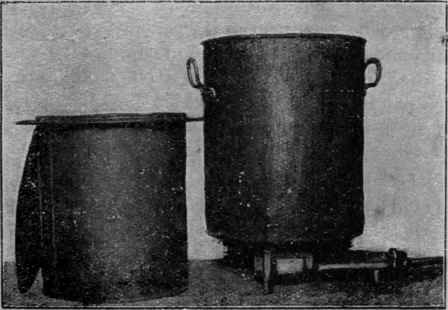
Capsule-Mass Water-Bath On Gas-Stove.
Continue to:


My Books

