


Plasters
Description
This section is from the book "The Art Of Dispensing", by Peter MacEwan. See also: Calculation of Drug Dosages.
Plasters
It is seldom nowadays that the dispenser is called upon to spread other than a cantharidin plaster, and, consequently, few of the rising generation can handle the plaster-spatula with dexterity. It is customary to use paper shapes in spreading plasters, for if not used the edges are uneven. There should be no hesitation about the way to melt the plaster. Sufficient for the surface required (average 15 grains per square inch) is shaved off the roll and melted in a porcelain dish over a gentle gas-flame or water-bath. This is the surest plan. While the plaster is melting the leather may be cut and prepared ; allow an inch all round for a margin. The shape of the plaster is cut from white wrapping-paper, which should be wetted on the label-damper and placed on the margin. Zinc shapes are kept for stock plasters. By the time the paper shape is adjusted the plaster will have melted. The plaster must not be so hot as to frizzle the leather, and the spatula, warmed in a gas-flame, should not make the leather curl, but be just hot enough to smooth it. Place the leather on a thick pad of paper, and smooth it before putting on the shape.
Having obtained the proper temperature (as low as will permit of easy spreading), the melted plaster is poured on the leather near the margin, and the operator applies his spatula at a slight angle, the point of the blade somewhat overlapping the paper shape. The plaster is pushed with a gently firm pressure in such a manner that the iron may not be raised from the leather until it has gone all round it (the leather being turned to suit the position of the operator, but the spreading must not be stopped while this is being done). Evenness of spreading is attained by regularity of pressure; but no one can spread a plaster properly who does not do it in a few rapid strokes. The plaster-iron generally used is a thick belt of iron 3 1/2 inches long, by § inch wide and thick. The form illustrated is specially adapted fo spreading large plasters, as well as for compounding ointments.
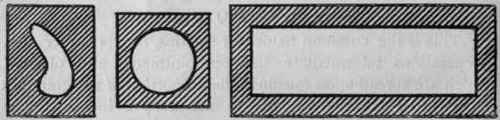
Plaster-Shapes.

Plaster-Spatula.
When a plaster on leather with an adhesive margin is required, it is customary to leave one non-adhesive margin outside the adhesive one. The first step is to place in the centre of the leather a piece of paper the size of the plaster, and outside this a shape that will leave 1/2 inch or so between the centrepiece and the non-adhesive margin. Spread with soap plaster, when cold remove the central piece of paper and put on a shape (well soaped) which will cover the adhesive part, and spread with the plaster.
Plasters for bed-sores (soap cerate usually) are spread without margin on split-skin or chamois leather.
Paper Plaster-shapes may generally be attached to leather by merely damping the paper, and pressing down with a dry cloth. If the shape is to be laid on a previously spread plaster, it should be well brushed with thin soft soap ; after its removal, any soap adhering to the plaster must be taken off with a wet cloth or sponge.
Breast-plasters should be about 7 inches in diameter, exclusive of 1 inch margin, with a hole near the middle 1 inch in diameter, and with a piece cut out, beginning from the hole and gradually widening towards the circumference to about 1 inch, so as to allow the plaster to be adapted to the curved surface of the breast.

Left Ear.
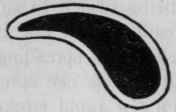
Right Ear.
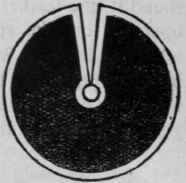
Breast.

Back.

Side,

Chest.
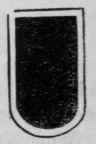
Shoulder Shapes Of Plasters For Different Parts Of The Body.
If a plaster is wanted soon after it is spread, place it on a cold metal surface, where it quickly hardens. Waxed paper (or paper rubbed on one side with a piece of hard soap) should be used for covering it. Send out in a box if possible.
It is not permissible in the United Kingdom to dispense rubber-combination plasters of official emplastra unless specially prescribed, as the basis differs from those in the British Pharmacopoeia. The process by which they are made is substantially as follows:
1. Purification of indiarubber by macerating and pressing it, and removing foreign impurities by elutriating with water.
2. Forming a homogeneous mass of the dried purified rubber by working it on heated revolving rollers and incorporating sufficient quantities of orris-powder and resins.
3. Incorporating the medicinal agent- e.g., belladonna extract- with the rubber mass by working it on warmed revolving rollers.
4. Spreading the prepared plaster on a suitable fabric.
An adhesive plaster similar in properties to rubber plaster can be extemporaneously prepared as follows:
Rubber (cut in small pieces)................ | 20 grammes |
Soft paraffin ..... | 20 grammes |
Lead plaster ..... | 960 grammes |
Melt the rubber at a temperature not exceeding 150° C., add the soft paraffin, and continue the heat until the rubber is dissolved. Add the lead plaster to the hot mixture, continue the heat until it becomes liquid; then let it cool, and stir it until it stiffens. (Compare with The Chemist and Druggist,1907, II. p. 178.)
Blisters (emp. cantharidis, B.P. 1898) are spread on adhesive plaster (calico). Cut a paper shape of the size desired, and place it on the plaster, leaving 1/2 inch to 3/4 inch margin. Now soften the cantharides plaster by working it in the hand for a minute or two, and then spread over the calico with the thumb, usually, although some prefer a slightly warmed spatula. The objections to the thumb method are that it is not elegant and the plaster is spread unevenly, as may be judged by holding it between the eyes and the light. The plaster should be of such thickness that the yellow colour of the adhesive plaster should be obliterated when it is held up to the light. When spread remove the shape, trim the edges of the calico, and cover the blister with waxed paper. These remarks also apply to the cantharidin plaster of the British Pharmacopoeia, 1914, which differs essentially in appearance from the old plaster, and this may help to extinguish the bad practice of 'finishing-off' blisters by rubbing them with powdered cantharides or brushing with liquor epispasticus.
Plaster-mulls are preparations like salve-mulls, with a plaster basis, prescribed by Unna.
Continue to:


My Books

