


Comedo. Acne Punctata
Description
This section is from the book "A Treatise On The Materia Medica And Therapeutics Of The Skin", by Henry G. Piffard. Also available from Amazon: A Treatise On The Materia Medica And Therapeutics Of The Skin.
Comedo. Acne Punctata
Definition And Description
The term Comedo is applied to a condition in which the skin, especially of the face, is studded with little black points looking like grains of gunpowder. These points indicate the opening of the sebaceous follicles, and the black speck itself is caused by the dirt which has been entangled in the external extremity of the plug of sebum which fills the follicle. If the skin in the neighborhood of these points be firmly compressed, the sebum will be forced out of the follicle in the form of a little worm-like body. Comedo, then, is simply a condition in which the sebum is retained in the follicle for an unusual length of time. This distends the follicle, and the longer the retention is maintained the larger the follicle becomes. The process, as a rule, goes on without giving rise to any special local irritation, and nothing marks the progress of the affection other than an increase in the size and number of the affected glands. Occasionally inflammation ensues, and a papule or perhaps a pustule forms, giving rise to a common form of simple acne. Comedo occurs most frequently in young persons, of both sexes, from the age of puberty to the twenty-fifth or thirtieth year. It is rarely seen in those more advanced in life.
Course
The progress of the affection is slow and indolent, and if uninterrupted by treatment is frequently prolonged for years, gradually becoming less evident, and finally disappearing entirely.
Diagnosis And Prognosis
As Comedo is totally unlike any other affection of the skin, its diagnosis offers no difficulties. The prognosis, however, is not so easily decided.
While in some cases proper treatment will produce prompt amelioration and total disappearance of the eruption, in others the most careful and persistent efforts are followed by continual and annoying relapses.
Etiology
The affection consists, as above stated, in retention of the sebum with enlargement of the sebaceous follicles, and depends, we be-lieve, in the majority of cases, on gastro-intestinal or genital irritation; in fact, on the same causes as acne simplex, which baa already been considered. Masturbation, in particular, we are satisfied, has much to do with the continuance and aggravation, if not the origin of the affection.
Treatment
Attention should be given to the general health if this seems to be in any way disordered. Dyspeptic conditions, anaemia, and constipation, are sometimes present, and both the general condition and the local difficulty sometimes improve rapidly under the use of small doses of iron, nux vomica, and sulphur, continued for two or three weeks or longer. If masturbation be a complicating feature, the habit must, of course, be abandoned. It is not, however, an easy matter to determine whether this practice is indulged in or not, as direct inquiries on the subject are usually fruitless. If the question, however, can be positively determined, phosphoric acid and ergot are likely to prove of service. The principal indications for local treatment are to remove the sebaceous plugs and to stimulate, if possible, the functions of the skin. The impacted sebum may be removed by squeezing the skin around the follicle between the nails, or more readily with the aid of a watch-key. This very common device is objectionable, as the sharp corners of the watch-key tube may cut into the skin, and incite inflammation, leading to the formation of an acne papule. A much better way is to use a little instrument that I have devised for the purpose, and which is here shown g.7).
The little circular ring at the end of the instrument is placed over the comedo and gentle pressure is made. This will generally cause the plug to emerge from the follicle. Sometimes, however, it requires considerable pressure to effect this; more, in fact, than it is prudent to exert or the patient cares to endure. This difficulty can be remedied by first distending the mouth of the follicle with the point of a needle, and afterward applying the instrument.
If the affection be at all extensive and the comedones numerous, the physician can teach the patient how to use the instrument, and then abandon this part of the treatment to the latter's own care. The patient, with the aid of a looking-glass, can thus, in a few seances, free himself, at least temporarily, of the greater part of his trouble; and by resorting to the operation, from time to time, when necessary, keep his hoe in a very presentable condition, until the tendency to the return of the affection is broken up, or of its own accord deserts him, which it will usually do in four or five years from its first appearance.
It is also usually desirable to stimulate the circulation in the skin and to improve the tone of the contractile tissue that surrounds the sebaceous follicles. To this end electricity will often prove of service. My friend, Dr. Denslow, of this city, has recently communicated to me a method, by means of which he believes he accomplishes the same end. It consists in giving full doses of ergot.
Frequent washing of the face with soap and water, or with Quillaya, is usually beneficial.
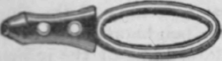
Fig. 7 - Comedone - exterior.
Continue to:


My Books

