


Scabies. Continued
Description
This section is from the book "A Treatise On The Materia Medica And Therapeutics Of The Skin", by Henry G. Piffard. Also available from Amazon: A Treatise On The Materia Medica And Therapeutics Of The Skin.
Scabies. Continued
The acarus, though barely visible to the naked eye, may be readily recognized under the microscope as a minute insect, from one-fortieth to one-fiftieth of an inch in length. The female is larger than the male, and is provided with eight legs. The anterior four are provided with suckers and numerous hairs, the posterior four have no suckers, but to each is attached a specially long hair, with several shorter ones. Upon the belly are short, triangular spines, with their apices directed backward. The male also has eight legs, the anterior four and the posterior pair with suckers, the other pair with long hairs as in the female; the triangular spines are absent. The young acarus has but six legs, four anteriorly and two posteriorly (Figs. 27 and 28).
The Cuniculus, or acarian burrow, arises in the following manner: A pregnant female, having been brought in contact with the skin, immediately penetrates the epidermis, and burrows along underneath it, each day laying an egg or two, until a dozen or more have been deposited. The conformation of her body is such that she cannot readily back out of the burrow, the triangular spines preventing, but is compelled to advance, and usually does so in a curved direction, leaving in her track a line of eggs behind her, interspersed with little points of black excrement.
* Raker: The Microscope Made Easy, 4th ed. London, 1754. + The adult Acarns has eight legs, the young have six. - H. G. P.
This is shown in Fig. 29.
After her ovulation is complete, she remains at the extremity of the burrow and dies, without again reaching the surface. Her decomposed remains cause irritation and may give rise to a pustule. In a few days the eggs hatch, and the young acari work their way to the surface. Here, after proper development, they copulate, and the impregnated females.
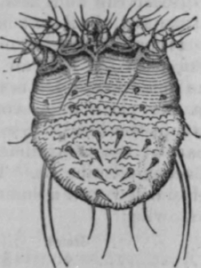
Fig. 27. - Female acarus. (Furstenberg.)

Fig. 28. - Male acarus. (Furstenberg.) dive down under the epidermis to breed a fresh colony, and in this way prolong the disease indefinitely. The female acarus may sometimes be extracted from the cuniculus on the point of a needle. The male insect never burrows, but remains upon the surface. It is, however, but rarely detected.
Diagnosis
The practised eye is, in the majority of cases, able to diagnosticate this disease at a glance, the general aspect of the eruption.
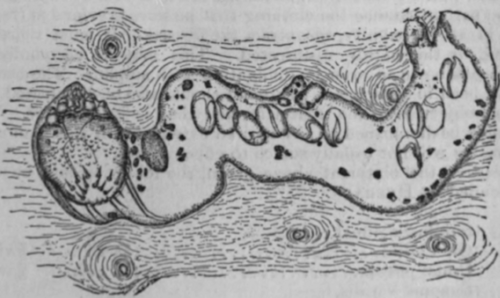
Fig. 29. - Cuniculus, with acarus, eggs, etc. (Furstenberg.) being sufficient. By one not very familiar with the subject the following points should be borne in mind: In advanced cases the eruption is usually polymorphous, and consiists in the special lesions of scabies, namely, the vesicles and burrows, together with secondary lesions consisting of papules, pustules, crusts, scratch-marks, etc., due to the irritation pro-duced by the insect. Large umbilicated pustules about the wrists are a frequent and valuable diagnostic sign. The penis in boys and men frequently exhibit papules, more rarely vesicles, while the breasts in women are the parts specially liable to be affected. The anterior aspect of the body is more frequently and profusely affected than the posterior, and the bead is almost always exempt. The history of contagion, and the presence of the disease in several members of a family is also of importance in connection with diagnosis.
Prognosis
This is always good, as the disease can be readily cured.
Treatment
The French method of treatment is, of all that have been proposed, the most thorough and effective. It may be carried out as fol-lows: The patient is first placed in a warm bath for half an hour, in order to thoroughly macerate and soften the epidermis. He is then vig-orously rubbed with soft soap, not only on the parts that seem to be specially affected, but all over the surface, except the head. A soft scrubbing brush adds to the efficiency of this part of the treatment, twenty minutes or a half hour being occupied in accomplishing it. The soap having been washed off, the skin is thoroughly dried, and a sufficiency of ordinary sulphur ointment, or, better, the following Grams.
Potassii iodidi.......................... 4.
Ungt. Sulphuris......................... 30.
M.


is rubbed all over the body in the most careful manner, special attention being devoted to the regions most affected. The patient is then put to bed, where he remains until the following morning. A warm bath, to cleanse the skin of the sulphur, completes the operation, and in ninety-nine cases out of a hundred the parasite is destroyed, the Scabies is cured, and the patient has only to recover from the secondary eruptions and the effects of the somewhat severe and painful course through which he has been put. Emollient applications are now usually indicated.
If the patient resume the clothing that he wore previous to treatment, he will, in all probability, recontract the disease. It must therefore be destroyed, or thoroughly disinfected. This may be accomplished by thorough baking in an oven, or fumigation with sulphur. The bedclothes that have been in use prior to treatment should also be disinfected. There is but one objection to the treatment, and that is its severity. This, of course, may be diminished to any desired extent, but if this is done a single operation will not usually suffice to effect a cure.
Instead of the ointment above given, the following may be used, as recommended by Hebra:
Sulph. Sublimat., Grams.
01. Cadini..........................aa 180.
Cretae prepar.........................120.
Saponis Viridis,
Unguenti...........................aa 500.
M.


A method devised by Vlemingkx, and employed in the Belgian army, is also very effective. The patient is first to be placed in a bath, in which he is rubbed all over vigorously for half an hour with pieces of coarse flannel and soft soap. After the soap has been well rubbed in, the patient is left for another half-hour in the bath. During the third half-hour he is again rubbed all over, and no less forcibly than before, with pieces of flannel, which this time are dipped in "Vlemingkx's solution" (see Formulary). The fourth half-hour is again passed in the bath, from which he emerges probably cured of the scabies, but with his skin very sore and looking, perhaps, worse than before he went in.
The objection to this treatment is the same as to the method first detailed, namely, its severity and its liability to induce an artificial eruption that may be a week or two in disappearing. The treatment is hardly to be advised in children and in persons of delicate skin. Instead, it is better to employ milder measures, even if the period of treatment is prolonged. To this end Anderson recommends inunctions with an ointment something like the following:
Sulph. praecip., Grams.
01. Cadini...........................aa 12.
Glycerit. Amyli........................ 24.
Ungt. benzoini........................48.
M.


Still milder is an ointment composed of one part of liquid Styrax to two parts of simple ointment, or the Balsam of Peru diluted with four or five parts of lard.
In addition to the foregoing the following drugs have been recommended: Addum Aceticum, 5; Acidum Sulphuricum, 11; Cimicifuga, 42; Kamala, 71; Manganesii Oxid. Nig., 75; and Petroleum, 83.
Continue to:


My Books

