


XVI. The Effects Of An Oatmeal Diet On The Thyroid Gland
Description
This section is from the book "Food And Feeding In Health And Disease", by Chalmers Watson. Also available from Amazon: Food and Feeding in Health and Disease.
XVI. The Effects Of An Oatmeal Diet On The Thyroid Gland
There is ample clinical evidence that a dietary into which oatmeal largely enters is one which is specially valuable for the growth and nutrition of children. In former days the diet of the people in many districts of Scotland included oatmeal as one of the staple ingredients, and, as is well known, this regime produced a big-boned and well-developed race. This being so, it is reasonable to think that there may be some ingredients in an oatmeal diet that have a favourable influence on one or more glands whose functional activity is of special importance during the growing period - for example, the thyroid gland. Some facts in favour of the correctness of this hypothesis have recently been ascertained, as follows: -
Six young rats about six weeks old were fed for four to eight weeks on a diet of uncooked oatmeal and water, an equal number of controls being fed on a bread-and-milk diet. At the post-mortem examination the most striking feature was the thyroid gland in the oatmeal-fed animals. This gland was markedly enlarged in the oatmeal-fed rats, the average percentage weight being 0.078 gramme, as against 0.029 gramme in the controls. Histologically the glands of the oatmeal fed rats showed evidence of greatly increased functional activity (see Fig. 28, and compare 27), with in two instances a swollen and detached condition of the secreting cells.
1 Chalmers Watson. British Medical Journal, vol. i., 1907.
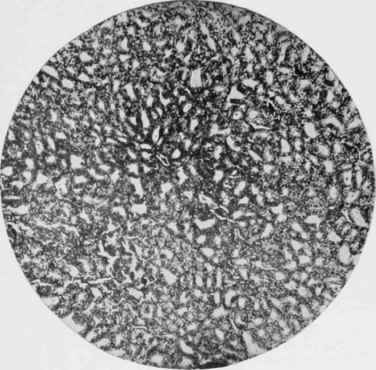
Fig. 27. - The normal appearance of the Thyroid Gland of a Rat fed on the ordinary laboratory diet - bread and milk in known proportions. ( x 50).
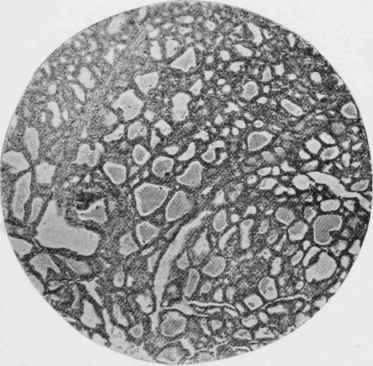
Fig. 28. - Thyroid Gland of a Rat of same age as Fig. 27. after being fed for six weeks on an catmeal diet. The gland is enlarged, the colloid being increased in amount and staining more deeply. ( x 50).
[Face page 602.
In a second series of six young rats which were fed on an exclusive porridge diet, the porridge being made with skimmed milk, a similar result was obtained.
These results appear to indicate that an excessive oatmeal diet has a markedly stimulating effect on the thyroid gland of young animals, and there seems no reason to doubt that a more moderate and more physiological use of the same food would be followed by a stimulation in a degree which would be wholly beneficial. It appears to me that we may find in these facts the explanation of the value of oatmeal in the dietary of young children, the results furnishing the scientific explanation, in whole or in part, of the well-established clinical fact that porridge is an excellent food for children. In accordance with the teaching of these results, we should no longer regard oatmeal water as a mere diluent or as a convenient form in which starch may first be administered to an infant (Holt), but as a foodstuff of very special value for the growing child.
This brings me to a brief consideration of the practical aspects of the subject, my remarks being restricted to the use of oatmeal in children from the third year onwards. Breakfast is the meal into which oatmeal should most largely enter, the best form of administration being porridge and milk, which should be followed by a glass of milk and some bread and butter. It is not, in my opinion, advisable to supplement the meal by meat in any form, for two reasons: First, because it is not necessary and may be harmful; and, secondly, because the use of the meat tends to create a distaste for the more wholesome but less appetising meal of porridge. If a child be given for its breakfast a little porridge, followed by bacon, it is certain that in nine out of ten cases, or an even greater proportion, the chief element in the repast, from the child's point of view, is the bacon. In this respect children are just like young animals. In an extensive experience of feeding rodents on different diets, I have never seen a young rat which would look at porridge or bread and milk if meat was available. We must, however, recognise two important reservations to this general recommendation of a porridge breakfast for children. In the first place, a porridge diet, per se, is not good for children on account of mastication not being essential for this diet. This fault may be counteracted by including in the diet crusted bread, rusks, Vienna rolls, and the like, which should be taken "dry," and not merely washed down with fluid, as is often the case. The inclusion of such articles of diet in the breakfast will ensure that due attention is paid to the development of the muscles of mastication, salivary glands, and jaws - a point of very great importance in the dietary of children. Secondly, clinical experience teaches us that certain children cannot properly digest and assimilate oatmeal. This feature is, in my experience, most frequently observed in the offspring of typically gouty parents. The parents of such children tell us that they cannot take porridge because of its "heating " properties, the objective indications of disturbed nutrition being found chiefly in a concentrated urine and in various skin eruptions These symptoms are, however, much less frequently observed if the porridge forms the main article of the meal and is not followed by other highly nitrogenous food, such as bacon and eggs, as is frequently the case. There are, however, some children who cannot properly est and assimilate porridge, and these are better without it, but, if careful attention be paid to the details of the dietary as a whole, it will, I believe, be found that these cases are much rarer than is commonly supposed.
Continue to:


My Books

