


The Effect Of Emotions And Sleep
Description
This section is from the book "The A. B. - Z. Of Our Own Nutrition", by Horace Fletcher. Also available from Amazon: The A. B.-Z. Of Our Own Nutrition.
The Effect Of Emotions And Sleep
Observations on the stomach of the cat showed that the peristalsis is inhibited whenever the animal manifests signs of anxiety, rage, or distress. Since the extrinsic innervation of a large part of the intestinal tract is the same as that of the stomach, it is of interest to note the effect of emotional states on the movements of the intestines. Esselmont, in a study of the dog's intestine, noted constantly after signs of emotion a marked increase of activity lasting for only a few moments. Fubini also observed that fear occasioned more rapid peristalsis. There is no doubt that many emotional states are a strong stimulus to peristalsis, but it is equally true that other emotional states inhibit peristalsis. In the cat the same conditions which stop the movements of the stomach stop also the movements of the intestines.
The female cats used in these observations ordinarily lie quietly on the holder and make no demonstration. Sometimes, however, with only a little premonitory restlessness, the cat suddenly flies into a rage, lashing her tail from side to side, pulling and jerking with every limb, and biting at everything near her head. During such excitement, and for some moments after the animal becomes pacified again, the movements, both of the large and small intestine, entirely cease. Such violence of excitement is not necessary to cause the movements to stop; a cat which was restless and continually whining while confined to the holder showed no signs of intestinal movements during any period of observation (one period lasted more than an hour), although the changes in the distribution of the food observable from one period to the next proved that movements were going on during the quiet intermissions. In another cat, uneasy and fretful for fifty minutes, no activity was seen; then she became quite for several minutes, and peristalsis of the small intestine appeared.
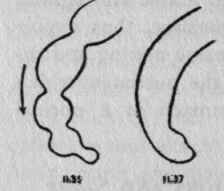
Figure 10. - Tracings showing the effect of excitement on antiperistalsis in the colon.
When the segmentation process in the small intestine is stopped by excitement the segments unite and the series of parts returns to the form of a solid string. The change occurring in the large intestine when the antiperistalsis is inhibited by excitement is shown in Figure 10. The tonic constrictions in the descending colon are apparently not affected by emotional states, for they do not seem to relax in the excitement which causes the movements to cease.
By holding the mouth and nostrils closed, or by pressing between the rami of the jaw, the breathing may be stopped. As soon as the cat shows distress from lack of breath every form of intestinal movement stops.
The statement is sometimes made in textbooks of physiology that the gastric and intestinal mechanisms cease to act during sleep. It is worthy of note that nearly all the animals curled up and slept during the time between observations; nevertheless, the progress of the food through the intestines continued. The statement is also made that at night, even without sleep, the intestines are almost entirely at rest; that this is their normal time for repose. I have seen both large and small intestines actively at work, however, from half past nine until half past ten o'clock at night.
Summary
1. Bismuth subnitrate, 10 to 33 per cent, mixed with the food renders the movement of the intestinal contents, and thereby the movements of the intestinal walls, visible on the fluorescent screen.
2. The activity most commonly seen in the small intestine is the simultaneous division of the food in a coil into small segments, and a rhythmic repetition of the segmentation each time applied to the new segments formed from parts of those just divided. In the cat this rhythmic segmentation may proceed at the rate of thirty divisions per minute. The effects of the constrictions causing the segmentation are the mixing of the food and the digestive juices, the bringing of the digested food into contact with the absorbing mechanisms, and the emptying of the venous and lymphatic radicles of their contents by compression of the intestinal wall.
3. Peristalsis is usually combined with segmentation. As the food is advancing, interfering constrictions often separate the rear end of the mass from the main body. The separation is momentary, however; the rear end is swept into union with the main body again, and the whole mass is pushed onward until another constriction repeats the changes.
4. The ileocecal valve is thoroughly competent for food entering the colon from the ileum.
5. The usual movement of the transverse and ascending colon and the caecum is an antiperistalsis. This recurs in periods about every fifteen minutes, and each period lasts commonly about five minutes; the waves recur during a period at the rate usually of eleven waves in two minutes. This antiperistalsis gives new significance to the ileocecal valve; for the food, now in a closed sac, is thoroughly churned and mixed by the constrictions running towards the caecum, and again exposed to absorbing walls without any interference with the processes in the small intestine.
6. As soon as new food enters the large intestine a strong general contraction takes place along the caecum and ascending colon, forcing some of the food onward; a moment later antiperistaltic waves begin to pass.
7. With the accumulation of material in the transverse colon, deep tonic constrictions appear one after another and carry the material into the descending colon, leaving the transverse and ascending portions free for the antiperistaltic waves.
8. In emptying the large intestine the material in the lower descending colon is first carried out by combined peristalsis and pressure of abdominal muscles; the remainder of the material is then spread into the evacuated region, and this region is again cleared; the second remainder may be similarly affected. In normal life the new food arriving in the colon must force forward the old contents of the ascending and transverse colon.
9. The observations have revealed no evidence of antiperistalsis in the small intestine, but since the ileocecal valve will allow nutrient material under pressure to pass backward, the antiperistalsis of the large intestine may force into the small intestine a considerable portion of a large nutrient enema. Segmentation in the small intestine affects such an enema precisely as it affects food which has passed normally through the stomach.
10. Signs of emotion, such as fear, distress, or rage, are accompanied by a total cessation of the movements of both large and small intestines. The movements continue in the cat both during sleep and at night.
Continue to:


My Books

