


Influence Of Restricted Food Supply. (3) Ash Constituents
Description
This section is from the book "Chemistry Of Food And Nutrition", by Henry C. Sherman. Also available from Amazon: Chemistry of food and nutrition.
Influence Of Restricted Food Supply. (3) Ash Constituents
Ash constituents have long been recognized as playing an important part in the growth of young animals and of these, as we have already seen, the elements most likely to be deficient are calcium, phosphorus, and iron. Infants (and young mammals generally) are born with a reserve store of iron usually sufficient to supply the growth requirement up to about the end of the normal suckling period. At any time after this initial reserve supply has been used, the iron in the body will be found very largely localized in the blood. The blood constitutes less than 7 per cent of the weight of the body but contains more than 70 per cent of its iron content. Hence a deficit of iron becomes more noticeable in the blood than in the other tissues - growth may not cease but the child (or young animal) may grow anemic; experiments illustrating this have been cited in the chapter on iron, and it has been shown that inorganic forms of iron are not of equal nutritive value with the organic forms which occur naturally in food materials. To an even greater extent than the iron is localized in the blood, the calcium of the body is localized in the bones; it is estimated that the bones contain over 99 per cent of the body calcium. An inadequate supply of calcium in the food during growth retards the development and calcification of the bones. The calcium needed by the growing organism can be assimilated from inorganic forms. Both of these facts are illustrated by the experiment of raising puppies on meat with and without bones to gnaw as described in Chapter XI (Iron In Food And Its Functions In Nutrition). It has also been found that the addition of calcium chloride and calcium carbonate to a basal ration of corn and common salt in the case of pregnant swine resulted in greater size, more vigor, bigger bone, and better general condition of the new-born pigs (Evvard, Dox, and Guernsey).
* Mendel. Biochemical Bulletin, Vol. 3, page 167.
Bone development may also be interfered with by inadequacy of the phosphorus supply. Several investigators, in studying the effect of diet upon growth of bone, have found that the bones formed in a young animal kept on phosphorus poor diet are apt to be soft, spongy, and weak (of low breaking strength), and that this may be prevented by the simple addition of calcium phosphate to the food.
Since phosphorus is a prominent constituent not only of bones but of all the soft tissues as well, the effects of a phosphorus deficiency may be far-reaching. In the experiments of Hart, McCollum, and Fuller, young pigs on phosphorus-poor food continued to grow for some time but finally developed not only the bone defects just noted but also weakness of the legs, stupor, and a more or less comatose condition accompanied by twitching of the muscles, dragging of the hind quarters, and ultimately loss of weight and collapse. These effects were all prevented by simple addition of calcium phosphate to the food. Hart and McCollum record cases in which swine restricted to a ration of corn meal and corn gluten showed little or no growth, but began to make good growth upon addition to the food of such salts as to make the ash content of the ration similar to that of milk.
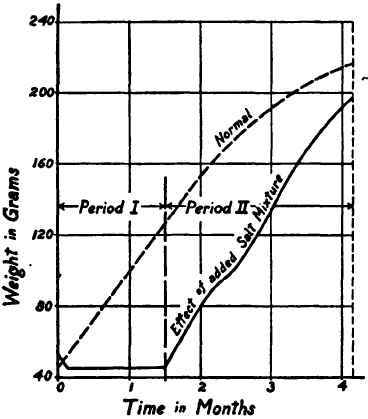
Fig. 13. - Effect upon growth of adding to a diet otherwise adequate a salt mixture of such composition as to make the composition of the total ash similar to that of milk ash; immediate resumption after entire suspension of growth. Courtesy of Dr. E. V. McCollum.
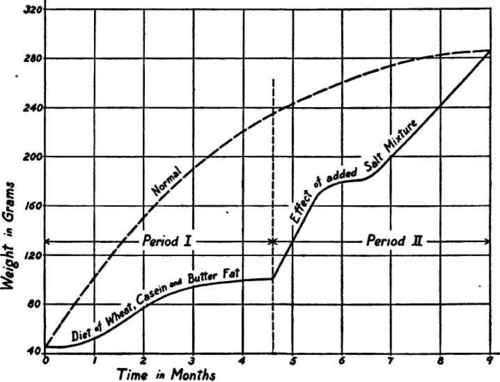
Fig. 14. - Growth at much less than half the normal rate through the greater part of the normal growth period, followed by accelerated growth upon adding a suitable salt mixture to the diet. Courtesy of Dr. £. V. McCollum.
McCollum, Simmonds, and Pitz have likewise shown that a defective inorganic content of the diet may also result in retardation or suspension of the general growth of the young animal, which may be followed by prompt resumption of growth (even at an accelerated rate so that the normal weight for the age may be regained) when a salt mixture is added such as to make the total ash of the ration similar in composition to milk ash (Figs. 13 and 14).
Continue to:


My Books

