


Influence Of Restricted Food Supply. (4) Vitamines Or Food Hormones
Description
This section is from the book "Chemistry Of Food And Nutrition", by Henry C. Sherman. Also available from Amazon: Chemistry of food and nutrition.
Influence Of Restricted Food Supply. (4) Vitamines Or Food Hormones
Osborne and Mendel (1913) found that the use of highly purified salts in rations of isolated food substances resulted in less growth than when salts of only ordinary purity were fed. This suggested to them that other inorganic salts might be needed, and a ration containing very small additions of salts of iodine, fluorine, manganese, and aluminum was fed with somewhat more favorable results than had attended the use of the usual (simpler) salt mixture; but none of their diets composed entirely of pure substances gave as good results as the corresponding food mixtures in which "protein-free milk" was used, and they concluded that the latter was unquestionably superior to any purely artificial food mixture. This superiority now seems to be attributable primarily to the presence in the "protein-free milk" of the "water soluble B," probably identical with the antineuritic "vitamine." If the latter is the case, the substance is not Confined to milk but is fairly widely distributed among natural food materials. Less widely distributed is the other "essential accessory" furnished by milk, the so-called "fat soluble A," to the presence of which in butter * is attributed its marked growth-promoting property as shown independently by McCollum and Davis and by Osborne and Mendel. The latter find that in a diet containing "protein-free milk" and an adequate protein, 5 per cent of butter fat usually suffices to insure normal growth and in a few cases from 1 to 3 per cent has seemed sufficient. When butter fat is fractionally crystallized from alcohol the growth-promoting factor remains in the oil fraction, the fractions of higher melting point being ineffective. Lard and olive oil were also found ineffective, while cod liver oil resembled butter fat in its growth-promoting property, and beef fat shows the same property to a less degree. McCollum finds the same property in the fat of egg yolk and of animal organs such as the kidney, but in no commercial fat of vegetable origin thus far examined, although feeding experiments with whole grains and grain embryos indicate that their fats must carry appreciable amounts of this growth-promoting substance. He finds also, as noted earlier in the chapter, that the same "fat soluble A" (as demonstrated by specially arranged feeding experiments) occurs in relative abundance in alfalfa and cabbage leaves and probably in green vegetables and forage plants generally. The accompanying charts (Figs. 15 and 16) show the effects of presence or absence of A or B upon the growth curves of young rats. Recognition of the independent need for each of these substances or groups of substances is too recent for definite correlation of each with a distinct type of stunting. Both "fat soluble A" and "water soluble B" are held to be essential for the maintenance of health as well as for growth. The fat soluble A appears to be dispensable, when maintenance alone is involved, for a somewhat longer period than is the water soluble B, which accounts for the polyneuritic symptoms in birds kept on polished rice diet and the cure of these symptoms by the feeding of extracts of foods rich in the water soluble B. Thus McCollum and Kennedy find "that pigeons can be brought into the polyneuritic state by feeding a diet free from both the essential factors A and B, and can be completely cured and maintained in a normal condition for at least 35 days on the same diet which brought on the disease, plus the water extract of a foodstuff (rolled oats) on which rats cannot grow without the addition of butter fat, but on which they do grow when the latter is added."
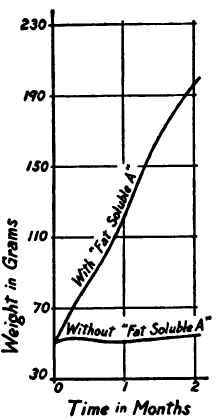
Fig. 15. - Effect upon growth of adding "fat soluble A" to a diet adequate in all other respects. Courtesy of Dr. E. V. McCollum.
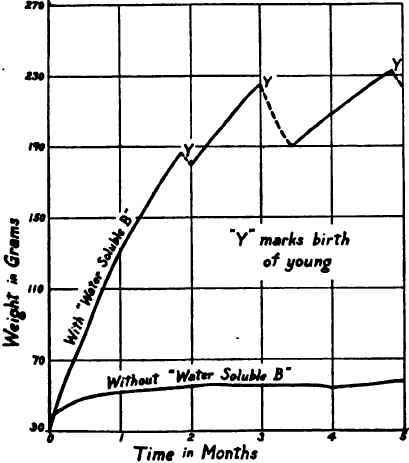
Fig. 16. - Effect upon growth of adding "water soluble B" to an otherwise adequate diet. Courtesy of Dr. E. V. McCollum.
* According to McCollum, "fat soluble A" is about 30 times more soluble in fat than in water. In milk about half of it is dissolved in the small volume of fat and about half in the large volume of water present. Skimmed milk is, therefore, not wholly devoid of this substance.
Continue to:


My Books

