


Uric Acid And The Purine Bases (Nucleic Acid Metabolism)
Description
This section is from the book "Chemistry Of Food And Nutrition", by Henry C. Sherman. Also available from Amazon: Chemistry of food and nutrition.
Uric Acid And The Purine Bases (Nucleic Acid Metabolism)
A part of the nitrogen of human urine is always in the form of uric acid and purine bases. These owe their origin either to the free purine substances of the food, such as the guanine and hypoxanthine of meat extract, or to the metabolism of nucleic acid derived from the nucleoproteins of the food or of the body tissues. The constituent groups of the nucleic acids and the order of their liberation on hydrolytic cleavage such as occurs in metabolism may be represented by the following diagram adapted from the works of Wells and of Jones:
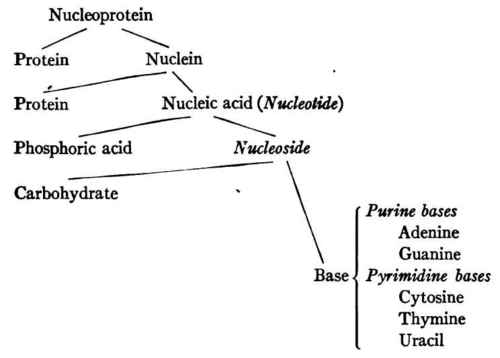
Explanation Of Diagram
The distinction between nucleo-proteins and nucleins is somewhat arbitrary and perhaps of doubtful value. Wells regards nucleoproteins simply as complexes containing a larger proportion of protein than is contained in nucleins or vice versa. Jones prefers to discuss nuclein metabolism entirely in terms of nucleic acid in order to avoid the danger of unnecessary confusion with protein metabolism. The nucleic acids do not contain any radicles found in simple proteins; they are compounds of phosphoric acid and carbohydrate with purine and pyrimidine bases in which the acid and base radicles are not linked to each other but both to the carbohydrate radicle. Phosphoric acid-carbohydrate-base chains of this sort are called nucleotides, and the nucleic acids containing four such chains in the molecule are, in this terminology, tetranucleotides. Nucleotidases are enzymes which split nucleic acids liberating the phosphoric acid and leaving compounds of carbohydrate with base which are collectively known as nucleosides. Nucleosidases are enzymes splitting nucleosides into their constituent carbohydrates and bases. In the case of plant nucleic acid the carbohydrate is a pentose (d.ribose) and the bases are adenine, guanine, cytosine, and uracil. In animal nucleic acid the carbohydrate is that of a hexose and the bases are adenine, guanine, cytosine, and thymine.
Lusk summarizes the hydrolysis of yeast nucleotides as follows:
Nucleotide-H3PO4 → Nucleoside-d.ribose →Base Adenylic acid →Adenosine → Adenine.
Guanylic acid → Guanosine → Guanine.
Cytodin-nucleotide → Cytodine → Cytosine.
Uridin-nucleotide → Uridine → Uracil.
And to show at a glance the characteristic cleavage products of the two types of nucleic acid:
Animal nucleic acid (Thymus) | Plant nucleic acid (Yeast) |
Phosphoric acid.................................. | Phosphoric acid |
Guanine.............................................. | Guanine |
Adenine.............................................. | Adenine |
Cytosine............................................. | Cytosine |
Thymine............................................. | Uracil |
Hexose................................................ | Pentose |
Formula And Relationships
The chemical relationships of the purine bases and uric acid so far as these are shown by empirical formulae are as follows:
Purine, C5H4N4
Adenine, C5H3N4NH2, amino-purine Guanine, C5H3N4ONH2, amino-oxy-purine Hypoxanthine, C5H4N4O, oxy-purine Xanthine, C5H4N4O2, dioxy-purine Uric acid, C5H4N4O3, trioxy-purine Uric add, the most highly oxidized of these purines, is the one chiefly found in the urine.
The chemical relations of these substances to each other are more fully shown by the structural formulae given on this page.
The chemical structure of the pyrimidine bases is indicated by the following formulae:
Cytosine
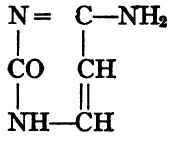
6-amino, 2-oxy-pyrimidine.
Thymine
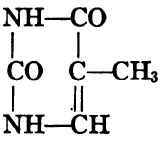
5-methyl, 2,6-dioxy-pyrimidine.
Uracil
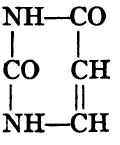
2,6-dioxy-pyrimidine.
Since these substances do not yield uric acid or purine bases their fate will not be discussed here.
The mode of origin of uric acid from nucleic acid through the purine bases is as follows:

Not only is uric acid the most highly oxidized of the purines, but it represents the highest degree to which oxidation can be carried without breaking the purine ring. The extent to which the purine ring is broken and uric acid destroyed in the body varies with the species. In most mammals such "uricolysis" is an important feature of the purine metabolism. In man the power to destroy uric acid seems to have been almost or entirely lost, many recent investigations tending to show that the human body does not contain uricolytic enzymes and that all of the uric acid formed in the body must be transported and excreted either through the kidneys (chiefly in the form of acid urates) or through the intestinal wall.
Purines undergoing metabolism in the body may be derived either (1) from the catabolism of nucleoprotein of body tissue or (2) from the food which may contain both nucleoproteins and free purines. Sometimes the term "endogenous uric acid" is applied to that fraction having the former origin, while "exogenous uric acid" indicates that fraction which is directly due to the food. The endogenous uric acid in the urine of man of average size amounts usually to about 0.3 to 0.4 gram per day; the exogenous varies from mere traces to 2 grams or more according to the kind and amount of food consumed. On ordinary mixed diet the total urinary output of uric acid averages about 0.6 to 0.7 gram per man per day. The usual range is about 0.5 to 1.0 gram of uric acid per man per day, in which case the uric acid nitrogen constitutes about 1 to 3 per cent of the total nitrogen of the urine.
Recent investigations of Jones, Levene, and others have greatly elaborated the theory of nucleic acid structure and purine metabolism outlined above. For full discussion the reader is referred to the works of Jones (1914) and Jones and Read (1917).
Creatine And Creatinine
Chemically creatinine is the anhydride of creatine:

The biochemical relationships and physiological significance of these substances have been much studied in recent years, and the literature of the subject is far too extensive to be summarized satisfactorily here. The main facts with regard to their elimination as end products of metabolism are: that creatine appears in the urine of children normally and in that of adults during starvation, fevers, and other wasting diseases and when there is impaired functioning of the liver; that normal adults ordinarily excrete little or no creatine but a considerable amount of creatinine. The quantity of creatinine excreted is fairly constant for the individual, averaging about 0.02 gram per kilogram of body weight per day. On ordinary mixed diet the creatinine nitrogen usually constitutes 3 to 7 per cent of the total nitrogen of the urine.
Continue to:


My Books

