


Transition Pulse. Part 5
Description
This section is from the book "Human Vitality And Efficiency Under Prolonged Restricted Diet", by Francis G.BENEDICT, Walter R. Miles, Paul Roth, And H. Monmouth Smith. Also available from Amazon: Human Vitality and Efficiency Under Prolonged Restricted Diet.
Transition Pulse. Part 5
Transition Pulse Of A Group Of Normal Men
As was stated at the beginning of this discussion, no transition pulse records were taken while the subjects were living on a normal diet, so that to secure data for purposes of comparison, 5 members of the staff of the Laboratory volunteered to go through the same walking routine in the post-absorptive condition, although no blood-pressure measurements were made at the end of walking. The transition pulse cycles of these men are given in figure 101.


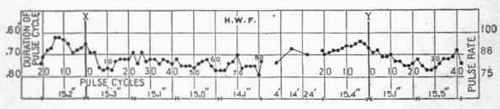


Fig. 101. - Transition puke curves for a group of five normal men. For detailed explanation, see figure 95.
The pulse cycles of T. M. C. show a shortened duration for the first six beats during walking, after which the duration lengthens until the fourteenth cycle. The remaining portion of the curve exhibits no rapid changes, though a gradual shortening of the duration takes place after the twenty-sixth cycle, which is followed by another gradual lengthening after the fifty-sixth cycle. At the transition from walking to standing the pulse cycles had nearly the same duration as at the end of the first transition period, but by the twelfth beat had lengthened to 0.71 second and by the twenty-second beat to 0.83 second. A period of reaction then followed for the next eight beats.
The curve of E. L. F. shows the rapid shortening of the cycle to 0.61 second at the eighth beat during walking, followed by four slightly lengthened cycles, and a rise to 0.58 second for the twenty-fourth cycle. From this point there is a rapid fall in the curve to 0.69 second for the thirty-sixth cycle, which value it maintained with fair uniformity during the remainder of this transition period. At the transition from walking to standing, there appears the usual immediate lengthening of the cycle followed by a period of eight beats, during which the cycle again shortens. At the thirtieth beat, the cycle had reached its longest duration of 0.73 second. From this point until the end of the record the cycle continued to shorten so that at the close the duration was 0.62 second, which was shorter than the average during the walking period.
The curve of H. W. F. is unlike the other curves of this group or of Squads A and B in that the pulse cycle undergoes no shortening in the transition from standing to walking. It is true that during the preliminary 15.2 seconds of standing, the duration had shortened from the twentieth to the fourteenth cycles preceding the transition, which was coincident with the warning that the walking was about to begin; this effect had, however, passed away and a secondary shortening was stopped and changed to a lengthened cycle when the walking began. Although the records have been searched, no explanation for this unusual behavior is apparent. In the case of H. M. S. no signal was given and the starting of the treadmill was entirely unexpected by the subject. The transition cycle therefore shows no influence of a preliminary warning. The change in the duration of the pulse cycle during walking was from 0.84 to 0.76 second in the first two cycles, and reached 0.71 second by the sixteenth cycle. The duration lengthened from this point to 0.78 second at the twenty-sixth cycle. For the last half of this transition record, the cycle lengths are unusually uniform, being not far from 0.74 second. The curve for the transition from walking to standing differs in no marked respect from the other curves except that the thirteenth and fourteenth cycles indicate a sudden shortening to an average of 0.66 second, with an immediate return to the previous duration.
The curve of H. S. does not show large changes, but there is apparent the usual shortening of the pulse cycles following the stimulus of walking. By the eighth cycle, the duration is again as long as during the standing period, and reaches its maximum duration at the twentieth cycle; subsequently it shortens slowly to 0.60 second at the sixtieth cycle. At the transition from walking to standing, there does not appear to be a response until the twentieth cycle, when the duration increases suddenly from 0.65 to 0.73 second. By the end of the record, the cycle is slower than during the preliminary standing period, and in this respect it is similar to that of T. M. C.
The average pulse-cycle duration during standing preliminary to the walking transition as estimated from the curves is as follows: T.M.C., 0.75; E.L.F., 0.78; H.W.F., 0.68; H.M.S., 0.84; H.S., 0.66 second. The values of H.W.F. and H.S. are exceptional, for the corresponding pulse-rates appear to be higher by the equivalent of 13 and 11 beats per minute, respectively, than the rates counted during the 10-minute standing period and given in table 101. (See page 449.) There is, however, no known reason for the variations with these subjects which would not have applied equally to the other men, both in the normal group and in Squads A and B. If we accept these figures for pulse-cycle durations, the changes between the values for the preliminary standing period and the durations that occur at the apex of the wave immediately following the beginning of walking range from - 0.09 second for H.W.F. to 0.17 second for E.L.F., with an average of 0.07 second for the group. If a comparison is also made between these preliminary standing values and the durations as found from the pulse-rates after 6 and 24 minutes of walking, the average pulse-cycle duration appears to be 0.03 second shorter than the average standing value after 6 minutes of walking and 0.05 second after 24 minutes. These figures include the values of H.W.F. and H.S.; excluding these two, the change in the duration appears to be 0.08 second shorter after both 6 and 24 minutes of walking than when standing.
Continue to:


My Books

