


Creatin
Description
This section is from the book "The Elements Of The Science Of Nutrition", by Graham Lusk. Also available from Amazon: The Elements of the Science of Nutrition.
Creatin
Creatinin is the anhydrid of creatin, a constituent of normal muscle. Creatin by treatment with acid is converted into creatinin as follows:
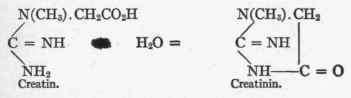
The close chemical relation between these two substances has led to a search into the problem of their physiologic interrelation, which as yet has been crowned with small success.
Myers and Fine2 report the following creatin content of muscle in various species:
Man .................................................................. | 0.39 | per cent. | creatin. |
Dog...................................... | 0.37 | " | " |
Cat...................................... | 0.45 | " | " |
Rabbit................................... | 0.52 | " | " |
When creatin is administered it may be destroyed or eliminated in the urine, but it is not eliminated as creatinin.
1 Palmer, Means, and Gamble: "Journal of Biological Chemistry," 1914, xix, 239.
2 Myers and Fine: Ibid., 1913, xiv, 9.
Folin1 and F. G. Benedict2 first reported the presence of creatin in the urine of fasting men and offered the hypothesis that it arose from disintegrating muscle tissue. Cathcart3 independently made the same observation, but witnessed the disappearance of creatin from the urine of the fasting man after giving him carbohydrate, and first suggested that carbohydrate metabolism was associated with creatin oxidation. Mendel and Rose4 reached the same conclusion.
The appearance of creatin in the urine in various other conditions has been attributed to the elimination of creatin liberated through muscle breakdown, but may now be explained as due to lack of carbohydrate metabolism. Among the conditions reported in which creatin appears in the urine are phosphorus-poisoning,5 carcinoma of the liver,6 during the period of the involution of the uterus after parturition7 and also immediately before parturition.8
However, Mellanby9 has shown that cesarean section with removal of the uterus is followed by the same excretion of creatin as after normal parturition. Morse10 confirms these observations.
That creatin elimination is not an index of cellular destruction was beautifully shown by Stanley Benedict,11 who maintained a phlorhizinized and fasting dog nearly in nitrogen and weight equilibrium by feeding him with washed meat. The results are given below:
I Folin: "Hammarsten's Festschrift," 1906.
2 Benedict, F. G.: Carnegie Institution of Washington, 1907, Publication No. 77, p. 386.
3 Cathcart: "Journal of Physiology," 1907, xxxv, 500.
4 Mendel and Rose: "Journal of Biological Chemistry," 1911-12, x, 213. 5 Lefmann: "Zeitschrift fur physiologische Chemie," 1908, lvii, 476. 6Van Hoogenhuyze and Verploegh: Ibid., 1908, lvii, 161. Also Mellanby, >"Journal of Physiology," 1908, xxxvi, 447.
7 Shaffer: "American Journal of Physiology," 1908, xxiii, 14.
8 Murlin: Ibid., 1909, xxiii, p. xxxi.
9 Mellanbv, E.: Proc. of the Royal Society, London, Series B, 1912, Ixxvi, 88.
10 Morse, A.: "Journal of the Amer. Med. Assoc," 1915, lxv, 1613.
II Benedict, S. R., and Osterberg: "Journal of Biological Chemistry," 1914, xviii, 195.
Creatin Excretion In A Phlorhizinized Dog In N Equilibrium
Weight. | N IN Food. | N IN Urine. | N Loss From Body. | Creatin N. | Cre- ATININ N. | D:N. | |
Kg. | Grams. | Grams. | Grams. | Grams. | Grams. | ||
Third day fasting | 7.62 | 2.74 | -2.74 | 0.075 | 0.075 | ||
Fourth day fasting: phlorhizin. | 7.58 | 6.34 | -6.34 | 0.110 | 0.074 | 3.9 | |
Second day phlorhizin......... | 7.44 | 12.00 | 11.91 | - 1.21 | 0.154 | 0.071 | 3.4 |
Fifth day phlorhizin......... | 7.08 | 13.46 | 12.79 | -1.23 | 0.131 | 0.070 | 3.2 |
On account of the maintenance of the quantity of body protein the creatinin excretion remained constant, but in spite of this maintenance there was a large elimination of creatin. At the completion of the experiments analysis of the muscle-cells showed more rather than less than the normal content of creatin. These are the only experiments which demonstrate an elimination of creatin without a corresponding loss of body tissue or loss of muscle creatin. Stanley Benedict concludes that the creatin elimination is due to complete carbohydrate starvation, that under normal conditions creatin is probably formed in the organism in relatively large amounts, and is for the most part utilized or destroyed when carbohydrate is being oxidized as well.
A long-continued carbohydrate diet which is free from protein reduces the quantity of creatin present in muscle tissue.1
Muscular fatigue leaves the creatin content of dog's muscle unchanged from the normal.2
Summarizing the known data, it appears that creatinin is not oxidized in the organism, but if formed is probably completely eliminated in the urine, whereas creatin is continuously produced in quantities above the requirement for the saturation of muscle tissue, and this excess in the presence of carbohydrate oxidation may be destroyed, but in the case of carbohydrate starvation may be eliminated in the urine.
1 Myers and Fine: "Journal of Biological Chemistry," 1913, xv, 305. 2 Mellanby: "Journal of Physiology," 1908, xxxvi, 447; Scaffidi: "Biochem-ische Zeitschrift," 1913,1, 402.
Uric Acid
See Chapter on Purin Metabolism.
Continue to:


My Books

