


Metabolism In Fever. Part 3
Description
This section is from the book "The Elements Of The Science Of Nutrition", by Graham Lusk. Also available from Amazon: The Elements of the Science of Nutrition.
Metabolism In Fever. Part 3
Senator1 early recognized that the increase in body temperature took place in consequence of a disturbed relationship between an abnormally high heat production and a heat elimination not correspondingly high. Senator assumed an increase in the production of heat, which Traube did not, and Leyden2 found a considerable increase of metabolism in fever.
The effect of a cold bath upon a vigorous man is to constrict the peripheral blood-vessels and to increase the heat production. The body temperature, instead of falling, may rise for eight or ten minutes and then sink.3 If the individual pass from the bath during the earlier minutes the hot blood comes to the surface to be cooled, and the body glows with a red color, the so-called "reaction." This experiment shows that there are factors invoked during the first few minutes which prevent the discharge of the heat produced. One factor must be a general constriction of the peripheral arteries, causing the blood to remain in the heat-producing inner organs of the body. In this experiment, therefore, cooling of the organism is prevented by the mechanism of physical regulation above described, and the mechanism of chemical regulation which reflexly increases heat production.
To combat a rise in temperature, however, the only means available is the physical regulation - i. e., the change in the distribution of the blood and the production of sweat. If these avenues of heat loss be diminished or shut off, heat accumulates within the body and the temperature rises. Why an increase in heat production of 89 per cent, may not cause a rise in temperature in a normal animal has already been explained; whereas, a high fever may be accompanied by much less of an increase in metabolism. The cause of the fever must, therefore, be a diminution in the ability to discharge the heat produced.
1 Senator: "Allgemeine medizinische Central-Zeitung," 1868, xxxvii, 926; and "Untersuchungen uber die fieberhaften Prozesse," Berlin, 1873.
2 Leyden: "Deutsches Archiv fur klinische Medizin," 1870, vii, 536. 3 Lefevre, J.: "Comptes rendus soc. biol.," 1894, xlvi, 604.
In further support of this Senator has shown that the fever following pus injections in a dog begins with a retention of heat within his body. Nebelthau1 found in a rabbit that during the first twelve hours of infection in which the temperature rose from 38.60 to 40.1° the discharge of heat was but 96.3 per cent, of that of the previous period. Assuming the heat production to have been the same in these two periods, then the retention of heat would account for the pathologic increase in temperature. At a later stage the discharge of heat rose to equalize its production at the higher temperature.
It is evident from this discussion that a problem of great interest is involved in the following three questions: (1) Does an increased metabolism precede a rise in body temperature? (2) Do increases in metabolism and body temperature occur simultaneously? (3) Does the rise in body temperature precede the increase in metabolism? The questions can only be answered by simultaneous determinations of the heat production by the methods of direct and indirect calorimetry, accomplished in short periods and using most exact methods and technic.
Such work was accomplished by Coleman and DuBois2 in their studies concerning typhoid fever. Their results are presented in the form of a chart (Fig. 26).
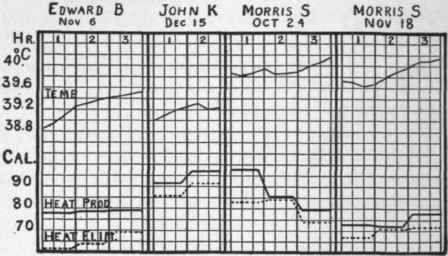

Fig. 26. - Curves showing the relationship and heat elimination in fever Rising temperature. The uppermost line shows the rectal temperature as measured every twenty minutes. The heavy continued line represents the heat production in hourly periods as determined by the method of indirect calorim-etry. The dotted line gives the heat elimination as determined by the measurement of the calories of radiation, conduction, and vaporization. The difference between the levels of these two lines represents the heat stored in the body as the temperature rises. Note the fact that in every case except one the heat elimination increases with a rising temperature.
In every one of these cases there was a rising body temperature. In every case but one an increase in heat production accompanied the rising body temperature; and the heat elimination, though not equal to the heat production, rose to meet the needs of the higher level of metabolism. The major part of the evidence, therefore, points to an increase in the metabolism which is coincident with an elevation of body temperature when determinations are made in hourly periods.
1 Nebelthau: "Zeitschrift fur Biologie," 1895, xxxi, 353.
2 Coleman and DuBois: "Archives of Internal Medicine," 1915, xv, 887.
In one instance (Morris S., October 24th) the heat production and heat elimination both fell notwithstanding a rising body temperature.
This could only have been accomplished through an alteration in the apparatus for the elimination of heat from the body, in the sense of Traube's analysis of fever.
Coleman and DuBois also cite experiments which show that when the body temperature is constant in high fever the heat production and heat elimination are equal to each other, and when the body temperature falls the heat elimination rises above the heat production, while the amount of the latter may or may not fall.
Coleman, Barr, and DuBois have recently noted in the case of a man suffering from erysipelas that a fall in body temperature of 1°C. during sleep in the calorimeter had no effect upon the hourly production of heat (unpublished). In this individual the reduction of body temperature was therefore wholly dependent on the mechanism of the physical regulation of temperature.
Continue to:


My Books

