


The Influence Of Protein Food. Nitrogen Equilibrium. Part 5
Description
This section is from the book "The Elements Of The Science Of Nutrition", by Graham Lusk. Also available from Amazon: The Elements of the Science of Nutrition.
The Influence Of Protein Food. Nitrogen Equilibrium. Part 5
The amount of urea excretion is found to be closely parallel to the urea concentration of the blood. This relation was formulated in Ambard's laws of urea elimination.5
(1) When the concentration of urea in the urine is constant the quantity of urea excreted in the urine varies proportionately to the square of the concentration of urea in the blood.
(2) When the concentration of urea in the blood remains constant the quantity excreted in the urine varies inversely as the square root of the concentration in the urine.
1 Albarran: "Exploration des fonctions r6nales," Paris, 1905, p. 329.
2 Barringer and Barringer: "Amer. Jour, of Physiology," 1910-11, xxvii, 119.
3 Janney: "Zeitschrift fur physiologische Chemie," 1911-12, Ixxvi, 99. 4 Marshall and Davis: "Journal of Biological Chemistry," 1914, xviii, 53. 5 Ambard: "Comptes rendus societe de biologie," 1910, lxii, 506.
From these laws Ambard's coefficient or constant for the urea elimination through the kidney of human subjects was evolved. Arbitrary standards of normal weight, such as 70 kilograms, and of urea excreted in twenty-four hours, such as 25 grams, were adopted in the formula, which is as follows:
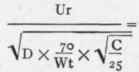
K or Constant of Ambard.
Ur = Urea per liter of blood in grams.
D = Urea in urine in twenty-four hours in grams. Wt = Weight of patient in kilograms.
C = Concentration, or grams urea per liter of urine.
Ambard found the constant in normal individuals varied between 0.06 and 0.07. McLean,1 who has used more accurate methods for measuring urea, finds the constant to be nearer 0.08, with wider variations than French observers found. This coefficient is being applied to determine kidney efficiency in renal disease. When the coefficient is found to be much increased, then urea is being retained by the organism on account of renal insufficiency.
Citing from McLean and Selling,2 the following results may be given:
Person. | Time. | Urea N | Ambard's Coefficient. | ||
In Blood. | In Urine. | ||||
In 24 Hours. | Per Liter. | ||||
F. C. M. | Forty-five minutes after 10 g. urea........... | Mg. | Grams. | Grams. | |
24 | 24.6 | 16.4 | 0.068 | ||
F. C. M. | Three days low protein diet................. | 14 | 6.9 | 9.7 | 0.085 |
H. K. A. | After heavy dinner.. . . | 22 | 11.4 | 11.6 | 0.088 |
B. | Nephritic .................. | 29 | 9.6 | 7.6 | 0.150 |
1 McLean: "Journal of Exp. Medicine," 1915, xxii, 212.
2McLean and Selling: "Journal of Biological Chemistry," 1914, xix, 31.
In some interesting work Pepper and Austin1 find that after giving 900 grams of meat to a dog the non-protein nitrogen in the blood rises rapidly from 20 to 60 mg. per 100 c.c., and the urinary nitrogen rises from 0.15 gram to 1.1 grams per hour.
It is evident from this analysis that the curve of nitrogen elimination is not an exact indicator of the time relations of the breaking up of amino-acids in the body, for a part of the urea formed accumulates in the blood and is not at first eliminated in the urine, and too low a protein metabolism may thus in error be computed. Later, with a diminished absorption of amino-acids and diminished production of urea, the excess which is not attributable to the metabolism of the moment is eliminated from the blood, and the urinary nitrogen of these hours will give too high figures if used to compute the protein metabolism of short periods (see p. 173).
It may here be noted that the elimination of sodium chlorid follows Ambard's laws in the behavior of that quantity which is in excess of 5.62 grams of NaCl per liter of blood-plasma2 (see p. 523) which is the threshold value of elimination by the kidney.
It was shown by Rubner,3 who gave washed meat containing 24.72 grams of nitrogen to a dog daily for three days, that the sulphur elimination preceded that of the nitrogen, while that of phosphorus followed it. The results of the third day, at a time when the dog was essentially in nitrogen equilibrium, are divided into six hourly periods and are given below:
Period. | S. | N. | N/S | Of 100 Per Cent, were Excreted | ||
S. | N. | P. | ||||
I.......... | 0.448 | 5.57 | 12.4 | 36.7 | 24.8 | 16.0 |
II.......... | 0.387 | 8.94 | 23.1 | 31.7 | 39.8 | 32.I |
1ll....... | 0.257 | 5.32 | 20.7 | 21.1 | 23.6 | 33.4 |
IV.......... | 0.131 | 2.66 | 20.3 | 10.5 | 11.8 | 18.5 |
I.223 | 22.49 | 18.4 | ||||
1 Pepper and Austin: "Journal of Biological Chemistry," 1915, xxii, 81.
2 For discussion, see McLean, loc. cil.
3 Rubner: "Gesetze des Energieverbrauchs," 1902, 368.
The elimination of sulphur more rapidly than nitrogen after meat ingestion has been confirmed by von Wendt1 in man. It appears that the end-products of the metabolism of sulphur-containing cystin appear in the urine more rapidly than urea, while phosphorus, which is an end-product of nuclein metabolism, makes its appearance more slowly.
Two explanations of the early elimination offer themselves: one, that the sulphur-containing cystin radicle is oxidized with exceptional ease; two, that the sulphur compounds may not accumulate in the organism as does urea. Variations in the rate of sulphur elimination may also undoubtedly be influenced by bacterial activity.
If in man various proteins be added to an already sufficient mixed diet (superposition experiments), the rate of destruction of the added protein as indicated by the extra N eliminated in the urine varies with the character of the protein. Such experiments were first devised by Falta,2 who established the following classification of proteins in the order of the rapidity of their destruction: a, gelatin, casein, serum albumin, fibrin; b, blood globulin; c, hemoglobin; d, egg-albumin. Hamalainen and Helme3 continued these experiments and they also investigated the elimination of sulphur and phosphorus. They gave a man weighing 66 kilograms a diet containing 3650 calories and 5 grams of nitrogen. On this diet they superimposed on different days the following amounts of proteins:
800 g. white of egg | = | 14.40 g. | N | + | 1.56 g. | S. |
57 g. proton | = | 6.94 g. | N | + | 0.419 g. | s. |
3 20 g. veal | = | 13.44 g. | N | + | 0.832 g. | s. |
1 von Wendt: "Skan. Archiv fur Physiologie," 1905, xvii, 211.
2 Falta: "Deutsches Archiv fur klinische Medizin," 1906, lxxxvi, 517.
3 Hamalainen and Helme: "Skan. Archiv fur Physiologie," 1907, xix, 182.
Continue to:


My Books

