


The Influence Of Protein Food. Nitrogen Equilibrium. Part 6
Description
This section is from the book "The Elements Of The Science Of Nutrition", by Graham Lusk. Also available from Amazon: The Elements of the Science of Nutrition.
The Influence Of Protein Food. Nitrogen Equilibrium. Part 6
And noticed the time of the elimination of nitrogen, sulphur, and phosphorus through the kidney. It was six days before all the nitrogen of the ingested white of egg was eliminated, whereas that in veal and proton required only two or three days. This is evident from the following table:
Daily Percentage Elimination Of The Nitrogen, Sulphur, And Phosphorus Of Ingested Protein Superimposed On An Adequate Diet
Day. | Egg-white. | Proton. | Veal. | ||||
N. | S. | N. | S. | N. | S. | P. | |
1....................... | 21 | 41.4 | 64 | 90 | 56 | 74.2 | 60 |
2....................... | 21 | 32.2 | 10 | 10 | 26 | 17.8 | 24 |
3....................... | 22 | 14.4 | 13 | 18 | 8.0 | 16 | |
4....................... | II | 4.3 | 13 | ||||
5....................... | 14 | 5.5 | |||||
6....................... | II | 2.4 | |||||
The rapidity of the sulphur elimination is everywhere noticeable. The "nitrogen lag" in the case of white of egg is pronounced and may be due to the retention of peptids which are only slowly metabolized, or it may be due to the retention of amino-acids themselves.
Mendel and Lewis1 suggest that the flattened curves of nitrogen elimination found after the ingestion of egg-white or ovalbumin may, to a great extent, be explained by a difference in the rate and completeness of the absorption of these substances when contrasted with the behavior of meat, casein, ovovitellin, edestin, gliadin and gelatin, between which little difference could be observed.
Cathcart and Green2 have superimposed egg-albumin upon a vegetarian diet in man. In egg-albumin the ratio S : N is 1 :8. The S : N of the urine in starvation is i : 15, but after ingesting egg-albumin it was found to be 1 : 9.8. This indicates a high specific oxidation of sulphur, and leaves a residuum of amino-acids suitable for regrouping into a pabulum of "deposit protein" which is poor in sulphur. It remains to be shown, however, whether such "deposit protein" if metabolized during the early days of fasting will give indication of a low sulphur content.
1 Mendel and Lewis: "Journal of Biological Chemistry," 1913-14, xvi, 75.
2 Cathcart and Green: "Biochemical Journal," 1913, vii, 1.
Sherman and Hawk1 give curves showing beautifully an almost parallel elimination of sulphur and nitrogen in man on a mixed diet. A curve showing this is here presented:
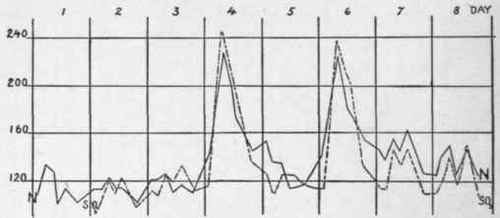
Fig. 13. - The curves here shown represent the relative fluctuations in the average rates of excretion of nitrogen and SO3. The values on the left represent percentages of an assumed standard rate of excretion for each of these constituents. It will be seen that in general the excretion of sulphates ran quite closely parallel to that of nitrogen.
Wolf2 presents similar curves after giving veal cutlets or casein to a man. It is evident that the early elimination of sulphur does not always appear. Wolf also describes experiments in which after the ingestion of a liter of raw white of egg by a man the maximal elimination of urinary sulphur followed that of urea by several hours. In this instance the ingesta contained 16.6 grams of nitrogen, and the urine during twenty-four hours only 8.7 grams. This indicates that a large fraction of the protein had a fate which is purely speculative.
If we pass from the consideration of protein metabolism, as indicated by the nitrogen curve, to the consideration of the intermediary metabolism of protein we can see more clearly that the curve of protein nitrogen excretion Is not a true index to the sum of the activities contributed to the cells by protein metabolism.
1 Sherman and Hawk: "Amer. Jour, of Physiology," 1900, iv, 43. 2 Wolf: "Biochemische Zeitschnft," 1912, xl, 193, 234.
Continue to:


My Books

