


Chapter VI. The Influence Of Protein Food. Part II. The Intermediary Metabolism
Description
This section is from the book "The Elements Of The Science Of Nutrition", by Graham Lusk. Also available from Amazon: The Elements of the Science of Nutrition.
Chapter VI. The Influence Of Protein Food. Part II. The Intermediary Metabolism
The term "intermediary metabolism" with which so much modern work is intimately associated was used by Bidder and Schmidt on the first page of their celebrated "Verdauungssafte und Stofrwechsel," published in 1852. Their conception of the breakdown of protein has already been cited.
Voit1 believed that there was an early cleavage of the protein molecule into a nitrogenous portion and a non-nitrogenous portion, a cleavage involving the liberation of only a small amount of energy; that there was a rapid combustion of the nitrogenous radicle, as shown by the elimination of the nitrogenous end-products in the urine; and that the non-nitrogenous radicle which contained the major part of the potential energy of the protein molecule might in part be temporatily stored either as glycogen or fat and be gradually doled out to the tissues as the need required.
Claude Bernard believed that glycogen could arise from protein. Wolrfberg2 let fowls fast two days to remove the glycogen and then for two days gave meat powder which was free from carbohydrate. Two fowls, killed during the interval of protein digestion, showed considerable glycogen in their livers (1.56 and 1.45 per cent.) and muscles (0.251 and 0.454 per cent.), much more than would have been present in starvation. Two similar fowls, killed seventeen and twenty-four hours after the last protein ingestion, contained much less glycogen in their livers (0.145 and 0.22 per cent.) and muscles (0.211 and 0.162 per cent.). This origin of glycogen from protein was fully confirmed by Kulz3 in a very extended series of experiments in which chopped meat, fully extracted with warm water, was made the basis of the ingesta. It became evident from these experiments that if sufficient protein were given to an animal, part of the protein carbon could be retained as glycogen.
1 Voit: "Zeitschrift fur Biologie," 1891, xxviii, 291.
2 Wolffberg: Ibid., 1876, xii, 278.
3 Kulz: "Ludwig's Festschrift," 1890, p. 83.
It has long been believed that sugar arises from protein in diabetes. Kossel,1 who knew that hexone bases, leucin, and other protein end-products contained six atoms of carbon, first suggested a relation between them and glucose. The theory of the origin of sugar in diabetes from these amino products was strongly advocated by Friedrich Muller.2 The definite proof of this was afforded by Stiles and Lusk,3 who gave a mixture of amino bodies prepared by the pancreatic proteolysis of meat to a dog rendered diabetic with phlorhizin. The mixture was free from protein. The nitrogen ingested was entirely eliminated in the urine, and for each gram of such nitrogen 2.4 grams of extra sugar appeared in the urine.
Considerable sugar may originate from protein in the course of its ordinary metabolism. The question arises at what time during the metabolism does this sugar become available for combustion in the organism? This question was answered by an experiment of Reilly, Nolan, and Lusk.4 These authors gave a fasting phlorhizinized dog 500 grams of meat and collected the urine in two three-hour and one six-hour periods. The results were as follows:
Excretion Of Glucose And Nitrogen Before And After Ingesting 500 Grams Of Meat In Diabetes
Glucose. | Nitrogen. | D:N. | |
Preceding three hours .............. | 5.96 | 1.75 | 3.41 |
First three hours after feeding.......... | 12.43 | 2.52 | 4.92 |
Second three hours after feeding ............ | 14.70 | 3.76 | 3.91 |
Third three hours after feeding......... | 11.23 | 3.85 | 2.92 |
Fourth three hours after feeding........ | 11.23 | 3.85 | 2.92 |
Following three hours................. | 6.34 | 1.78 | 3.56 |
1 Kossel: "Deutsche medizinische Wochenschrift," 1898, xxiv, 581.
2 Muller and Seemann: Ibid., 1899, xxv, 269.
3 Stiles and Lusk: "American Journal of Physiology," 1903, ix, 380.
4 Reilly, Nolan, and Lusk: "American Journal of Physiology," 1898, i, 395. For similar work after giving casein, serum albumin, gliadin, and edestin with separation of urine in hourly periods, consult Janney: "Journal of Biological Chemistry," 1915, xx, 321.
The normal fasting relation between glucose and nitrogen changed immediately upon the ingestion of meat. During the first hours more glucose was eliminated than corresponded to the nitrogen in the urine. During the later hours this proportion was reversed. The sugar elimination, therefore, took place decidedly before that of the nitrogen. This is shown in the following calculation of the percentage elimination of nitrogen and glucose in three-hour periods following the ingestion of 500 grams of meat in the above experiment:
Glucose. | Nitrogen. | |
During first three hours ............ | ..... 25.06 | 18.02 |
During second three hours ....... | ..... 29.64 | 26.90 |
During third three hours .......... | 22.65 | 27.54 |
During fourth three hours ............ | 22.65 | 27.54 |
100.00 | 100.00 |
The relations are represented in the following curve:
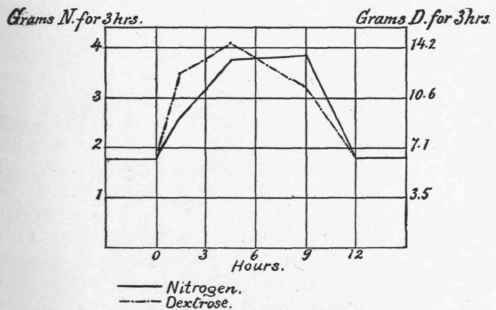
Fig. 14. - Curve showing the elimination of glucose before nitrogen after meat ingestion (500 grams) in diabetes.
That the glucose production from the meat ingested was proportional to the protein destroyed is evident from the following comparison, in which the sum of the glucose and nitrogen eliminated in the twelve hours is considered. Nitrogen and glucose double in quantity after the ingestion of meat but their ratio remains the same as in starvation.
Glucose. | Nitrogen. | D:N. | |
Fasting twelve hours ............ | 23.87 | 7.00 | 3. 41 |
After 500 gm. meat, twelve hours...... | 49.59 | 14.00 | 3. 54 |
Subsesquent twelve hours ............... | 25.36 | 7.11 | 3. 50 |
The curve shows that there is an early production of sugar from protein which may be liberated in metabolism before the nitrogen belonging to the protein is eliminated in the urine. A similar early production of sugar from protein has also been observed after feeding dogs with meat in pancreas diabetes.1
Since 1 gram of nitrogen in the urine represents a destruction of 6.25 grams of meat protein, and since there is simultaneously an average elimination of 3.65 grams of glucose in phlor-hizin diabetes, it may be calculated that the sugar production from meat amounts to 58 per cent, by weight of the meat protein metabolized and may contain 51 per cent, of its total available energy (see p. 471).
Another calculation shows that of the carbon from protein which is ordinarily eliminated in the respiration 57.2 per cent, may pass through the glucose stage (see p. 470).
Continue to:


My Books

