


The Respiratory Metabolism. Part 5
Description
This section is from the book "The Elements Of The Science Of Nutrition", by Graham Lusk. Also available from Amazon: The Elements of the Science of Nutrition.
The Respiratory Metabolism. Part 5
Rubner, therefore, planned an experiment in which a dog was kept at a temperature of 330. At times the animal was made to fast in order that the basal requirement could be determined, and during other definite periods meat, fat, and carbohydrates, either alone or combined, were ingested, and the increased metabolism due to the varying dietaries was noticed. The experiment extended over a period of forty-six days.
1 Rubner: "Archiv fur Hygiene," 1903, xlvi, 390.
A summary of the results obtained is graphically illustrated by the accompanying Fig. 16, which has been taken from Rubner.1
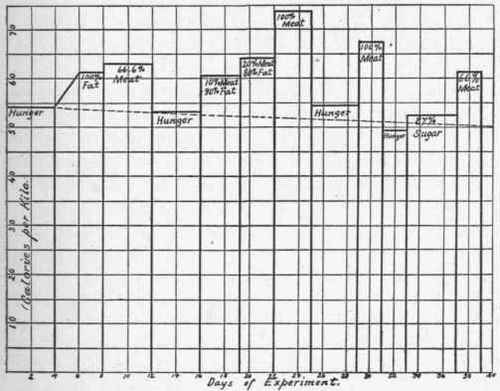
Fig. 16. - Rubner's chart indicating the specific dynamic action of different food-stuffs ingested at a room temperature of 33 °. The dotted line indicates the height of the fasting metabolism.
It is clearly evident that meat ingestion raises the metabolism most, fat next, and sugar least of all the food-stuffs. The ingestion of the starvation requirement for energy in the form of fat raises the metabolism 12.7 per cent.; in the form of sugar, 5.8 per cent. During the two periods, when approximately 100 per cent, of the basal requirement was ingested as meat, there was an average increase in the metabolism of 36.7 per cent.
After making deductions for the effect of the fat contained in the meat given, Rubner computed that there was an average increase in metabolism of 30.94 calories for 100 calories contained in the protein of the diet in the resting animal when it was outside of the influence of the chemical regulation of temperature. The action of gelatin is similar, the increase in metabolism being 28 per cent, for every 100 calories in the gelatin ingested.
Again Rubner2 has determined the amount of the metabolism of a fasting dog and that of the same dog made diabetic with phlorhizin (see p. 474). Under the latter circumstances the protein metabolism is greatly increased. He found that for every 100 calories increase in body protein broken down there was an increased heat production of 31.9 calories. Here was a rise in heat production not due to protein ingestion and, therefore, not due to intestinal work, but due to the mere fact of increased protein metabolism in starvation. The specific dynaihic action of protein then may thus be tabulated:
Increased Heat Production For Every 100 Calories Ingested Or Metabolized
Meat protein......................................... | 30.9 |
Gelatin .............. | 28.0 |
Body protien (phlorhizin diabetes) ........................ | 31.9 |
The dog of Williams, Riche, and Lusk showed an increase of 30 calories in heat production for every 100 calories contained in the protein of the 1200 grams of meat ingested.
1 Rubner: "Energiegesetze," p. 322.
1 Rubner: Ibid., p. 370.
It has furthermore been shown by Falta, Grote, and Stae-helin1 that casein and the amino-acids resulting from the hydrolysis of casein when given to a dog exert the same specific dynamic action as do the proteins of meat.
That these results are not limited in their application is shown by Rubner's2 experiment on a man who was given 120 per cent, of the starvation requirement of energy first in the form of sugar and then of meat. The metabolism was as follows:
Starvation ................. | 2042 calories in 24 hours. |
Sugar alone ................. | 2087 " " " |
Meat alone .................. | 2566 " " " |
As neither man nor dog ever lives on meat alone except under forced feeding, the results are not usually so pronounced as in the above case.
Average mixed diets, according to Rubner, must contain between 11 and 14 per cent, more than the calories produced in fasting in order to constitute an ingestion minimum for the maintenance of a man in caloric equilibrium.
One must now pass to the discussion of the cause of the specific dynamic action of protein.
In 1881 Voit laid down the principle that the intensity of metabolism in the cells was modified by the quality and quantity of the food materials brought to them by the blood. He believed that the inherent power of the cells to metabolize was augmented by the presence of increased quantities of food-stuffs. Rubner developed another conception. He declared that the fundamental metabolism of a normal warmblooded animal was always constant, and that the effect of food ingestion did not change this. The increased heat production which followed the taking of food was due to heat developed from a lot of intermediary reactions and oxidations, and had nothing whatever to do with the fundamental level of the cellular requirement of energy which was entirely unchanged. Thus, when protein was metabolized it could supply energy for the maintenance of true cellular activity in so far as glucose was produced from it, whereas other intermediary cleavage products were simply oxidized with the production of extra heat, which was in no way involved in the life processes of the cells. The utilization of energy in protein might be compared with the burning of a tree as fuel for the steam engine, the trunk of the tree being used as fuel within the engine for the production of power, whereas the limbs and twigs are burned as brush outside and supply only heat. The theory may be schematically indicated as follows:
1 Falta, Grote, and Staehelin: "Hofmeister's Beitrage," 1907, ix, 334.
2 Rubner: "Energiegesetze," p. 410.
Starvation Requirement Of Potential Energy By Cells
= 100 CALORIES
140 Calories in Protein of Meat Ingested | |
40 Calories = free heat liberated in early cleavage, available in replacement of heat of chemical regulation. | 100 Calories = Potential energy from protein available for cell life. |
This conception was founded on the erroneous idea that sugar exerted little or no specific dynamic action (see p. 294).
Experiments were instituted in the author's laboratory1 with the intention of more fully establishing the truth of Rubner's theories of specific dynamic action.2 It was known that glycocoll and alanin were completely convertible into glucose in the diabetic organism, whereas glutamic acid was in part so converted, three of its five carbon atoms passing into glucose, the other two being oxidized. It follows from Rubner's hypothesis that glycocoll and alanin should exert no specific dynamic action, whereas glutamic acid should manifest this phenomenon. The reverse proved to be true: glycocoll and alanin are capable of greatly increasing the heat production, whereas the strong dibasic glutamic acid is without influence. Glycocoll and alanin produce powerful effects, lasting eight and five hours respectively, whereas on giving those quantities of glucose into which the amino-acids are convertible only an almost negligible influence is observable.
1 Lusk: "Journal of Biological Chemistry," 1912-13, xiii, 155. 2The argument here presented is to be found in Lusk: "Journal of Biological Chemistry," 1915, xx, p. viii.
Continue to:


My Books

