


Glutamic Acid, Hooc.CH2.CH2.CHNH2.COOH
Description
This section is from the book "The Elements Of The Science Of Nutrition", by Graham Lusk. Also available from Amazon: The Elements of the Science of Nutrition.
Glutamic Acid, Hooc.CH2.CH2.CHNH2.COOH
Present in all proteins, frequently largest constituent amino-acid in the molecule, as in gliadin of wheat (44 per cent.) and in muscle (22 per cent.). Three carbon atoms enter into the formation of glucose.
This was the first amino-acid whose power to form glucose was measured.5 Ringer and Lusk held that this power to form glucose was through β-oxidation of the central carbon atom, as follows:
1 Ringer, Frankel, and Jonas: "Journal of Biological Chemistry," 1913, xiv, 539.
2 Ackermann: "Zeitschrift fur Biologie," 1911, lvi, 87. 3 Dakin: Loc. cit.
4 Mayer, P.: "Biochemische Zeitschrift," 1914, lxii, 462. 5 Lusk: "American Journal of Physiology," 1908, xxii, 174.
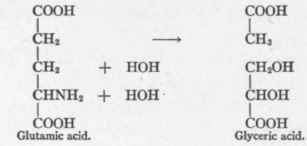
Since glyceric acid forms glucose, this pathway would be a natural one. Dakin agrees with this as possible. Warkalla1 confirms the synthesis of three carbon groups of glutamic acid into glucose.
F. Ehrlich2 showed that fermenting yeast converted glutamic acid into succinic acid, HOOC.CH2.CH2.COOH, and Neuberg3 finds that keto-glutaric acid, HOOC.CH2.CH2.CO.-COOH, yields the same product under similar conditions. This indicates keto-glutaric acid as a probable intermediary product. Since Ringer4 has shown that succinic acid is convertible into glucose, this appears to be a possible pathway of the decomposition of glutamic acid.
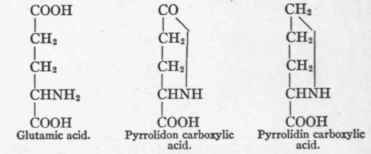
According to Abderhalden,5 glutamic acid may be condensed into pyrrolidon carboxylic acid. The conversion of this into prolin or pyrrolidin carboxylic acid has not yet been achieved.
1 Warkalla: "Cremer's Beitrage," 1914, i, 91.
2 Ehrlich, F.: "Biochemische Zeitschrift," 1909, xviii, 391. 3 Neuberg and Ringer, M.: Ibid., 1915, lxxi, 226.
4 Ringer, Frankel, and Jonas: "Journal of Biological Chemistry," 1913, xiv, 539.
5 Abderhalden and Kautzsch: "Zeitschrift fur physiologische Chemie," 1910, lxviii, 487.
Pyrrolidin carboxylic acid made in some such manner may become the mother substance used in the construction of hemoglobin in the animal or of chlorophyll in the plant.
Continue to:


My Books

