


The Nutritive Value Of Various Materials Used As Foods. Part 4
Description
This section is from the book "The Elements Of The Science Of Nutrition", by Graham Lusk. Also available from Amazon: The Elements of the Science of Nutrition.
The Nutritive Value Of Various Materials Used As Foods. Part 4
In another chapter of this book (see p. 156) the unequal nutritional value of the proteins, such as are found in meat or gelatin, have been emphasized. This difference in nutritive value was set forth by Karl Thomas,1 who took starch and sugar in large quantity in his diet, determined the minimal loss of body protein under these circumstances, and then added to the diet food materials containing different proteins, in order to determine their relative power in sparing the body from a loss of tissue protein. The values given below Thomas named the biologic values of the proteins employed:
Biologic Values Of Different Proteins, As Measured By The Percentage Quantity Of Body Protein Which Their Ingestion Will Spare From Loss
Ox meat................... 104
Cows' milk.................100
Fish....................... 95
Rice....................... 88
Cauliflower................. 84
Crab meat................. 79
Potatoes.................... 79
Cherry-juice................ 79
Yeast..................... 71
Casein..................... 70
Nutrose................... 69
Spinach.................... 64
Peas...................... 56
Wheat flour................ 40
Cornmeal.................. 30
1 Thomas, K.: "Archiv fur Physiologie," 1909, p. 219.
These excellent experiments show clearly the superior value of meat, fish, and milk proteins as conservers of body protein when contrasted with the ordinary group of vegetable proteins.
The reason for this biologic difference lies in the amino-acid content of the different proteins, as has been beautifully shown in experiments with growing animals. Willcock and Hopkins1 were the pioneers in this field. . They prepared a diet in which casein was the sole nitrogenous constituent and obtained good growth in mice when this diet was administered to them. When zein, the principal protein of corn, was substituted for casein in the diet, the animals declined and died in about seventeen days. Addition of tyrosin, which zein contains in plentiful amount, was without effect upon the length of life. When, however, tryptophan, which, as well as lysin and glycocoll, is absent from the zein molecule, was added to the diet in an amount equal to 2 per cent, of the total zein given, the animals lived thirty-two days. Hopkins suggests the possibility that in the absence of tryptophan epinephrin cannot be formed and collapse follows. Osborne and Mendel2 have maintained a rat at an almost constant body weight of 50 grams for one hundred and eighty-two days on a food containing zein as its dominant protein, with the addition of tryptophan equal to 3 per cent, of the zein. Since zein is free from the amino-acid lysin, it seemed possible that normal growth might be obtained when the protein in the dietary consisted of zein supplemented by tryptophan and lysin; such, indeed, proved to be the case (Fig. 22).
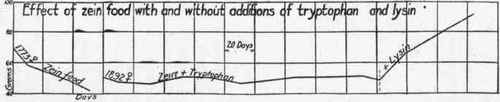
Fig. 22. - Showing nutritive decline on zein food, maintenance after addition of tryptophan, growth after addition of both tryptophan and lysin. Rat 1892 was maintained during one-half year without significant change in body weight on the zein + tryptophan food. Despite this inadequate diet the capacity to grow was not lost at the end of this prolonged period, and the animal ultimately grew to full adult size on a mixed diet.
A striking detail of this work is that at the beginning of the experiment a patch of hair on the animal's back was dyed red and this color remained unchanged for six months. When lysin was added to the diet and growth was resumed the color soon disappeared. New growth became possible in the hairs as in other parts of the body. The addition of lysin alone to a dietary containing zein does not prevent the decline which always accompanies the partaking of a diet which is free from tryptophan.
1 Willcock and Hopkins: "Journal of Physiology," 1906-7, xxxv, 88.
2 Osborne and Mendel: "Journal of Biological Chemistry," 1915, xx, 331.
From the experiments of McCollum,1 one may calculate that gelatin (which lacks tyrosin, tryptophan, and cystin) when given with starch to a pig in such quantity that the gelatin is the equivalent of the "wear-and-tear" quota of protein metabolism body protein is protected from waste to an extent of 39 per cent, (see p. 283). When zein is administered under similar conditions body protein is spared to an extent of 73 per cent., thus demonstrating the superiority of zein to gelatin in this regard.
The study of the failure of zein to produce growth or to prevent decline brings up the question as to the nutritive value of maize. Osborne and Mendel2 state that zein and glutelin form 72 per cent, of the proteins of the maize kernel. Glutelin, which is present in about one-half the quantity of that of zein, is a complete protein, containing all the familiar amino-acids, and is efficient in producing growth, but there is not enough of this higher quality protein to produce more than moderate growth. A small addition of a protein like lactalbumin, however, to a diet containing maize protein at once induced normal growth.
1 McCollum, E. V.: "American Journal of Physiology," 1911-12, xxix, 215.
2 Osborne and Mendel: "Journal of Biological Chemistry," 1914, xviii, 1.
The corn grain contains [little calcium, and the daily addition of 2.5 grams to the diet of a corn-fed pregnant sow very favorably influences the condition of the offspring.1
Hart and McCollum2 noticed that when swine are restricted to cornmeal and corn-gluten feed there is little or no growth, but when salts are added, so that the salt content of the ration approximates that of milk, good growth follows. The desire for salts may explain the "rooting" of the hog. The desirability of a milk addition to the diet of the growing hog is emphasized in the following experiment, which shows the higher biologic value of the milk proteins as contrasted with vegetable proteins. (See also p. 371).
Effect Of The Kind Of Protein Upon The Amount Of Protein Retained For Growth
Source of Protein. | Calories Per Kg. in Ration. | Protein in Per Cent, in Ration. | Protein Retained for Growth in Per Cent. |
Corn............................ | 109 | 10.5 | 20 |
Wheat.......................... | 103 | 11.0 | 22 |
Oats............................ | 94 | 14.5 | 23 |
⅓ com +⅓ wheat +⅓ oats........ | 98 | 12.3 | 26 |
Wheat embryo + wheat gluten.... | 98 | 57.9 | 21 |
Casein.......................... | 102 | 16.5 | 46 |
Skim milk....................... | 94 | 15.5 | 63 |
1Evvard, Dox, and Guernsey: "American Journal of Physiology," 1914, xxxiv, 312.
2Hart and McCollum: "Journal of Biological Chemistry," 1914, xix, 373. Consult also Hogan: Ibid., 1916, xxvii, 193.
Continue to:


My Books

