


The Regulation Of Temperature. Part 2
Description
This section is from the book "The Elements Of The Science Of Nutrition", by Graham Lusk. Also available from Amazon: The Elements of the Science of Nutrition.
The Regulation Of Temperature. Part 2
If the body were a mass of cells having the shape of a ball with a constant heat production in its center, it would be easy to calculate its temperature in the different zones of the interior. The loss of heat from the surface would obviously be equal to the heat production if the temperature of the various zones continued constant.
If two balls of the same material, but of unequal size, were equally warm, the smaller would cool more quickly than the larger on account of the relatively greater exposed surface from which heat could be discharged. The heat elimination would be proportional to the surface exposed.
To determine the surface of geometrically similar solids, and hence of animals of similar shapes, the following formula was used by Meeh,1 in which S = surface and V = volume:
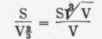
Since animals contain the same materials, one may substitute W = weight for V.
Then the value of may be empirically determined for each shape or animal, and this value = k. Hence the formula would read:


= k or S =

1 Meeh: "Zeitschrift fur Biologie," 1879, xv, 425.
The value of k or the constant in the relationship of weight in kilograms to surface in square meters in each animal has been given by Rubner as follows:
Man................................................. 12.3
Dog............................................. 11.2-10.3
Rabbit.......................................... 12.9-12.0
Rabbit (without ears).................................. 10.8
Calf................................................. 10.5
Sheep................................................ 12.1
Cat.................................................. 9.9
Pig.................................................. 8.7
Guinea-pig........................................... 8.5
Fowl................................................. 10.4
Rat.................................................. 9.1
White mouse.......................................... 11.4
To compute the body surface of a man, for example, the formula would be employed.

The use of the above formula rendered possible the calculation of the heat elimination per unit of area in fasting animals during periods of twenty-four hours when the temperature of the environment is 150 C. and when moderate voluntary movements are permitted. When the subjects have been previously well fed, and are not emaciated, there is a surprising uniformity of result. It. is Ruhner's law that the metabolism is pro-portionaljto the superficial area of an animal.
Erwin Voit1 has calculated the following general table showing the heat production in resting animals of various sizes at medium temperatures of the environment:
Calories Produced | |||
Weight in Kg. | Per Kilo. | Per Sq. M. Surface. | |
Horse ................ | 441 | "•3 | 948 |
Pig.......................... | 128 | 19.1 | 1078 |
Man........................ | 64.3 | 32.1 | 1042 |
Dog......................... | 15.2 | 51.5 | IO39 |
Rabbit...................... | 2.3 | 75.1 | 776 |
Goose.................. | 3.5 | 66.7 | 969 |
Fowl........................ | 2.0 | 71.0 | 943 |
Mouse2...................... | 0.018 | 212.0 | 1188 |
Rabbit2 (without ears)......... | 2.3 | 75.1 | 917 |
The universality of this law of Rubner's is remarkable. Even at a room temperature of 300 C. where all thermal influence is removed, two guinea-pigs of different sizes will produce heat in proportion to their surface. In this case there is a minimum of heat production determined for the resting organism according to the law of superficial area.
1 E. Voit: "Zeitschrift fur Biologie," 1901, xli, 120. 2 Rubner: "Energiegesetze," 1902, p. 282.
When this discovery was first made, the interpretation was offered that the variation in the metabolism of different animals in proportion to the skin area was due to the "chemical regulation" brought about by the specific sensory influences of cold proceeding from a definite area of surface. Before this Regnault and Reiset had noted that the heat production of sparrows per unit of weight was tenfold that of fowls, a phenomenon which they asserted was due to the fact that the smaller animals present a relatively larger surface to the surrounding air and thereby experience a considerable chilling, with the consequent generation of sufficient heat to maintain the normal body temperature. This explanation fell when Rubner discovered that at a temperature of 300 C, under which condition all thermal stimulus to the organism ceased, two guinea-pigs of different sizes still produced heat in proportion to their skin areas, A similar fact was noted by Frank and Voit1 who found that the administration of curare, which paralyzes the voluntary muscles, scarcely affected the carbon dioxid output of a dog as compared with what was eliminated during ordinary muscular rest, provided the temperature of the animal was maintained at the normal by keeping him in a warmed-diamber. The mass of living cells preserved the same metabolism as before, even though a pathway of heat increase, had been cut off through paralysis by curare of the motor nerve-endings in the muscles. Keeping the animal in a warmed chamber was necessary in this case, for Rohrig and Zunt2 had show that curarized animals at the ordinary room temperature lost the power of maintaining their body temperature and that their metabolism decreased accordingly. The removal of the chemical regulation caused a behavior toward external temperature similar to that of cold-blooded animals.
1 Frank and Voit: "Zeitschrift fur Biologie," 1901, xlii, 309. 2 Rohrig and Zuntz: "Pfluger's Archiv," 1871, iv, 57.
Although the effect of cold on the skin (inducing chemical regulation) is of itself demonstrably insufficient to account for the "law of skin area," Rubner1 argues that even at 300 C, when the body is losing heat by means of the dilatation of the blood-vessels and the evaporation of water (physical regulation), the law is still a necessity if the general mechanism for loss of heat in the various animals is the same in all. An infant produces 90 calories per kilogram in twenty-four hours; an adult, 32 calories. Were the metabolism of an adult 90 calories per kilogram, the means of heat elimination through his comparatively smaller surface would have to be materially modified if a normal temperature were to be maintained with comfort.
Continue to:


My Books

