


Chapter 16. The Shoulders. Part 3
Description
This section is from the book "Reichian Therapy. The Technique, for Home Use", by Jack Willis. Also available as a hardcopy from Amazon.com.
Chapter 16. The Shoulders. Part 3
Arms Up And Hit
This is a general exercise and may be done at any time during the course of your self-work. This is another of the exercises where you learn to tolerate and control anger.
The goal of this exercise is to become comfortable with controlled anger. Controlled in this sense does not mean that it does not or should not become very strong, it only means that the anger is vented in the context of a safe environment without it being directed physically against any person. You can, in fantasy, imagine that you are hitting a person if that helps you get the power into the hit.
During the inhale the arms are raised over the head and back with the elbows straight. Note the difference in the arm here to the Mussolini jaw exercise. In the Mussolini jaw exercise the arms were bent, here they are straight.
You may raise the arms slowly during the inhale or quickly and not coordinated with the inhale. The exercise often works better if the arms are raised during the inhale so that again, as in the Mussolini jaw exercise, you are putting the tension into your arms with the breath. But this is not necessary for the exercise to work properly.
Unless your fingernails are too long, you should use a fist. If you can't form a fist, then you will have to hit open handed.
The difference in this exercise from previous ones is that the exhale is started with a shout instead of the 'ah' sound. The sound of the shout does make a difference, in fact a large difference.
First, it is an 'uh' sound rather than an 'ah' sound. Next, it is an open-throated sound. Here is a hint for which I have no real explanation. I have heard it often enough to know it is real, the why escapes me. If you have any metal in the room (even an air conditioning duct or a metal lamp), on an open throated shout you will hear the metal ring. That is, the metal will vibrate slightly so that you can hear a slight ring from the metal. With most people the throat is not open, it is tight. For that reason most people can not get a real shout. They get a yell or a scream or even just a loud sound; but not a shout. Again, perhaps it will help to think about the sound as though you were attacking an enemy and the shout was meant to frighten your advisory. You will find examples of wrong and right shouts on the Sounds of Reichian audio; there is also an example of the metal ringing effect (here from a ceiling fan).
So the exhale is started with a shout as the arms are brought forcefully forward to strike or pound the bed. Perhaps it will help to think about the strike as though you were trying to break the bed. To get the benefit of the exercise keep in mind that its purpose is to stimulate and sanction the feeling of anger, therefore hit the bed with as much feeling of anger as you can muster.
Arms Crossed And Hit
This is a general exercise and may be begun at any time during the course of your self-work. This is an alternate form to the previous exercise of arms up and hit.
The difference in this exercise from the previous one is (1) the arms are brought across the body as though you were going to fend off a blow and (2) the strike is with the arms and not with the forearms or hands.
Note that the arm is brought up at right angles to the body, the elbow is bent and the forearms are crossed (Figure 114). You arms are not next to the body (as though covering the breasts); they are extended above the body so that when you strike the bed the arms are out away from the body (90 degrees) at the shoulder level.

Figure 114
The arms are brought up on the inhale. This is a normal inhale. The exhale is started with an open throated shout at the same time as the arms are slammed against the bed. Like the previous hit-the-bed exercise, the idea here is to sanction and facilitate the experience of anger.
The difference in this exercise, and the reason why it accomplishes something different from the previous hit-the-bed exercise, is that most of the power here comes from the wing muscles.
Choke The Towel
This exercise uses a bath towel. You want to have the towel handy and folded before you begin the shoulder exercises so that you do not have to stop the work to get the towel.
Lengthwise fold the towel in half and then in half again. Now fold the (1/4 width) towel in half. This is the towel you will use in this exercise and that you should have prepared ahead of time.
Grab the towel near the middle and twist it. Get it so that it is twisted as tightly as it will go (see Figure 115). After a normal inhale, on the exhale choke the towel as hard as you can and either growl with the exhale or use someone's name as though you were choking that person. This is a safe way to express long-held hatred.
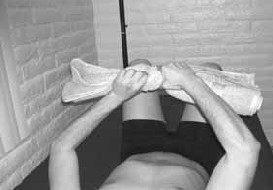
Figure 115
Most people tire quickly with this exercise so do it only as long as you have the strength. As always don't force yourself beyond the demands of the particular work session.
Reach With The Hands
This is a very soft exercise with very specific objectives. There is no harm in trying this exercise early in your self-work; but if it does not have a significant impact on you then it is being used too soon. Put it aside and try it again every six months or so until you find that it is impactful.
On the inhale raise your arms directly over your body (toward the ceiling). Reach upward extending both shoulders. Reach as though you were trying to touch the ceiling. Both shoulders should be rounded and you can feel the pull in your wing muscles.
On the exhale, let your hands drop back to your chest. The arms do not lower, they drop. Women can let the hands flop onto the lower ribs beneath the breasts.


Figure 116
What you are doing is mimicking the gesture made by children when they want to be picked up by an adult. Thus it helps if, when you are reaching upward, you try to create in yourself the desire to be picked up or held or nurtured or soothed or protected. Note in the left photograph above that the fingers are spread.
If you find after a few minutes that the exercise is only mechanical, that you are not having any emotive response, then stop. This is one of several exercises where it is easy to form it into a mechanical habit and thus it permanently looses its power.
Arms Up And Vocalize
This is a slightly more advanced variant of the previous exercise. It can be more powerful and, in fact, can be too powerful for early use.
This is an important point, so I will spend a few paragraphs discussing it. How often have I said it?
SELF-IMPROVEMENT IS NOT A RACE OR A CONTEST!!!
You definitely can overdo it. You can go too far too fast and the result will not be faster improvement, it will be damage. This is the ALWAYS TOO SLOWLY principle.
If you go too slowly, the worst than can happen is that you get bored. If you go too fast, you can, figuratively, blow emotional fuses. You can overload your system and it will respond by shutting down even more rigidly than before.
The human organism responds, and must respond, slowly. Like any skill or knowledge, we must get there slowly over time. As we grow, our brain changes. Using non-technical terms, our brain gets wired in a certain way. To change that requires time. Too rapid work does not undo the past bad wiring, it simply makes it stronger (in the wrong way).
This exercise is done with normal breathing. The arms reach toward the ceiling and are held there. The fingers may be wiggled if that feels appropriate. On the inhale, while leaving the arms upright, relax the body. On the exhale vocalize whatever phrase seems to produce an emotive result. Some suggested phrases are:
help me
please
why
mommy
daddy
I want you
I need you when
help
If it feels appropriate, the hands may be bent (palms up to the ceiling) and simulate the idea that you are pushing against something. Then the phrases like:
no
no I won't
go away
stop
I hate you
leave me alone may seem appropriate.

Figure 117
There is no set phrase or word. Whatever at the moment seems as if it is what you want to say or express is then appropriate. In doing this exercise try to put some emotion, like an actor on a stage, into the words. Thus, for example, the word "stop" might be said with a pleading tone or with a demanding tone or a helpless tone.
Let me say it once more: if the response is too strong or it starts to get away from you, stop the exercise. It is far better to miss an opportunity than to overdo it.
Continue to:


My Books

