


Chapter 17. The Chest And Diaphragm
Description
This section is from the book "Reichian Therapy. The Technique, for Home Use", by Jack Willis. Also available as a hardcopy from Amazon.com.
Chapter 17. The Chest And Diaphragm
The Chest
Cough exhale
Sneeze
I held off these two exercises from Part One of the book because you have enough there to keep you busy. Besides it gives me something to write about regarding the chest in Part Two.
Cough Exhale
Coughing almost requires the use of the muscles between the ribs. Recall that proper inhale means use of the muscles between the ribs, not the muscles of the neck (the accessory muscles of respiration.)
By coughing repeatedly on the exhale you are using and thus freeing the muscles between the ribs. The best way to do this is to push the belly out before the exhale and then cough the exhale. You can use your hands on your abdomen to see that it does not contract (which would mean that you are trying to use your diaphragm to do the cough).

Figure 118
The only error on this exercise is to cough from the throat instead of the chest. Try to keep your throat open so that the sound, as it were, comes from the chest instead of the throat.
Sneeze
A sneeze is the ultimate user of the muscles between the ribs. Unfortunately there are only two good ways to bring on a sneeze. One is to use a feather brushing the nose, the other is the use of common household black pepper. Using a feather may not work if you are doing it to yourself, but if you have a helper (Chapter 22) then use of a feather will usually work. But a little bit of common black pepper will always work. So use it. Just a little bit in the nose should bring on a good bout of sneezing. Lick the end of your finger, dip it in some pepper, and then place it into your nostril; both nostrils if needed.
One thing, however. The sneeze should be as loud and explosive as you can make it. These are not polite sneezes. These are blow the wall down sneezes. If your sneezes are tiny or just a "ka chu" it only means that you have a lot of work to do on freeing those chest muscles. Go back to Part One and work more on the exercises to free the chest.
The Diaphragm
The diaphragm is famous for expressing anxiety. If, while you are working on the chest, the diaphragm, or the abdomen, the anxiety gets to a level where it is interfering with your daily life, then work on the shoulders or on anger until the anxiety abates. Recall that in Part One I mentioned the thing we do with children when they are crying. We say "let me see a smile." The smile overcomes the tears since they are opposite. Anger can overcome anxiety in the same way a smile overcomes tears.
Some people are anxious all the time or have attacks of anxiety. It is not part of the Reichian work so I will only discuss this on the last page of Chapter 22. There I give you two relatively easy ways to stop strong anxiety (or a panic attack).
Gasp Inhale Belly
I presented this exercise to you in Part One of the book in discussing breathing. But this exercise is also an exercise for the diaphragm and has, if done fully, a major effect on the pelvis.
There are a set of muscles in the pelvis in the inside of your body. These muscles, as a set, are called the pelvic diaphragm.
The only good way to impact the pelvic diaphragm (which has a significant effect on sexuality) is by the belly breathing. And the most impactful of these belly breathing exercises is the gasp inhale belly. Most people when they do the gasp inhale belly exercise still guard the abdomen and do not allow the full rapid inhale. They do learn to do a rapid inhale, but it is also an abbreviated inhale; that is, they do not inhale fully and thus the gasp does not get down to the pelvis.
There is a way to correct this. Making sure that the chest does not move (you can even tense the muscles in your chest to help prevent movement), breathe into the belly and force more inhale until you can feel the air pushing against the pelvis (or the genitals). Then exhale fully. Now inhale again down into the pelvis and continue this until you become accustomed to the feel of the pressure going down to the pelvis.
Here is another helper. At what seems to you to be the end of the inhale to the belly, place one hand between the wings of the pelvis, just above the pubic bone, and then try to put air into that area so that you can feel the belly expand beneath your hand. If you really get the air down this far you will literally feel the pulling at the pubic bone (see Figure 118 on page 272). The two wings of the pelvis are held together only by a ligament at the pubic bone. Therefore as the air gets down to this area, it pushes the two wings apart and you can feel the pulling on that ligament.
Once you can get the air down to the pelvis and feel the pull on the pelvic ligament, then you can gradually speed up your inhale, holding all the time to the feel of the pressure going down to the pelvis. Finally, you can get to the gasp inhale belly and feel the impact of each gasp inhale in the pelvis.
I wish there were some way I could illustrate just how rapid the gasp is. Certainly the total inhale to the belly takes less than a half a second and likely about 1/4 of a second. One issue is that there should be no sound on the inhale. Most people when they try this exercise add a throat sound much like a rasp. Properly there is no inhale sound at all. The throat is open; it is just a pipe to the lungs so there is no sound at all except the extremely quiet sound of the rushing air. If you have any noticeable sound on your gasp inhale belly, then your inhale will be too slow since the partially closed throat is inhibiting the inrush of the air.
The absence of sound, of course, can not be put on the audio. What I have done is do some gasps with the throat sound followed by some gasps without the throat sound.
Gag
Gagging has already been discussed in Part One on the daily exercises. Gagging is one of the best diaphragm loosening exercises. You are referred to Part One on daily exercises (page 50) for the discussion on the proper way to do the gag.
If you have not been practicing the gagging on a regular basis, then you can do some work on it here. A good way is to first do the head over the bed exercise on page 230 and then do the gagging. The head over the bed exercise sometimes produces nausea and that makes it easier to do the gagging.
Note: you should not have eaten for at least three hours before you do any gagging. You don't want there to be any food in the stomach.
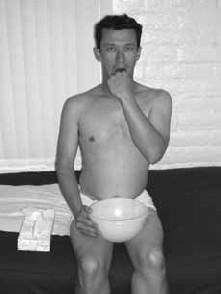
Figure 119
When you were doing the daily gag in the shower, you did not need the bowl or the tissue. Here, use a bowl and tissue to blow your nose. Note that the person is sitting upright, not leaning into the gag. Recall that there are three ways to initiate a gag reflex (touch the throat at the back of the mouth, stimulating the uvula hanging down at the back of the mouth, pressing on the back of the tongue.)
Continue to:


My Books

