


Chapter 18. The Abdomen
Description
This section is from the book "Reichian Therapy. The Technique, for Home Use", by Jack Willis. Also available as a hardcopy from Amazon.com.
Chapter 18. The Abdomen
Introduction
Introduction
Roll The Pelvis
When I started to write this book on the Reichian therapy exercises, one problem I faced was how to organize the material. In what order should I present the material? As you see, my decision was to present the daily exercises and the breathing in Part One of this book and then to cover everything else in the second part by going part by part from the forehead to the legs.
This provided us with a kind of logic of presentation, but it also left unaddressed an important issue. The issue is: despite the order of presentation, what is the proper order of execution. Now in part that is unanswerable since people are different. One person can have significant tension in the forehead and the eyes while the next person has almost no tension there. By a like measure, though the author has never seen someone who did not have some tension in the abdomen, still the degree of tension can vary greatly. The same is true of the chest. People with the long thin chest take a lot longer to get it up than people with the high-held barrel chest take to get it down.
In presenting this exercise I would like, for the first time, to draw a distinction between being able to breathe fully into the belly and having the belly be relaxed. In drawing this distinction I would first recall for you that when you are lying on the bed in the working position the abdominal muscles have no postural function. That is, the abdomen should be able to relax in the working position and become relatively soft.
There is one and only one big exercise to loosen the abdomen. It is a "big" exercise because it, all by itself, will over time produce profound loosening of the abdominal muscles (in the non-postural position). This exercise can (and should) be begun early in the work while doing the breathing work, but whenever it is begun it will both do its job of loosening the abdominal muscles and allowing the breath to go more deeply into the abdomen.
What happens if you have spent all your time on Part One before you started the work in Part Two? No harm has been done. The issue is that if your abdomen is tense you will not be able to effectively do the breathe belly only and not at all the gasp inhale belly. Further it is more difficult to free the diaphragm if the abdomen is overly tense. It is further evident, as you continued to read through this book, that you certainly could not do the croak hold and flick if the abdomen were tight.
Anatomically there are only three areas for the abdomen: the front (taken care of here by roll the pelvis), the side (taken care of by the side bend exercise discussed starting at page 122) and the lower back which will be addressed in the next chapter on the pelvis.
That makes this exercise an extremely important one. It is this exercise that, after enough time, will result in loosening your abdomen.
Recall in this connection the section I had in Part One on gym exercise. I pointed out there that few repetitions against heavy weight will build tension which defeats this work while many repetitions against light weight builds tonus and definition. Now if you are doing full sit-ups (with the legs extended and lifting your whole torso with your abdominal muscles) then you are doing repetitions against a heavy weight (it does not matter if you are so good at it that you can do five hundred sit-ups, you are still working against a heavy weight). If, on the other hand, you have your knees bent and you are coming up only part way (a curl), that is no problem for this work.
This is a good point to remind you of something I mentioned in Chapter one. "Armor" tends to return. If you have previously cleared the forehead and eyes as I recommended and now you have spent several months on other parts of the body, it is a good idea to return to check on whether your eyes are still free of "armor." The same goes for the face, tongue, jaw, and shoulders.
Roll The Pelvis
In Part One I mentioned this motion of rolling the pelvis in the push exhale exercise. But I did not present this exercise by itself in Part One. I would have liked to since it so important an exercise, but it just did not fit the breathing focus of Part One of the book. Now finally, I can present this exercise on its own. It is really quite a critical exercise since it is the one and only exercise we have for getting the frontal abdominal muscle (the rectus abdominis) to let go of any held tension.
At the beginning of the exhale, with the 'ah' sound, roll the pelvis. Hold it up for the whole exhale, then lower it as the exercise ends.
Each one of those motions is a location of error in doing this exercise. Note that
1. the 'ah' is with the roll
2. the pelvis is held up for the whole exhale
3. the pelvis is lowered (not dropped) at the end of the exhale; not after the end of the exhale, but at the end of the exhale.
Since the 'ah' sound is short you can't really complete the roll at the same time as the sound. The point is that the roll starts at the same time as the beginning of the exhale and is completed quickly. The roll, however, is not abrupt; it is not a jerk or a toss. The motion of the pelvis should be quick but fluid.

Figure 120
There are several common errors in this exercise.
The first error is that the rolling of the pelvis is done after the 'ah' sound rather than with the 'ah' sound. The roll should be done at the start of the exhale which is the same time as the 'ah' sound is made.
The second error is that the lower back is raised instead of the roll being limited to the pelvis. To show this, I have reproduced Figure 120 as Figure 121 left panel, along side a photograph where the back is rolled up (Figure 121 right panel).

Figure 121
The third error is that the pelvis is not held up for the complete exhale. In this connection there is another small issue. Just as there is the tendency to roll the pelvis after the 'ah' sound rather that with the 'ah', so, too, there is a tendency to lower the pelvis after the end of the exhale rather then with or at the end of the exhale.
The fourth error is that the pelvis is dropped rather than lowered.
The fifth error is that the roll is done with the abdominal muscles rather than with the thigh muscles, or the roll is done by spreading the legs to use the interior thigh muscles. This is shown in Figure 122 on page 283. In the left side photograph, the pelvis is rolled using the legs muscles (the quadriceps femoris). In the right side photograph, the pelvis is rolled by tensing the abdominal muscle (the rectus abdominis).
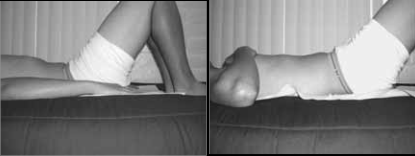
Figure 122
The next figure shows rolling the pelvis by spreading the legs. On the left is the normal spread of the legs, on the right the legs have separated in order to roll the pelvis.
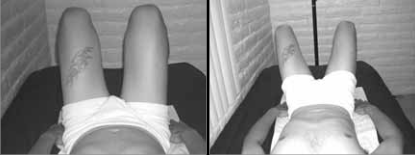
Figure 123
You might recall that I spoke about having to concentrate on each movement. There is no better exercise than this one to learn to trust your body. Initially you will have to focus on each motion:
1. roll with the 'ah' sound
2. hold the pelvis up for the whole exhale
3. lower the pelvis (not drop) at the end of the exhale
Once you have it down at the concentrate level, then you should focus on the feel of the body while doing the motion properly. In time you can let the body do the work without you having to focus on it. You simply have the feel of the body and it is the feel that you replicate with each breath rather than the specific motions.
There is an analogy here. At one time when you were tiny you had to learn to walk and climb stairs without falling. Now you do both things without thinking about your legs and feet. So, too, here you should learn to let the body movement be automatic without the need to control each movement.
This exercise can be profitably done for a complete one-hour session (or as long as you make your sessions). Further, even though it might seem boring, this exercise can be profitably done for many months, week after week (or, if you are doing sessions every third day, for many month's worth of sessions).
You can judge your progress by pressing your fingers into your abdomen. Your fingers should be able to go in several inches without pain and without significant resistance.
Continue to:


My Books

