


Chapter 20. The Legs
Description
This section is from the book "Reichian Therapy. The Technique, for Home Use", by Jack Willis. Also available as a hardcopy from Amazon.com.
Chapter 20. The Legs
1. Swim kick
2. Legs open and close
3. Kick with the legs (swim kick)
4. Slam kick fast
5. Slam kick slow
It is quite surprising how much of one's nature is held in the legs.
Many of you are doing exercises which involve the legs, like jogging, running, stationary bicycle, stair climbing and others.
There are two paradoxes in these exercises. One is that while you are doing these exercises for your health, they tend to wear out the hip, knee, and ankle joints. The other paradox is that these same exercises can also result in chronic tension in the leg muscles, the opposite of what we want.
If you want to exercise your legs, the best way is by a nice brisk walk each day. There are two benefits to this way of exercising the legs (and heart). First, it does as good a job as jogging or bicycling and two, it does not result in the degree of injury to the ankle, knee and hip.
That said, I want to emphasize that I am not playing parent here. One purpose of Reichian therapy is to get rid of the demand rigidity in your nature and your life. So I am not laying down any new rigid demands on you life. I am only giving you something to think about.
Kick With The Legs (Swim Kick)
In Part One I spoke of the spasms that may result from the deep breathing. I mentioned there that a calcium & magnesium supplement might take care of the problem or that use of the swim kick can often take care of the issue. To make sure that there is no confusion, I am talking here about the strong and often painful spasms that can occur during the work, I am not talking about the trembling or jerking.
I have no good science as to why the swim kick exercise can work to permanently get rid of the spasms that can result from the deep breathing (i.e. the hyperventilation). But it often does work, so I will just leave it at that.
Lying on your back in the normal working posture, extend your legs so they are flat against the bed. Now, as your breathing continues, alternately lift a leg and bring it down against the bed. Do not bend the knee as you raise the leg, the knee is locked. The distance raised is about 12 inches. This distance is not something to measure, it is presented here only to give you an idea of how much the legs are raised. The speed is about 60-70 kicks per minute. This speed is just to give you some idea, it is not a requirement. A way to think about it is that breathing is about 12 breaths per minute so this is five to six kicks per breath.

Figure 126
Do not try to coordinate the kicking and the breathing. Breathing should continue at the same speed and depth as before you started kicking the legs. Also do not try to count the kicks per breath. The two actions: breathing and kicking, are independent. I am only trying to give you some idea of the speed.
There are two reasons to do the swim kick exercise. The two reasons are: (1) to get rid of spasms in the body that come with the breathing and (2) as a regular exercise as part of the Reichian work.
In using the swim kick exercise for purpose (1) [to get rid of spasms] continue the exercise for as long as you conceivably can. Most people tire after five to ten minutes of this exercise. Don't let yourself stop. Keep going in spite of the exhaustion. If you can possibly do so, keep going for 50 minutes. Since this exercise will either permanently get rid of the tendency to spasms or it will not work at all, then only one session of this long use of the exercise is needed.
In using the swim kick exercise for purpose (2) [part of the regular exercise set] it is usually done for only 10 to 15 minutes.
There is one caution with this exercise and not everyone can do this. The caution is to try to not tense the abdomen during the exercise. The abdominal muscle are not needed to raise the legs and thus they should not be used. If you find that you cannot let your abdominal muscles relax while doing the exercise then treat that caution as a goal. As you loosen up the abdominal muscles you can measure your progress by doing this exercise to see if you can do it without tensing the abdominal muscles.
Legs Open And Close
This is the main leg exercise. The student is, however, warned that it works very slowly. That is, it takes months of use to show its effects. Don't be discouraged. Just keep going. The exercise will do its job even if you do not directly see the progress.
We start by referring back to the basic working position. Lying on your back with your arms at your side, elbows slightly bent, your legs are bent so that the feet are flat on the bed. Moreover the feet are apart in line with the hip joint. The feet are as close to the buttocks as you can get them (without strain).
Now move the legs so that the ankles are touching and the feet are in the middle of the buttocks.
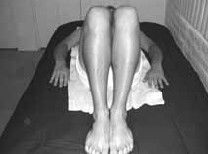
Figure 127
On the exhale let the legs flop open. On the inhale bring the legs slowly up to the center where they touch. The raising of the legs should occupy the whole of the inhale. That is, the legs start up at the beginning of the exhale and the legs are not fully up until the end of the exhale. The breathing rate here is a little slower than is the normal body work breathing. This is done so that the period of raising the legs during the inhale does not have to be rushed.
The left photograph in Figure 128 shows the legs flopped open. The right photograph shows them coming up during the inhale.

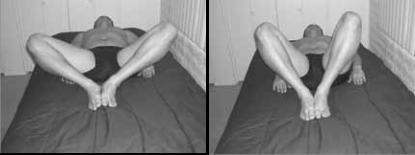
Figure 128
What is not apparent in the left photograph without my pointing it out is that this model shows significant character-based tension in his thigh adductors. An adductor muscle is one that draws parts of the body together. To close the legs, as in the right photograph, requires use of the thigh adductors. If our model's adductor muscles were not chronically tense, his legs would flop all the way open to rest on the bed instead of going only about half way down.
There are a host of errors in this exercise, all of which render it less effective.
First, errors in the breathing. Many people switch to a shallow breath when they do this exercise. The breath should be just as deep and just as rhythmic during this exercise as it was before the exercise started.
* * * *
Just to remind you of what was discussed in Part One of this book about rhythm, ideally the breath should be like a pendulum. The exhale brings on the inhale which brings on the exhale which brings on the inhale which.... Most people — in my experience all people — breathe as a two step process. First they inhale, pause ever so slightly, then exhale. You might recall from Part One that rhythmic breathing was the final goal of the breathing work. After learning to breathe belly-then-chest on inhale and exhale, and learning to fill the lungs fully both with the diaphragm (belly breathing) and the muscles between the ribs (the intercostal muscles), and learning to be able to breathe only with the chest or only with the belly, and learning to do the gasp inhale and gasp exhale breathing; then we went to learning rhythmic breathing.
* * * *
Next, still in breathing, some people change to a chest only breathing so that they can keep the abdomen tense as the legs open and close. The belly should not tense and the breathing should be full (belly then chest).
The most common error in raising the legs is that (a) either the legs are raised rapidly instead of slowly or (b) the first 1/2 to 3/4 of the raising is done rapidly and then the last 1/4 to 1/2 is done extra slowly to use up the inhale time.
The movement of the legs (from the open to the closed position, or from the down to the up position, you can look at it either way) is done during the whole of the inhale. Since the inhale during the exercise should not have changed from the pattern before starting the exercise (except that the complete breath cycle is a bit slower), then the legs should not be together before the inhale has finished. The effort at learning to get the leg movement coordinated with the breathing will pay off.
The other common error is to have a rapid leg movement during part of the inhale, then an extra slow movement to match to the breathing. It may be difficult for you, when you are working on this exercise, to feel the movement of your legs. It is OK to put a pillow under your head so that you can, while your head is lying against the pillow, see your leg movement and that it is moving at a constant speed.
It has not been my practice in this book to tell you about performance criteria for the exercises except to discuss common errors. Here I do want to mention a measurement criterion. With your feet together and your legs flopped open, your goal is to have your knee be against the bed. Don't get concerned if your knee is initially way up. The knee-against-the-bed is a goal not a requirement.
Continue to:


My Books

