


Chapter 14. The Tongue
Description
This section is from the book "Reichian Therapy. The Technique, for Home Use", by Jack Willis. Also available as a hardcopy from Amazon.com.
Chapter 14. The Tongue
Lick the ceiling
Lick the chin
Lick the nose
Tongue in directions
We have now reached the point where you should have made good progress on the breathing before you do the exercises here. Getting all the breathing down properly can take a very long time so I am not saying that you should have completed your breathing work before you try these and the following exercises, rather I am saying that you should have made some real progress on the breathing before you start doing these exercises.
As I have said disgustingly often, ALWAYS TOO SLOWLY. Trying to rush into advanced exercises before you have fully or mostly freed the chest, the diaphragm and the belly can result in regression instead of progress. Here is a way to tell if you are trying these exercises too soon.
I am talking here about the tongue, but these exercises have a major effect on the throat. Because of this connection, most people have great difficulty keeping the soft 'ah' sound when they do these tongue exercises.
Try it yourself. But don't get taken in by your subconscious's attempts to fake progress. If you find that you have to concentrate hard on the sound to keep it correct, then you are not ready yet for these exercises. Your breathing and the sound should by this time be fairly automatic such that they don't take any focus at all. So sticking out your tongue should not change that breathing and sound.
Even though I cautioned about the throat, in fact each of the exercises on the tongue in this exercise have different primary effects. I am not going to tell you what those different primary effects are since I don't want to lead you and, more important, I don't want to give your subconscious reasons and methods to defend against the different effects.
A note of caution on these exercises. Shortly we will look at "lick the chin" and "lick the nose." The ability of any person to accomplish much extension and bending of the tongue is very much a function of each person's mouth structure and genetics. As you know there is a little bit of tissue that connects the bottom of your tongue to the bottom of your mouth. In some people this tissue is short and thus the tongue can not be extended very far. Further the ability to bend the tongue to the chin or the nose is a result of your individual genetic muscle structure. Therefore just do your individual best and push as best you can but don't be concerned if you are not as good as the models and don't take it as some sign of progress if you are better than the models.
First, we will look at just sticking the tongue straight out in the lick the ceiling exercise.
Lick The Ceiling
This model does a good job of sticking out his tongue (licking the ceiling), but, as you'll see shortly, he is not as good at other parts of the tongue work.

Figure 88
There are three common errors in these exercises.
When the tongue is out, it is allowed to relax and not be fully extended. In each of the first three exercises make sure that you are constantly pushing your tongue out as far as possible. Do not let it relax back into your mouth. This is difficult for most people to feel. They can not feel that they have allowed their tongue to relax. If you have a VCR or DVD camera, you can set it up so that it photographs you while you do the exercises and then you can view it later (after the session) to see if you were letting your tongue relax back into your mouth. Don't stop the session to view the video. It is not a serious error if the tongue relaxes, it simply will not accomplish as much. So the proper procedure is to go on with the session and look at any video later. This error is shown in the right panel of Figure 89.

Figure 89
A second common error is that when the tongue is stuck out, the mouth is nearly closed so that the lower teeth are used to push or hold the tongue. This is especially true of the 'lick the nose' exercise. For all the tongue exercises, keep you mouth open as widely as possible. Here, again, you can use a video camera to record your performance and view it after the session.
In Figure 90 on page 222 you can see, left to right, how after doing the exercise for a few minutes the mouth closes.

Figure 90
The third mistake is that the sound changes. It is almost as if people think that there is some relationship of the tongue muscles to the vocal cords. There are none. It is another example of a fused muscle set. Try not to change the 'ah' sound on the exhale. There is a tendency to change the 'ah' sound from a soft easy sound to a hard guttural sound.
Lick The Nose
Stick your tongue straight out as far as possible and up as though to lick your nose. Hold it there for about five minutes. Remember to keep your mouth open. Note in this photograph that the model has closed his mouth and is using his lower teeth and lip in at attempt to push his tongue up to lick his nose. This is not correct, the mouth should stay fully open.
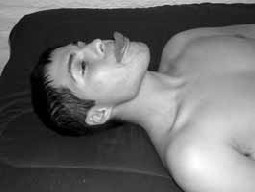
Figure 91
Lick The Chin
Stick your tongue out as far as possible and down as though to lick your chin. Hold it there for about five minutes. The breathing should not change from the normal rhythm and sound. Please, when doing these tongue exercise, remember that you are a student of the work. Don't assume that you will get it right at the start. All these exercises take learning and allowing the subconsciousness' image of your body time to change.
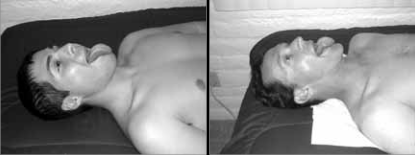
Figure 92
You might note in the above figure that the model on the left is better able to lick his chin than is the model on the right. This provides an example of how performance can differ from one exercise to the next. Recall in Figure 91 that the model on the left had to use his lower jaw to do the lick the nose exercise but here in lick the chin he is better at it than the model on the right.
Tongue In Directions
This exercise is like eyes in directions (Chapter 11, page 189) but with the tongue. For one full breath, inhale and exhale, the tongue is down to the chin. to the right, up to the nose, to the left. Remember to keep your mouth well open. The jaw should not move (to open or close) as the tongue is moved from one direction to another.
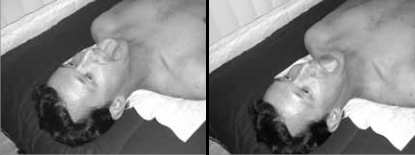

Figure 93
Postscript
The order of exercises which I present in Part Two of this book would probably not be followed by a therapist in an office practice. There are a host of reasons why, with any given patient, the therapist would properly deviate significantly from this order of exercises. As one example, I indicated that you should not do the tongue exercises before you have mastered the 'ah' sound. But the tongue exercises also aid in opening the throat. Thus a therapist might use the tongue exercises early in the work as a way to help open the patient's throat.
Dr. Regardie, my therapist, had one patient where, for reasons best left unsaid, he had to start the Reichian work on the patient's feet. He had to ignore all issues of breathing and 'ah' sound until, with pressure, he had made real progress on the patient's feet.
By a like token, there are cases where the legs are treated before the arms and shoulders.
I had a case where, from almost the first session, I had to use strong pressure on the back muscles again ignoring issues of breathing and exhale sounds (though not ignoring the forehead and eye work).
What I have presented in this book is the best general — not particularized to specific individuals — advice I could give.
Working in the order I have presented here may, at its worst, slow down the work but it should not present any serious problems.
Continue to:


My Books

