


Chapter 22. Working With A Helper
Description
This section is from the book "Reichian Therapy. The Technique, for Home Use", by Jack Willis. Also available as a hardcopy from Amazon.com.
Chapter 22. Working With A Helper
First a word about pressure. It is, on the whole, evident that males can take (and need) more pressure. Females can take (and need) less pressure.
The purpose of pressure is to force a muscle to yield some of its held tension. When pressure is applied sometimes the worker and the helper can feel the muscle loosen. In other cases there will be no noticeable change but the effect will still be there (remember that most of the change occurs in the dreams).
If a muscle is relaxed, then pressure feels only like pressure. If a muscle is tense, then pressure will produce pain.
Pain is not the objective, it is an unfortunate side effect. I strongly point out that the use of pressure is not an excuse for a disguised sadism.
Some theorists have held that all the work could be done with no pressure, it is only that it takes much longer to do its work if pressure is not used. I can not agree. The crucial area of the neck, if you use these muscle as accessory muscles of respiration, and the muscles of the back can not be corrected without the use of pressure. If you have to work without a helper to apply pressure, then you can but do what you can do without the pressure. You can, if you are able to, use self-pressure on the neck and then find a masseuse for pressure on the back, but other than that you will just have to settle for what you can do with all the rest of the work and just accept the limitations.
If the helper's finger nails are short, then often the thumbs can be used for the pressure. If the helper's finger nails will bite into the skin of the worker, then the use of the thumb is definitely counter-indicated. In the case of longer finger nails, then the knuckle of the first finger should be used.
I will in what follows, in examining each area of work, indicate where pressure can be used.
Here is a photograph showing how the knuckle can be braced with the thumb to make its use easier.

Figure 133
Here is a picture of the kind of device that may be purchased over the internet from message supply companies.

Figure 134
The next photograph is of the three pressure devices that I use in my practice. They look mean, but they are not. The three different sizes are labeled as to where on the body they are usually used. These devices are made from hardware-store purchased round wooden rods (dowel rod) and tips that, in the U.S., are called "crutch tips." They are used on the end of canes, crutches, or furniture to keep the furniture from marring what is beneath it.

Figure 135
The major benefit of these pressure devices is that they allow for much longer pressure to be applied before my thumbs or fingers start to hurt. The disadvantage is that you loose the feel of the muscle that your hand provides. Therefore in practice I use both hand pressure and device pressure.
There is another issue. I will indicate in this chapter how the helper can tell the worker whether he (she) is or is not doing the exercise properly. However, this is not and should not be treated as permission to or an excuse to nag or criticize. Let's take the eyes open and close exercise for the forehead. The helper might notice after just a few minutes that the forehead is no longer being wrinkled during the eyes open phase. At that point a single statement "wrinkle the forehead on the inhale" is sufficient. If the worker again stops wrinkling the forehead after just a few more inhales, that means that the person is not able to do more at that time. Nothing is accomplished except implied criticism and demeaning the worker to point out again and again that the worker is not able to wrinkle the forehead for any extended series of inhales. The helper should simply let the exercise continue being done wrong and keep his (her) mouth shut unless the worker asks whether it is being done correctly.
The same applies to the sound (except here more mentions of the issue can be made, but not to the point of criticism or belittling). If the worker appears to be trying, that is enough. On the whole it is better to let a mistake continue than it is to treat the session as a way for the helper to psychologically beat up the worker.
Finally, I also present here some exercises that can be done only with a helper. These new exercises will be noted as new and set off with the symbols I have used through out the books.
The Forehead
tonic eyes open tonic eyes closed
The helper can be of use in two ways. One is to call the worker's attention to the fact that the forehead is not wrinkling or that the eyes are only closed but not pressed tightly closed.
The second help is with pressure. There are several ways to apply pressure. They are shown in the following figure.
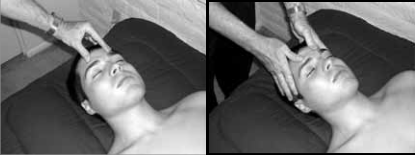
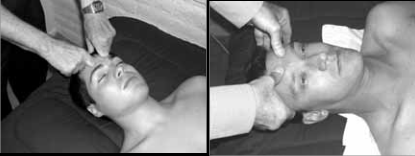
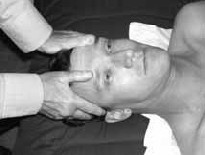
Figure 136
In the first two photos the fingers are moved back and forth across the forehead while pressing. If the helper's finger nails prevent this type of pressure then photo three shows using the knuckle of the first finger as an alternate. The final shots shows other ways to use thumb pressure. Pressure in all cases, here and later, should be applied to the level of the worker's tolerance. That is, use as much pressure as the worker is willing to tolerate. Start light and get stronger until the worker objects. To both males and females I add the same injunction: the more pressure you can tolerate, the better. That does not mean that the worker should be masochistic and treat the sessions as some kind of pain-endurance contest. Different muscles have different thickness and can tolerate more or less pain. Also there are major differences in the amount of tension that a muscle can hold and thus differences in the amount of pain produced with pressure. As an example, the muscles of the forehead are very thin and can not hold that much tension, thus they can usually (but not always) take more pressure. By contrast the muscles of the calf are very thick and dense. Pressure there is much more painful.
The Eyes
eyes open and close
The helper can point out if the open and close is not fully open or not fully closed or if the pattern diverges from the open on inhale, close on exhale. The remark should not be made no more than about two times. If the worker can not do better, then he (she) is doing the best he (she) can do at this time so further correction is simply criticism.
Since many people when they start this eye work soon tire and lose the ability to wrinkle the forehead or tightly close the eyes, the helper can tell the worker if it appears time to switch exercises. It is not bad practice in this exercise, or in fact with any exercise, that when performance falls off the exercise is stopped; normal Reichian breathing is done for 10 or 15 minutes; then the exercise is restarted for a second trial.
eyes in directions
All the helper needs to do here is watch that (1) the eyes go to the extreme end of all four direction (down, left, up, right); (2) that the eyes are not brought back to the center; (3) that the pattern is not lost. If there are any errors simply point it out once. The worker is doing the best he (she) can. No help is provided by frequent corrections.
roll the eyes
No corrections by the helper are needed here. Roll the eyes is difficult at first and it may take many sessions before the worker can do it properly and continuously (for 10 minutes). The helper can note if, in the roll, the eyes are not hitting the extreme angles. Then one statement to the worker can be made.
express feeling in the eyes
Here the helper can lean over the worker so that the worker has someone to focus the feeling on.
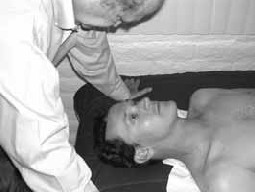
Figure 137
The helper's role here can be tricky. Without going into the psychology of this, suffice it to say that the helper, in the worker's eyes, becomes the parent (of the same sex) standing over the worker/child. That means that often emotions that one had as a child relative to that parent are facilitated by the helper standing over the worker as I am doing in Figure 137. That alone can be both a significant contribution and an impediment.
As a contribution it aids the worker in re-creating those childhood emotions. As an impediment, the worker may be unwilling to deal with strong childhood emotions while they are seemingly directed to the helper.
This requires trust on the part of both worker and helper. The worker has to trust that the helper will not be injured by the expression of strong recreated childhood emotions and the helper has to trust that the emotions of the worker are recreations of childhood and not take the emotions as meaning anything in the present.
As the worker expresses or attempts to express one emotion after another in the eyes (see the list on page 193), the helper can attempt to guess the emotion by the look in the eyes.
Also, as a variant of this exercise, the helper can request particular emotions from the list on page 193 or the helper can add other suggested emotions.
bug eyes, skull eyes
No helper action needed.
Pressure
There is an area of pressure which can profitably be employed with the forehead exercises, the face exercises and the jaw exercises. This is shown in Figure 138. The hand on the forehead is only to brace the head. The pressure is applied to either of two places.
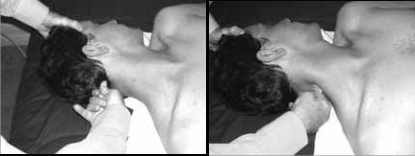
Figure 138
One is the muscles at the base of the skull. Place your fingers at the back of the head and move downward to where there is a drop at the base of the skull. There are a series of muscles here from the middle of the neck all the way to the side of the neck.
The other is in the middle of the neck as shown in the figure.
There is only one significant muscle here (the trapezius) but it can take a lot of pressure and generally feels good rather than painful.
Footnote 36. None of these muscles was mentioned when I was discussing the anatomy of the neck. In that discussion we were concerned with the accessory muscles of respiration. The many muscles which are at the base of the skull need not be named. It is sufficient to know that pressure all along the base of the skull is useful to this work.
Continue to:


My Books

