


The Cold-Blast Valve
Description
This section is from the "Blast Furnace Construction In America" book, by J. E. Johnson, Jr.. Also see Amazon: Blast Furnace Construction In America.
The Cold-Blast Valve
A standard design for this valve has gradually been evolved, and while the individual valves used by different stove builders differ in details, the general principle of all is the same. They are all flat slide valves designed to withstand pressure from one direction only, since this is all that is necessary for this service, and are always operated by a hand-wheel and pinion.
Figs. 150 and 151 show the design of the cold-blast valve used by Frank C. Roberts & Co. Its construction and operation are obvious from the drawings. There is one point, however, which might escape the casual observer and is therefore worthy of mention. The rack on which the pinion works to operate the valve is not rigidly attached to the latter, but is free to slide between the guides shown in Fig. 151 within the limits set by the stops, these come against the guides and through them move the valve proper. The end of the rack is widened out to a T-shape and this covers a slot through the main valve. When the valve is to be opened to put the stove on blast the unbalanced pressure on it is very great, and if the stove tender succeeded in opening it in spite of the friction produced by this pressure, the rush of air into the stove might be so rapid as to do damage.
With the arrangement shown the first movement of the pinion slides the rack proper on the back of the main valve and thus uncovers the port in the latter; through this the air flows until in about a minute the pressure within the stove is the same as that in the blast main; this relieves the friction on the valve, which can then be moved back into the valve housing without further difficulty.
Fig. 150. Roberts cold-blast valve.

Fig. 151. Roberts cold-blast valve.
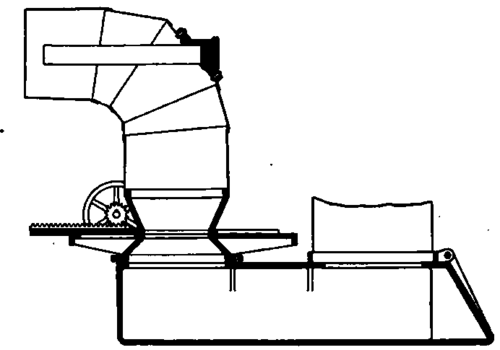
Fig. 152. Spearman Burner.
Stove Burners
Only one type of stove burner is in extensive use, known, from its inventor, as the Spearman burner.
An excellent design of this by the Wm. B. Pollock Co. of Youngs-town is shown by Fig. 152. The gooseneck rests on a slide supported on a hollow base which serves as a gas inlet. When the gooseneck is in the position shown, the opening in its base corresponds with that in the slide and its end projects inside the burner opening in the stove so that the gas enters and burns with the air which is drawn in around the gooseneck and also through the small pipe in the center. The purpose of the latter is to give more intimate mixture of air and gas, thus giving better combustion.
When the gooseneck is withdrawn its slide closes the opening in the base and the opening in the stove is closed by a cap or door in exactly the same way as the chimney valve opening is closed in the Stenbakken design. (See Fig. 159 on p. 221).
Much attention is being paid to stove burners at the present time with a view to securing more perfect combustion by better mixture of the air and gas. Mr. A. J. Boynton, superintendent of the Lorain furnaces of the U. S. Steel Corporation, has put in use an excellent burner which is a decided departure from standard practice. The burner consists of a square casting with a round projecting nose which fits close against the seat ring in the burner opening. This casting is mounted on small wheels so that it can easily be withdrawn to permit closing the burner-opening in the regular way. The gas enters at the rear and passes through a number of flat passages cored through the casting. The spaces between these passageways are about the same size as the passages and open at the sides, these multiple side openings being under the control of a slide on each side so operated as to give the same opening at each air port and to vary the amount from nothing to full opening.
The gas is controlled by an independent bell valve in the supply pipe. This gives complete independent control of both air and gas supply and intimate mixture of air and gas at the nose of the burner.
Later developments of burners are described in the chapter on "Combustion of the Gas".
Continue to:


My Books

