


Too Much Coil For Heating The Boiler
Description
This section is from the book "American Plumbing Practice", by The Engineering Record. Also available from Amazon: Plumbing: A working manual of American plumbing practice.
Too Much Coil For Heating The Boiler
C. S , Freeport, writes:
"Enclosed you will find a sketch of a hot and cold job which gives me trouble, and as I am a subscriber to your paper, I would like you to inform me what the trouble is.
"The boiler is regulation make, and the hot-water pipe is above the cold, and has a rise all the way from cold-water pipe in the bottom of the boiler, and has no trap at all in it; but the coil lies on a level, and each pipe of 10 is 10 feet long. The water heats part of the time and gets the hottest in the cold water clear to the boiler, and when you draw water at the hopper it hammers and draws tepid water from the boiler to the hopper. It also makes noise when you draw at the sink. The boiler and hopper are in the basement. The sinks are on the next floor. I mark with arrows the direction the water takes. Please enlighten me."
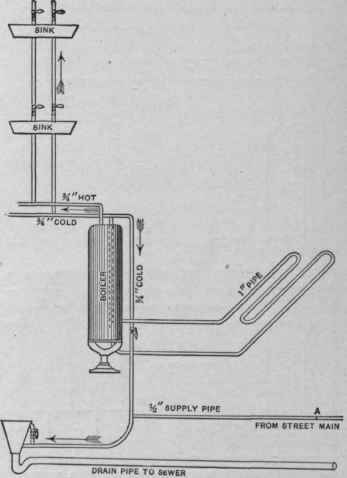
[If we understand you rightly there is ico feet of 1-inch pipe in the coil and the coil is practically level. If this length of pipe is exposed to the heat of an ordinary fire, it is too much for a boiler of the size you mention, and in any case 100 feet of pipe connected continuously with return bends or couplings cannot make a good heater. To understand this, imagine the cold water flowing into the first few feet of coil - say it enters at 8o° Fahr. - and that before it has traveled 10 feet it has a temperature of 212 degrees or higher. What then can be gained by passing it through a longer coil? Why, nothing - at least for the purposes under consideration; and if we consider what the effect of a considerable length of coil beyond the point at which steam forms will be, we are forced to the conclusion there will be a repulsion and a tendency to drive the water out of the coil at both ends. If the coil is on its edge and not too long, with a good rise in the intended direction of the floor, it may find all its vent upward and be a "good water-back." If it is flat, level, and very long, it is as likely to react into the bottom of the "boiler" as to go forward, and it will be only a short time until the coil will burn out near the middle of its length.
The tepid water at the hopper or at the first sink is accounted for by the smallness of diameter of the supply pipe, or a partial stoppage within it, or both. There is sufficient pressure in the street to send the water to the highest faucet in the house when no water is being drawn elsewhere in the house. The pipes, then (both hot and cold), above the level of the boiler are small reservoirs. When the hopper is flushed the pressure in the supply pipe A is lessened, and it has then not sufficient pressure to hold the water on the upper ends of the lines of pipes, and this water must flow backward, all in the hot-water pipe going into the boiler and forcing an equal amount out through the boiler inlet (cold pipe), while the water in the cold line simply runs down the line for some distance and meets the hot water coming out of the boiler through the inlet pipe. This mixture (warm) must then pass down the cold pipe, as there is no other way for it to get out, and passes to the hopper warm or tepid. This of course cannot last long, unless it is a steam pressure from the boiler that is forcing its way down the cold pipe. The noise when water is drawn at the sink would indicate the formation of steam.]
Continue to:


My Books

