


Tools Used In Plumbing. Part 3
Description
This section is from the book "A Working Manual Of American Plumbing Practice", by William Beall Gray, Charles B. Ball. Also available from Amazon: Plumbing.
Tools Used In Plumbing. Part 3
Other forms of pipe-cutters, with solid back and one wheel, or one wheel and two rollers, are made, the latter rolling the stock inward and making the burr so heavy that it should be reamed out. The wheel and roller cutters are used more than any other. They will cut true longer by retrograde motion.
In connection with cutting iron pipe, some reference should be made to pipe-threading dies, of which there are many makes, not all worthy of use. It is generally admitted that careless and incompetent handling and the general abuse to which pipe dies are subjected by the general run of pipe fitters, are largely responsible for the poor work turned out and the generally discouraging service obtained from such tools. But with mild-steel pipe, which does not run at all uniform in hardness, and which is more unsatisfactory in every way to work than is the genuine wrought-iron pipe, it is necessary to employ good and well-designed, dies in order to avoid extra labor and expense and to produce creditable results in thread-cutting. The rake and form of the die must be suitable to the kind of material to be cut; and it is economy to purchase modern dies designed with this point in view, and then to give them the same treatment that would be gladly accorded fine machinery of any other type.
Fig. 227 is a hinged pipe-vise. The upper jaw and frame are reversible so that the vise can be thrown open or closed to the right or left as required. The vise has a gravity pawl A, which drops into place automatically. A clutch at either side will engage the pawl when the vise is fastened to either the right or the left side of a post. A very desirable feature of the hinged vise is that pipe having fittings which will not pass through the frame at all can be quickly put in or taken out with no undue opening or closing of the screw, by simply lifting the pawl and swinging the vise back on the hinge.

Fig. 227. Hinged Pipe-Vise..
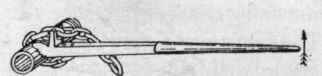
Fig. 228. Chain-Tongs..
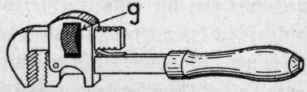
Fig. 229. Pipe Wrench for Small Work..
Fig. 228 represents a pair of old-fashioned chain-tongs, which may be used on any size of pipe the chain will reach around. There are other types, with double jaws, with chain hinged in center, which can be used either way, and which are more convenient.
Pipe wrenches are used for small sizes. Steel-handle wrenches are coming into use on large sizes. Fig. 229 shows a pipe wrench with wood handle, for small work. The jaw is opened or closed by rotating the knurled thumb-nut g.
Fig. 230 illustrates a plumber's gasoline furnace, adapted to heating solder pots and copper bolts. The gasoline supply for the blast passes through A A, and is provided with valve H and clean-out plug J. The lower end of the supply extends nearly to the bottom of the reservoir. The gasoline passes through coil E, which is partially filled with wire, usually a scrap of small wire cable, to prevent flame from running back into the reservoir, and issues from a single small hole at F, which is turned so that the flame will impinge on the coil. Air-pressure on top of the gasoline in the reservoir is necessary to make a blast. The air-cock is shown at G. For ordinary purposes, sufficient pressure can be obtained by blowing air in the hose at C with the lungs; but for a strong blast, a bulb containing check-valves, shown at D, is used to increase the pressure. The filling screw is at B.
To light the furnace, valve H is opened and some of the gasoline allowed to play on the coil, from which it falls back into the bottom of cup K. When about two tablespoonfuls have reached the cup, close H, and light the gasoline through one of the holes in K. When it has burned out, the coil will be hot enough to vaporize the gasoline as it passes through it; and a gas instead of a liquid then issues from F in the form of a blast, which increases in intensity as E becomes hotter. Any tendency to produce more gas than necessary merely increases the pressure and the force of the blast. The strength of the blast can be regulated by valve H. As the air is forced into the reservoir above the gasoline, one pumping keeps the furnace in working order until the lowering of the gasoline level has provided so much room that the pressure of the expanded air is not sufficient to maintain the blast. Then it becomes necessary to pump in more air, or to replenish the gasoline and again establish the pressure over it as described.

Fig. 230. Plumber's Gasoline Furnace..
Fig. 231 is a blast torch used by plumbers for warming large joints, melting off old joints, heating soil-pipe hubs, thawing frozen water-pipe, etc. The principle of operation is the same as that of the furnace. A is a hand-pump for establishing the air-pressure; B, the air-pipe; and C, the air-cock connecting the pump to the top of the reservoir G. D is the filling screw, and H the supply valve to burner. The gas issues from a single orifice within the hood F. E is a gasoline cup used to heat the burner in order to start the blast, and corresponds to cup K of the furnace.
The thawing steamer, Fig. 232, is made of heavy copper and adapted to fit the bowl of a plumber's blast furnace. A is the safety-valve, D the reservoir, and B the valve connecting with the steam space. For use, the reservoir is filled about three-quarters full of water, and heated to steaming point. The steam is conveyed through a hose C, and injected into the end of the frozen pipe. As the ice melts and the water flows out, the hose is pushed further and further into the pipe, until the ice is all melted out of the frozen portion. This is an admirable way to thaw water-pipe frozen underground, within partition walls, and in other inaccessible places.
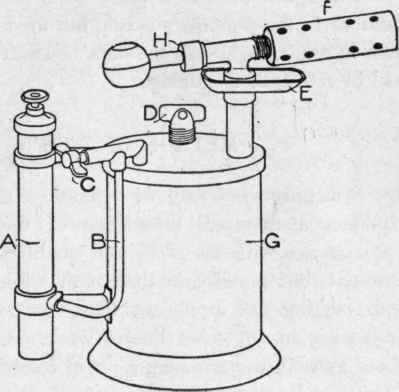
Fig. 231. Plumber's Blast Torch..
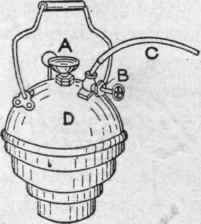
Pig. 232. Thawing Steamer..
There are numerous other tools used by the trade, not only peculiar to the plumber's needs, but used also in common by workmen in other lines. All the data necessary concerning them can be had by reference to catalogues.
Continue to:


My Books

