


Traps. Part 2
Description
This section is from the book "A Working Manual Of American Plumbing Practice", by William Beall Gray, Charles B. Ball. Also available from Amazon: Plumbing.
Traps. Part 2
Kinds of Traps. The kinds of fixture traps are innumerable. They can be divided into two general classes - those that seal with water only, and those that have a mechanical seal as an adjunct to that of the water. These may be again divided into plain and anti-siphoning- classes.
The trap having no concealed partitions and with all its walls exposed to view, is best. If. the water leaks through the wall, its defectiveness is evident, and the annoyance from the leak suggests repairing.
Of the simple water-seal fixture traps, the open-walled drawn lead is used for ordinary work. It can be had with equal-length arms or with extended inlet or outlet, so as to reach from fixture to floor or wall without a piece of intermediate pipe. The form shown by full lines in Fig. 200 represents a full "S" pattern. When the ends are bent as per dotted lines A and C, the trap is called a running trap; when the ends are at D and C, it is said to be a half-S or P trap; when the ends are set as at D and E, it is called a 3/4-S trap. F is a clean-out screw for emptying and cleansing. The distance represented by X should, in a trap for ordinary purposes, be 1/2 to 2 inches, according to size. Frequently this distance, which constitutes the water-lock, is much reduced; and sometimes the trap is unsealed by the plumber stretching its bends in order to reach some faulty roughing-in.
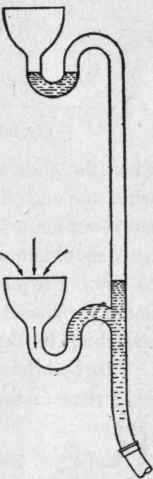
Fig. 199. Two Un-vented Fixtures Connected to SameWaste Pipe, Causing Self-Siphonage..
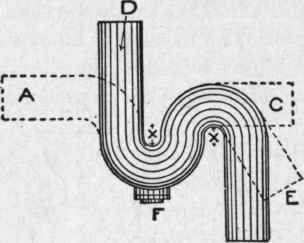
Fig. 200. "S"-Pattern Trap..

Fig. 201. A Bag Trap..
In buildings where the plumbing may be left unused for weeks from time to time, as is likely in rented houses, deep-seal traps, or those with mechanical seals also, should be used. This point is not so important in detached houses or those rented to one family only at a time, since, when a family moves out, there is no one to suffer. But in flat buildings, where some of the flats may be vacant for a time sufficient for an ordinary seal to be broken while other families are living in the house, deep-seal traps are more essential.
Fig. 201 shows what is termed a bag trap, made to bring the inlet and outlet in the same vertical line. These traps are inter-clvangeable with any others with straight-line outlet - for instance, as shown in Fig. 204.
An open-wall trap partly cast and partly tubing, generally made of brass, is shown in Fig. 202, the vent connection to wall being at A. This form of trap generally has a swivel-joint at B, which is below the water line, so that the body may be swiveled to meet roughing-in openings in any direction within two diameters of the line of fixture outlet. The bag form shown is most convenient for D-shape or standing waste bowls which present the outlet comparatively near the wall. The regular "S" of this type suits bowls with center outlet, and will reach a wider range of variation in roughing-in.

Fig. 202. Open-Wall Trap. Partly Cast..
Fig. 203 shows a common lead drum or pot trap, most convenient to the plumber. It is furnished without openings, and the plumber makes bends, and wipes-in his inlet and outlet at points in the circumference most convenient to reach the fixture opening. A is the screw-top clean-out; and B, the wrench-face for turning it. The trap is furnished, when desired, with nickel-plated brass flanged cover, as shown at C, to screw on at the floor-level. F is ordinarily the outlet, the inlet being wiped-in near the bottom to give it the water-lock. This is not proper, however, as it puts the sewer air against the clean-out cover, which might leak gases into the building without betraying any evidence of its defectiveness by water leakage. To be strictly correct, F should be the inlet; and the outlet, in the shape of an offset, or that of an inverted P-trap without the trap-screw, should be wiped-in near the bottom in a way to retain the proper seal and thus bring the sewer air against the water-seal instead of the clean-out cover.
Traps that retain their seals by means of interior weirs are of doubtful character, even at their best; none but well-tested cast-brass traps of such a pattern should ever be installed. Fig. 204 is a section of a flask or Atlas trap, with vent, usually made of cast brass and depending upon two interior weirs to form the seal, one retaining the water, and the other dipping into the water to prevent sewer air from getting into the house through the fixture. If the water weir of such a trap becomes defective, there is no evidence except odors by which the occupants may discover it. If the dipping weir is defective the value of the water seal is nil. In either case the trap is no barrier to the admission of drain air to the house.

Fig. 203. Common Lead Drum or Pot Trap..
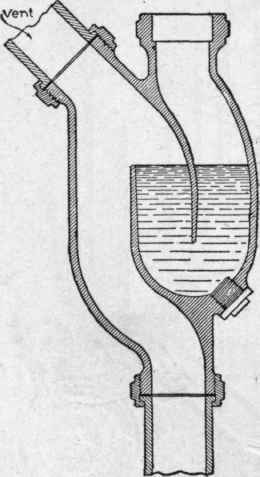
Fig. 204. Section of Flask or Atlas Trap with Two Interior Weirs..
Fig. 205 illustrates a form of trap suitable for use with baths. It has a submerged inlet connection which is expanded so that the flow enters the trap at a dipping angle which produces a swirl with cleansing effect. The extension collar A is made so that the screw-cover B forms the gasket joint below the water-level. The method of providing the outlet in this trap makes it open to the same objection raised in connection with Fig. 203. This form, however, has the merit of being accessible for inspection without disturbing its service, which is impossible with the flask pattern shown in Fig. 204.
Continue to:


My Books

