


Chapter VI. Plumbing Laws
Description
This section is from the book "Improved Plumbing Appliances", by J. Pickering Putnam. Also available from Amazon: Improved Plumbing Appliances.
Chapter VI. Plumbing Laws
NOW that the good custom of enacting City Plumbing Regulations is rapidly spreading throughout the country, it is, of course, important that those who make these laws should be thoroughly familiar with the first principles of the science of plumbing, and keep themselves well informed in its progress.
In most of the provisions of our plumbing codes, authorities are in accord, and no question as to their propriety can arise. But there are, on the other hand, a few points in dispute, and of these, that which relates to the venting of traps is one of the most if not the most important of all, for it influences the entire plumbing system, and affects, more than any other one thing, the cost and safety of the work.
Those who assume the great responsibility of compelling the public to vent every trap, should evidently know, first, what trap venting is for, and second, whether or not it is able to accomplish its purpose. This implies a very thorough knowledge of the hydraulics, pneumatics and chemistry of plumbing, and of their practical application in this particular direction. An examination of the origin of the plumbing laws enacted in this country will show that their framers have not possessed this necessary knowledge, and they might argue as an excuse for this that the leading writers and generally accepted authorities in sanitary plumbing vitally differ on this point. Some claim that the chief object of the vent-pipe is to prevent siphonage; others that its only purpose is to aerate the branch waste-pipes; and others still that it serves only to give employment to plumbers. Evidently such conflicting opinions could not all of them have been based on a serious and exhaustive scientific and practical investigation of the whole subject.
They have, as a fact, been founded on very meagre and insufficient data. The same may be said of expressions of opinion as to the reliability and practical working of the vent-pipe. To justify positive statements on this subject requires a still more elaborate and extensive experimental research, and in default of the facilities for conducting these independently, the law maker is bound to study carefully, critically and impartially those which have been made by others.
The trap tests at Worcester are the latest recorded experiments on siphonage, but they have been very incorrectly reported.
Inasmuch as we can hardly expect our busy legislators to devote the necessary time and money to original research in this very difficult and extensive held, it is evidently important that the work of others, which must then form their only source of information, should be presented to them in such a manner as to avoid any possibility of misunderstanding.
All that is necessary for us at present to determine from experiments on trap siphonage is the comparative power of resistance of different systems to siphonage such as is liable to occur in ordinary plumbing practice. It will be extremely useful to learn the positive power under all possible circumstances which could be encountered in good plumbing, but, for our present purposes, it is sufficient to determine whether or not the system now permissible under our trap vent laws affords as great a power of resistence as that which is forbidden by them. The law permits of the use of an ordinary S or siphon trap vented, but forbids the use of any form of trap without the vent.
Without entering, for the moment, into the question of the increased complexity, danger and expense entailed by the trap vent system, nor into that of the comparative chances of clogging of the trap and the vent-pipe, we shall here consider only this single point, namely, the comparative power of resistance to siphonage of the ventilated S-trap and of other forms of traps unvented in good plumbing, since to determine this has been the avowed object of the Worcester tests as well as of those made by the writer.
The tests on siphonage which were made for the Boston City Board of Health, in 1884, and published in the various plumbing and Sanitary papers, showed that several forms of traps, evented, including the common pot or round trap, were capable of resisting a very much more powerful siphoning action than the ventilated S-trap, which lost its seal when vented, as required by the law, in the most advantageous manner, with a short and straight pipe, under siphonage produced in the use of ordinary plumbing. The same siphonage successively repeated proved incapable of destroying the seal of an ordinary pot-trap and of other forms of traps designed to resist siphonage without venting.
The publication of these results produced very general comment. Doubt was expressed as to the reliability of the tests, and they were accordingly repeated in the presence and to the satisfaction of the most incredulous.
The subject was taken up by the technical journals, and attemps were made to throw discredit upon the experiments, partly because among the traps tested was one of the writer's own design, invented during and after these researches. In order to satisfy the critics, and to throw still further light upon the subject, the writer caused an elaborate piece of apparatus to be erected at the Massachusetts Institute of Technology of a kind different from that used in the previous tests, but still like them, representative of the piping used in ordinary house plumbing, and produced in the presence of the Suffolk District Medical Society, the Boston Society of Architects, and the Boston Master Plumbers, precisely the same results as had been done before the Board of Health. The apparatus was. left standing for several weeks and the experiments were several times re-repeated by invitation before different audiences. The results obtained were published in the Boston Medical and Surgical Journal; in several of the sanitary and technical papers; in the London Sanitary Record, and finally in book-form by Messrs. Ticknor & Co., under the title "Lectures on the Principles of House Drainage." About a year afterwards the writer accepted an invitation to repeat the tests at Worcester under the auspices of the Worcester Natural History
Society, and he was liberally aided in the task by one of the leading Worcester plumbers, who contributed the apparatus and erected it very largely at his own expense. The apparatus was totally different from that hitherto used, but the results were the same. The vented S-trap lost its seal instantly by tests which left the seal of an unvented pot and other anti-siphon traps unbroken. The writer again published these results, and established beyond any question that the complicated system required by the trap-vent law was far less effective in resisting siphonage than the simple one which the law prohibited.
A few days after the writer's experiments and lecture at Worcester, some of the plumbers of that city made some opposition public experiments on siphonage, and published a report worded in such a manner as to give an incautious reader the impression that the writer's statements were by their tests contradicted, whereas a careful study of the report showed directly the reverse, and that his statements were fully corroborated by these tests. Their official report reads as follows: "A 1 1/4-inch S-trap was next tested. With the vent-pipe open the seal of this trap was not disturbed even after three discharges in quick succession from the tank. But with the vent-pipe closed, the first discharge emptied the trap." This was all the "official" report said about the S-trap. The sanitary and plumbing journals spread this report all over the country, and the writer's previous statements were, in consequence of it, discredited, and some of his experiments ridiculed by persons who had not looked carefully into the matter. State boards of health and sanitary engineers were referred to the "Worcester tests" to show the great siphonage resisting power of a vented S-trap and the wisdom of the trap vent law.
Even so learned a writer as James C. Bayles, the editor of the Metal Worker, was completely deceived by this report, and, in his paper on Sanitary Codes, read before the New Jersey State Sanitary Association (see the Metal Worker for December 19th, 1885), he says: " It is also well to remember that the Worcester tests, the latest and most trustworthy series of trap experiments, show that a properly vented
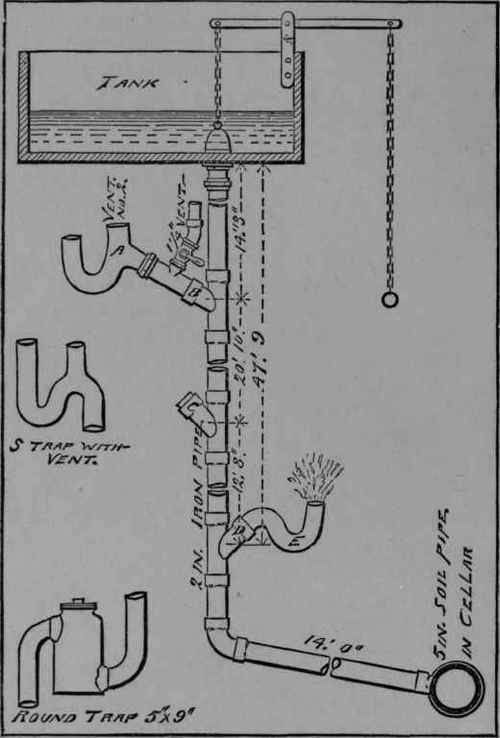
S-trap A had a vent as marked Vent No. a; all other traps were ventilated by the stop-cock attached to Y-branch B, where all traps were tested.
With Vent No. 2 open and stop-cock closed, it was not possible to remove anyr water from the S-trap, but with Vent .No. 2 closed and stop-cock open, the seal of the trap was broken. S-trap with vent shows the form of trap which the committee recommends.
Trap E was placed on Y-branch D to show back pressure, but Y-branch D, as well as Y branch C, was closed during experiments on syphonage.
Fig. 25.
Cut and fine print in the Chairman's Report. From The Sanitary Engineer.
S-trap is safe against the loss of seal by siphonage, even under conditions ingeniously devised to create a vacuum such as is never found in plumbing practice."
Now, the fact of the case is, that the vented S-trap instantly lost its seal under a single discharge from the tank, and by consulting the full {unofficial) report of the Chairman of the Committee of Plumbers who made the Worcester tests (see the Sanitary Engineer for September 10th, 1885), this will be seen.
The fact is stated in fine print, under the cut of the apparatus which accompanied the Chairman's report (Fig. 25). In the "official" report the very important fact that no vent-pipe at all was used on the S-trap, when it was described as holding its seal, was omitted. In other words, this trap was not "vented" at all, but simply had a large hole in its crown, a condition of things evidently impossible in plumbing. All the other traps had a 1 1/4-inch vent-pipe ten feet long attached to the opening in their outlet pipes. It is the friction of the air against the sides of the vent-pipe which deprives it of the power of protecting the trap against siphonage.
Thus, in the Worcester tests, it was shown that a fully vented S-trap lost its seal in a single discharge, whereas more than one form of unvented anti-siphon trap retained its seal under frequent repetitions of the ordeal.
As soon as the reports of the Worcester tests began to appear in the sanitary papers, the writer at once endeavored to correct the erroneous impression produced by them, but did not entirely succeed, and it is gratifying to see in the San-itary Engineer of April 22d, 1886, an article in which the attention of the public is called to the truth in this matter.
Continue to:


My Books

