


Chapter XII. Piping And General Arrangement Of Plumbing Work
Description
This section is from the book "Improved Plumbing Appliances", by J. Pickering Putnam. Also available from Amazon: Improved Plumbing Appliances.
Chapter XII. Piping And General Arrangement Of Plumbing Work
THE discovery, success, and recent construction of machinery for the extensive introduction of the Bower-Barff process for protecting iron from rust seems to have removed the only serious objection to the use of wrought-iron for waste-pipes, and we can no longer hesitate to recommend it for the purpose. By its use the piping of a house may be made absolutely reliable, and, where it is used with the plumbing fixtures hereinbefore described, set in the manner directed, and where the public sewers are properly constructed, flushed and ventilated, complete safety in house plumbing may be attained.
Wrought-iron pipe is tough, smooth, elastic, strong, and no more costly than well-jointed cast-iron. Its thickness is uniform and its jointing compact, comely, and entirely and permanently reliable. Although any good steam-fitter's pipe may be used, it is, nevertheless, much better to use piping and fittings especially prepared for plumbing purposes. A superior kind of pipe is now made by the Durham House Drainage Company, of New York, who have done the public a very great service in providing a perfect and complete system of wrought-iron plumbing pipe, including elbows, fittings, and apparatus for putting them together, scientifically designed to meet every want of the plumber. The work may be put in by the manufacturers themselves, or by any good plumber, to whom, we understand, the manufacturers are ready to afford every facility and assistance.
Figs. 81 and 82 show the difference between the Durham and the ordinary steam-fitter's joint, the former being made with flush interior surfaces and the latter with depressions
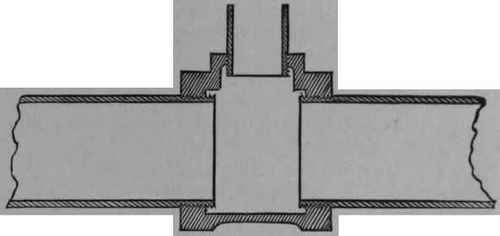
Fig. 81. - Ordinary Steam-fitter's Joint.
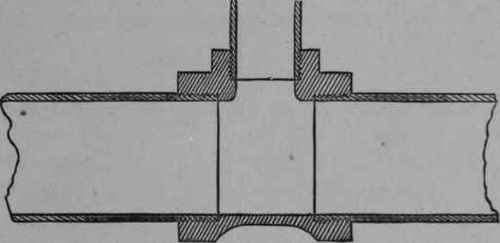
Fig. 82. - Durham Pipe Joint.
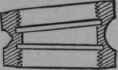
Fig. 83. - 5 5/8° Elbow.
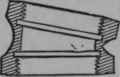
Fig. 84. - 11 1/4° Elbow.
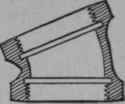
Fig. 85. - 22 1/2° Elbow.
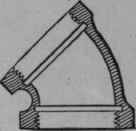
Fig. 86. - 45° Elbow.
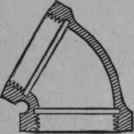
Fig. 87. - 60° Elbow.
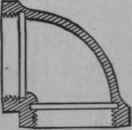
Fig. 88. - 90° Elbow.
which leave lodging places for small accumulations of sewage. The threads are tapering, to permit of absolute tightness. The further the pipe enters the fitting the lighter becomes the joint between the two. The joint is made up with red lead and oil, by means of steam-fitters' chain tongs, requiring no skill, so that any ordinary journeyman plumber can do the work and do it thoroughly.
Figs. 89 to 92, inclusive, illustrate the appearance of the Durham pipe both detached and put together.
The difficulty of cutting this pipe for repairs or alterations has now shown itself to be less of a drawback than has generally been supposed. With the cutting tools used by the Durham Company this can no longer be considered a serious objection to its use, it having been found possible to insert a new fitting anywhere in a stack of such pipe at a cost as low if not lower than it can be done with ordinary bell and spigot cast-iron piping, and without the least danger to the adjoining work.
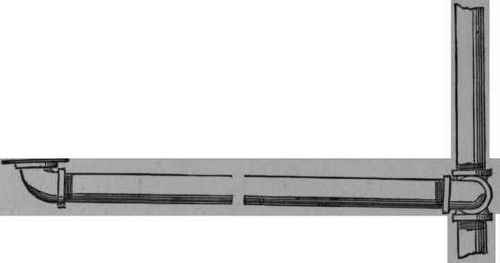
Fig. 89. - Durham Arm for supporting a Water-closet.
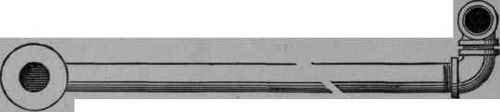
Fig. 90. - Plan of same.
Continue to:


My Books

