


Chapter XI. Simplicity Versus Complication
Description
This section is from the book "Improved Plumbing Appliances", by J. Pickering Putnam. Also available from Amazon: Improved Plumbing Appliances.
Chapter XI. Simplicity Versus Complication
IN the fifth chapter of this series, writing of the tendency which now prevails to over-complicate plumbing work, we drew illustrations from the well-known and handsome New York residences of Cornelius Vanderbilt and of Governor Tilden. We selected parts of the work in each (Figs. 21 and 22), which had been described in the Sanitary Engineer as masterpieces of the plumbers' art, and ventured the remark that a far safer and better result could have been attained by simpler means, as would be shown by a subsequent chapter.
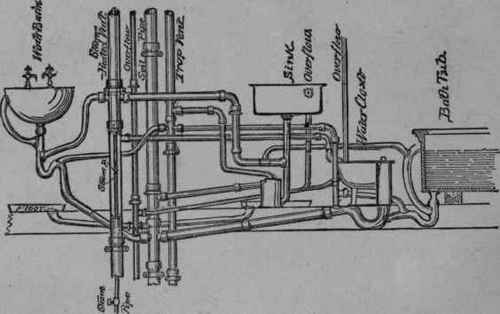
Fig. 79. - Complexity with Insecurity.
The Figures referred to and Fig. 79 are typical of the manner in which the most costly houses in New York are now being plumbed. They are not imaginary or exaggerated examples, but are taken from the best houses, and are cases which have been cited in the sanitary periodicals as models for imitation, and as correct interpretations of the present New York city plumbing laws.
In Fig. 79 we have substituted a sink for what was in reality a urinal, and we have brought together in a single group fixtures which really existed in two separate groups, for the purpose of drawing attention more forcibly to the great quantity of piping used, though by so doing we have really shown less pipes than actually existed. In this figure only the waste-pipes are shown. If we had added also the supply-pipes, the effect would have been so complicated that we should have hardly expected a reader unfamiliar with the details of modern plumbing work to accept our representations as a fair type.
Fig. 80 shows our simpler method of obtaining the same plumbing conveniences. Let us briefly examine the two in the light of what has preceded in these articles, and see which is the safest and best.
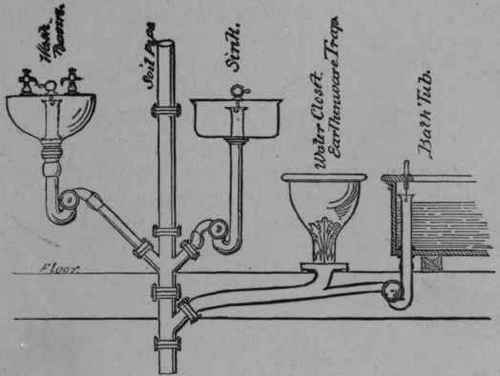
Fig. 80. - Simplicity with Security.
In the first place, the simplicity of our second method is a great and self-evident gain. It avoids a great many dangers of defective work. In the first arrangement there are three times as many joints to make tight as in the other, or about sixty against twenty, and it is in the jointing that lies the greatest danger and expense of executing the plumbing work. There is also about four times as much piping in the first as in the second arrangement, and four times as many chances of its getting out of repair; and if it required four times as much labor to make these repairs when found, it would require forty times as much brains on the part of the house-owner to know just when and where they were needed.
A second great gain in our simple system is in its security against siphonage and evaporation. The vented S-traps of Fig. 79 afford, as has been frequently demonstrated, much less security against siphonage than the unvented anti-siphon traps of Fig. 80; and while the former soon lose their seals under the ventilating currents after a few days' disuse, the latter are practically secure against evaporation altogether.
The third important gain of our second system is in its cleanliness. We have only about a third as much pipe surface to become foul as in the first. The pot trap and plunger water-closet, with their foul cesspools, have given place to a substantially self-cleansing trap and closet. It is not to be understood by the expression "substantially self-cleansing" that the interior of the trap will remain absolutely immaculate under a foul kitchen or pantry sink, but that it will not become hurt-fully foul or ever inoperative through clogging. A small amount of sediment must necessarily collect in any trap under such circumstances, as it will in an ordinary S-trap, or even in the waste-pipe itself; but with properly constructed fixtures the quantity of such sediment that can collect will be practically harmless.
The removal of the plunger closet in favor of the improved hopper also removes the chief cause of siphonage. Our improved hopper is equally effective in flushing the waste-pipes without producing the violent siphoning action on traps below.
These are the three chief features of superiority of our simple and reliable system over the complicated and dangerous one. There are many other advantages in the special treatment shown in Fig. 80 over that in Fig. 79, but. these are due to advantages (already sufficiently set forth in previous chapters) in the individual appliances used, rather than in the general principles of their arrangement and piping.
To offset these features of superiority, we know of absolutely nothing in favor of the complicated system which has in New York and a few other cities for some time been so wrongfully allowed to exist under the law to the detriment of the public. It would be better for the Boards of Health, who are responsible for this ill-conditioned law, to do their duty at once by the people and effect its repeal, even at the risk of appearing to "stultify themselves" as a member of the New York Board expressed himself to the writer, by admitting their mistake so soon after its enactment, rather than wait until they are forced to do so by the public themselves.
Continue to:


My Books

