


The "Sanitas" Closet. Continued
Description
This section is from the book "Improved Plumbing Appliances", by J. Pickering Putnam. Also available from Amazon: Improved Plumbing Appliances.
The "Sanitas" Closet. Continued
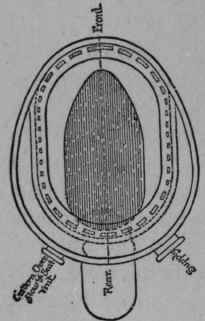
Fig. 75. - Plan of Closet.
A stream of water may be rendered noiseless, however rapid and powerful its movement, by properly directing it into a body of water larger than itself, provided the point of entrance be below the surface. It is not sufficient to do this in the manner usual in the old form of English and French siphon jet closets (Fig. 76), because the jet in these at once throws the standing water out of its way, and then makes an uproar even more appalling than the ordinary flushing stream. In these "trap-jet" closets, the water used for cleansing the upper part of the bowl, when used in combination with the jet in the trap, is not only insufficient to keep the lower jet covered, but makes a most disagreeable clamor of itself after the usual manner with modern closets.
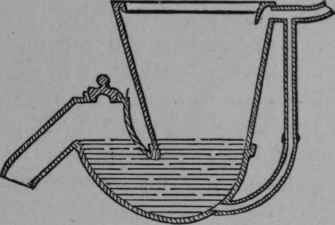
Fig. 76. - Old English Siphon Jet Closet.
The upper flushing stream should furnish a body of water nicely calculated to keep the lower stream just covered and should itself be noiseless. The former result is easily attained by simply adjusting the size of the upper and lower flushing openings with reference to each other; the latter by constructing a special chamber into which the upper flushing stream may be projected before it enters the bowl. The upper part of this chamber forms an annular ring and surrounds the flushing rim. Being above the level of the standing water in the bowl, it receives only clean water. Being constructed in such a manner as to drain itself back into the closet bowl after each flushing action, it stands, like the flushing rim proper, empty at all times excepting during the moment of flushing. The upper jet discharges into the standing water in the lower part of this chamber, as shown in Fig. 74, and its sound is instantly and entirely deadened. The water rises in the annular chamber and overflows through the flushing rim to descend quietly into the bowl, lubricate its sides, and assist the lower stream in ejecting the wastes and flushing the closet and drain-pipes.
In order to make a perfectly and permanently tight soil-pipe connection, metal plates or shoes are used. These shoes are cast to exactly fit the porcelain base. The shoe has a 4 1/2-inch hole in it, corresponding with the outlet hole in the water-closet. The lead pipe which is to connect the closet with the iron soil-pipe is to be first flanged over the 4 1/2-inch hole in the shoe at the floor, and the closet is then set in place on the shoe and screwed down by means of four brass machine screws which are furnished with each closet. The holes in the earthenware base correspond with the threaded holes tapped in the shoe. A mixture of red lead and putty is used between the earthenware base and the metallic shoe, and when this hardens the whole becomes, as it were, one piece, and the closet is thus independent of shrinkage or settling of the floors. All movement takes place in the flexible lead pipe below, which should always be used between a closet and the rigid iron soil-pipe. The joint thus becomes a permanently sewer gas-tight metallic joint which cannot be injured by jarring, settlement or shrinkage in the building.
It will be observed, by referring to the perspective drawing, that the closet is provided with a cistern overflow connection at the flushing rim. The same pipe may serve also as a ventilating pipe. By connecting this with a proper ventilating flue above the cistern in the manner shown in the drawing, the seat and bowl of the closet may be ventilated. Such ventilation is serviceable at the moment of usage of the closet, but it is not needed for the bowl and trap themselves, which are kept ordorless by their construction and arrangements for flushing. It is well, however, always to ventilate toilet-rooms for the purpose of removing the vapor and gases generated during their use by the occupant and by the gas burning, and as good a place as any to locate the ventilating outlet is under the seat of the water-closet in the manner described.
Fig. 77 represents the "Sanitas" Cistern Valve used with this closet. It consists of an ordinary weighted, leather-cushioned valve resting on an ordinary metallic seat. Water hammer is prevented in the long column of water in the supply-pipe by means of the brass cylinder surrounding the valve, which causes the valve to descend slowly when released. The time of descent of the valve, and consequently the amount of water discharged at each usage, is regulated by the small washers on the valve stem. Each additional washer used on the stem reduces the height to which the valve can be raised within the cylinder, and consequently the time required for it to descend ■to its seat. Once regulated, it is only necessary to jerk the valve open and instantly release it to cause the required amount of water to descend and flush the closet. Fig. 78 represents the closet in perspective.
Let us now examine our table of desiderata and see in how far this closet conforms to the various items.
1. Simplicity. We find here the simplest form possible with closets. The trap and the bowl are one and the same thing. Each forms half of the other. The flushing is accomplished by the pressure of the water only, and without machinery of any kind in the closet. We have, in fact, the simplicity of the short hopper, which is the simplest form of water-closet known.
2. Quickness and thoroughness of flushing. The maximum of rapidity of flushing is attained by having the supply-pipe always full of water, so that the action at the lower end takes place simultaneously with the lifting of the valve, and all delay and loss of power occasioned by the water falling from the cistern through the pipe and against the resistance of the enclosed air is avoided. The combined action of the two lower jets of water is, moreover, as already described, such as to accomplish the removal of the waste matters-with the utmost speed.
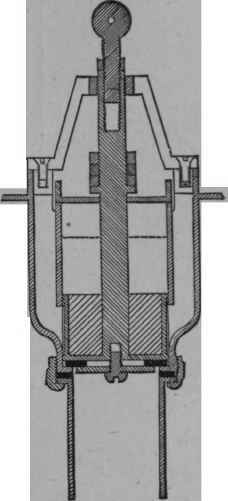
Fig. 77. - Cistern Valve.
The thoroughness of the flushing or cleansing action with a given quantity of water is evidently in direct proportion to the rapidity and direction of the action, it being assumed that the surfaces to be flushed are properly constructed to receive it, as is the case with the closet under consideration. The form and volume of the standing water in the bowl is such as to protect the sides from being fouled by adhesive matters. The solid and heavy wastes, which are the adhesive ones, cannot fall against these sides. If liquid or semi-liquid matters are projected against them they will not stick. Therefore these sides require not so much great force as a uniform distribution of the flushing water. The parts which require scouring force are those below and beyond, including the trap and the main soil and drain pipes, and it is these parts which in this closet receive it. The scouring action on the pipes is here equal to that of the plunger closet, while it is free from the siphoning action on fixtures below of the latter; for air freely follows the discharge and prevents the formation of a vacuum.

Fig. 78. - Perspective View of the Closet.
3. Freedom from all unscoured parts. The closet contains no cesspool in its construction and has the minimum extent of surface interior and exterior possible in a water-closet.
4. Economy in construction and water consumption. Being constructed of a single piece of earthenware of compact and simple form, this desideratum is met. The consumption of water is reduced to a minimum in the manner already explained. No loss of power is sustained in the supply-pipe, and each drop in the closet acts in the most effective manner, in concert with the rest, to produce a rapid and thorough flush.
5. Compactness and convenience of form. The closet occupies the minimum of space, as may be seen from the perspec tive drawing. The outlet is under the center, which facilitates its setting.
6. Amplitude of standing water in the bowl. The standing water has the proper form and depth, and its surface is calculated to stand at the most desirable distance below the seat of the closet. It will be seen upon reflection and experiment, and in testing different forms of water-closets, that the nearer the seat the surface of the standing water can be brought the less liability there will be for spattering when the soil falls into it. In fact, if the surface could be brought so near that the soil would actually touch it before falling, there would be no spattering at all. But, of course, it should not stand so near as to come in contact with the person. The distance established as the best, all things considered, is five inches below the top of the flushing rim, and this distance has been adopted in the case of the "Sanitas" closet.
7. Accessibility and visibility of all parts including the trap. A study of the drawings will show that this desideratum has been attained. The closet and trap, as well as its supplypipe and cistern, may easily be emptied by a sponge or ladle when the house is closed during the winter.
8. Smoothness of material. The closet being constructed of glazed earthenware in a single piece, and everywhere with easy bends, this requirement is fully answered.
9. Strength and durability of construction. The compact and simple form of the closet, the central position of the base under the bowl giving it equal and firm support, and the soundness and reliability of its soil-pipe connection, give it the greatest strength and durability possible with water-closets.
10. Facility and reliability of jointing. There is but a single, simple, and strong brass coupling connection to be made with the supply, and a single connection with the waste-pipe. The small coupling at the flushing rim for a seat vent and cistern overflow may be used or closed up as desired.
11. Security against evaporation and siphonage. The new principle of supply already described, together with the unusual depth of the water seal, render this closet practically secure against loss of seal through evaporation and siphonage.
12. Ease and convenience of flushing. It is only necessary to pull the valve-chain and immediately release it again to obtain a sufficient, and no more than sufficient, flush. The trap and bowl refill themselves automatically after the flush. The valve may also be operated by a simple seat or door attachment if desired.
13. Noiselessness in operation. This very important desideratum has been much neglected in modern water-closet construction. It has hitherto been assumed that it would be impossible to combine noiseless action with a powerful and rapid water scour. Nevertheless, this has been accomplished in our "Sanitas" closet in the manner already described; and the closet may be used in becoming secrecy, as is agreeable to civilized people, and without the usual "flourish of trumpets" which so ridiculously proclaims the fact to the household whenever any one has sought a moment of special privacy.
14. Neatness of appearance. Now that the wise custom of setting all the plumbing fixtures open is becoming every day more general, it is important that every fixture should be so designed as to present an agreeable and appropriate appearance. By this we not only save the expense of paneled wood-work, but secure better workmanship and healthier houses.
Continue to:


My Books

