


Lavatories. Part 4
Description
This section is from the book "Improved Plumbing Appliances", by J. Pickering Putnam. Also available from Amazon: Improved Plumbing Appliances.
Lavatories. Part 4
The only objectionable features, beyond the very high cost, are the great weight and coldness to the touch. The temperature of hot water drawn into an earthenware tub is considerably lowered by the mass of earthenware, and the contrast between the cold and hot surface is somewhat shocking to the nerves of delicate persons.
A valuable substitute for earthenware in tubs is porcelain-lined iron. A cast-iron tub, properly constructed and lined with a heavy coat of enamel properly applied, forms a sanitary fixture of a high order. Lighter and less expensive than the preceding, it still has its advantage of impervious-ness and cleanly appearance, and, with proper care in usage, it will last indefinitely. Improperly constructed, enameled, or used, the porcelain lining will break or scale off and the fixture becomes comparatively worthless, for the defective place cannot be covered or re-enameled. One of the chief causes of injury to the surface of bath-tubs is the careless handling of the stand-pipe. Hence, some form of construction is desirable by which such careless handling is rendered impossible, and when the stand-pipe itself is constructed of porcelain, the necessity of such protection is still more evident.
Fig- 53 represents an enameled iron plunge bath-tub of the improved construction indicated. These tubs are now usually set "open," while copper tubs are encased. The "open" setting is, however, of doubtful advisability, because the tub must set so near the floor as to make the space underneath it little more than a crack, from which collecting dust is difficult to remove and liable to be neglected by servants. The very reason which would induce us in most cases to omit the woodwork around wash-basins would lead us to its use around bath-tubs. There is ample room around the former, but not around the latter, to admit the duster and to permit of a free circulation of light and air, so all-important in connection with plumbing work.
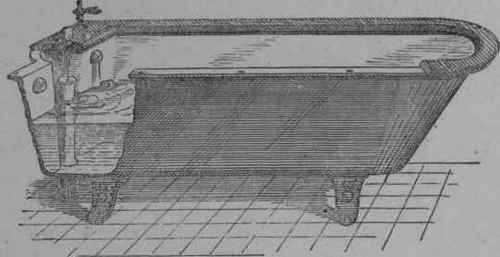
Fig. 53. - Improved Enameled Iron Plunge Bath-tub.
In either case the trap should always be rendered accessible either by placing it, together with the accompanying waste-pipes, in clear view on the ceiling below, or else, in cases where it is necessary to place it between the joists, by constructing a small trap-door in the floor in the manner shown in Fig. 54.
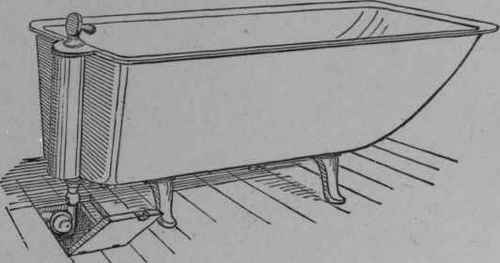
Fig. 54. - Enameled Iron Tub set "open," showing means of access to a trap set between the floor joists.
Fig. 55 illustrates a porcelain-lined iron Sitz or Hip bathtub constructed on the same principle.
In Europe copper tubs are made of metal heavy enough to stand alone without a frame. They are therefore treated like iron tubs in the setting. In this country, however, a lighter copper is used, tinned and planished, and a rough wooden frame is required to support it. Hence these tubs, which are by far the most common, on account of their moderate cost, must necessarily be encased in finished woodwork, and the casing should, of course, extend to the floor.

Fig. 55. - Improved Enameled Iron Sitz Bath.
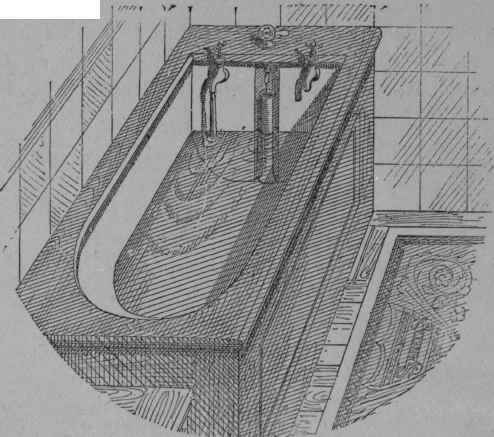
Fig. 56. - Improved Copper Bath-tub.
Fig. 56 represents in perspective a copper tub set in a bath-room with a paneled casing. At the foot is a trap-door in the floor permitting access to the trap. The stand-pipe, which is here of plated metal corresponding with the tub itself, stands in a niche and is operated from above like our other lavatories, thus avoiding the danger of denting the copper by its accidental dropping in handling. A dent in the copper of a bath-tub framed and cased in the American fashion is irreparable.
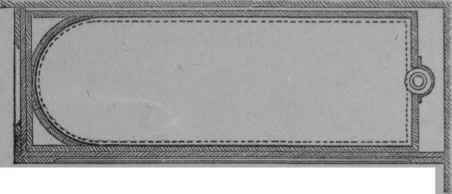
Fig. 57. - Plan.
Figs. 57, 58 and 59 show in plan and section the construction of the tub and its fittings. The weight of the copper in tubs should not be less than 16 ounces to the square foot. A lighter copper will soon "cockle" and become uneven from the expansion caused by the hot water. The best tubs have the weight of the copper stamped in their surfaces, so that no mistake need be made on this score. The supply faucets may be brought through the end of the tubs, either as plain bibb cocks or bath bibbs, or as some form of combination cock by which both hot and cold water may be introduced through a single nozzle and mixed in their passage, or, finally, as flat mouths or as concealed valves operated by handles placed above the end of the tub in the wooden frame. The plain bath bibbs are the most common in copper tubs as shown in Fig. 56. For earthenware or enameled iron tubs, the flat mouths with handles above are most suitable (Fig-. 53), inasmuch as the temptation to draw water into the pails or other vessels by which the enamel is endangered is, by this construction, avoided.
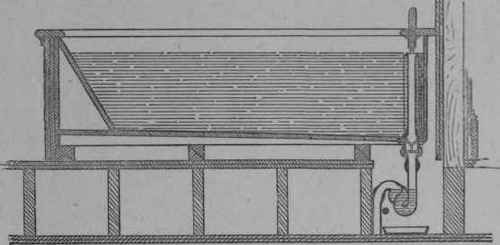
Fig. 58. - Section.
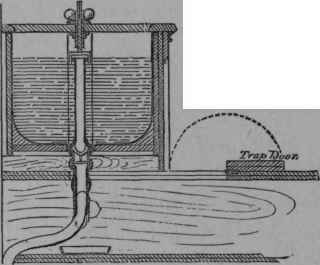
Fig. 59. - Section.
The supply faucets should deliver at the top of the tub. They are sometimes placed at the bottom to avoid the noise of filling. But in this case the opening of a cold-water cock in a basin or sink on a story below may, if the main supply should happen to be cut off or be of very low pressure, draw dirty water from the bath and pollute the drinking supply.
Continue to:


My Books

