


Lavatories. Part 3
Description
This section is from the book "Improved Plumbing Appliances", by J. Pickering Putnam. Also available from Amazon: Improved Plumbing Appliances.
Lavatories. Part 3
Fig. 48. - Perspective View of Lifting Mechanism.
It will be observed that the crank-pin is arranged to be directly above or below the centre of rotation of the disk, that is, at its upper and lower "dead points" when the outlet is respectively open or closed. From this it results that the stand-pipe is forced to remain in these positions, irrespective of its weight, until the handle is intentionally moved again. A ton's weight on the stand-pipe could not cause the pin to revolve from its fully opened position and close the outlet, but the pressure of an ounce properly applied at the handle is all that is required to do the work. This renders the action at the same time easy and positive. Neither strength nor care and delicacy of handling is required. A careless touch will raise or lower the stand-pipe and fix it firmly in the position taken.

Fig. 49. - Perspective View of Basin and Lift.

Fig. 50. - Perspective View, showing Stand-pipe and its Outlet Connections.
The device is constructed in such a manner that friction is reduced to a minimum and applied where it cannot affect its durability nor appearance. The only wearing surfaces are those of the crank, pin and axis, and these are within the case. Therefore, no exposed or plated surfaces are abraded. The working parts are made of hard metal and are large and strong enough to be practically indestructible.

Fig. 51. - Corner Lavatory - Two Basins set in Tiles and Marble.
The stem of the stand-pipe is made adjustable by a simple threaded extension rod and check nut, explained by the drawing, to accommodate it to variations in the depth of the basin. The tube of the lift is similarly made adjustable by long threading to accommodate it to different thicknesses of basin slabs, as shown. Other details are sufficiently described by the drawings and need no further notice.
Fig. 51 represents two such basins set together in a niche in a bath-room and surrounded by white glazed tiles. The slab and shelf are of white marble, supported by white marble brackets. The basins are secured to the marble by brass clamps. The supply-pipes here are of nickel-plated brass, and rise in the corners under the slabs. The traps and waste-pipes above the floor are of nickel-plated brass or white metal, with nickel-plated brass trap-cups, all connected together with nickel-plated threaded brass couplings. All pipes stand far enough away from the tiles to permit of easy cleaning or disconnection at any time. The whole arrangement is absolutely simple and safe, and presents an extremely neat and attractive appearance.
An incidental advantage of having the outlet at the rear of the basin instead of at the center is that, while the gradual pitch of the bottom of the basin from the center towards the outlet is sufficient to thoroughly drain off the water at each discharge, yet it is not so great but that it will restore the seal of the trap in case it be of such a kind that its seal would, in basins of ordinary form, be destroyed by self-siphonage.
The hole in the marble over this basin is designed to be circular or elliptical, since these forms can be cut by machinery, and are not only the most economical, but the most convenient in usage and the most agreeable in effect.
In Chapter VIII (Lavatories) we said that small branch waste-pipes of great length should be avoided on account of their siphoning action "and for other reasons." One of these reasons is the avoidance of the gurgling noise produced by the discharge of water through them. The simple system of plumbing we have adopted depends upon a powerful water-scour and the use of small pipes and anti-siphon traps. Air rushes forcibly through the water-seal of the traps and ventilates the waste-pipe. But if the pipe is long and has a quick fall, the suction of air through the water-seal at the end of the discharge will sometimes be so strong as to make a loud and disagreeable gurgling noise. This may happen whether the waste-pipe be vented or not. But with a vented pipe the noise is continuous during the whole of the discharge, while without venting it occurs only at the end, since the cause is the mixing of the air and water. To avoid this noise it is only necessary to avoid long waste-pipes where the fall is great between the lavatory and the connection with the soil-pipe. If the pipe is short, or the fall slight, the noise will be too slight to be noticed. Should it be, however, for any reason, necessary to use a long pipe and at the same time to give it a sudden fall (a combination which rarely, if ever, need be met with in a well-planned house), a choice must be made between two evils - the loud gurgling noise at the end of the discharge or a large-sized waste-pipe. If the position of the lavatory be such that the noise would be very annoying, a two-inch branch of iron soil-pipe may be brought to the lavatory, and if the use of the branch is to be such that it will be likely to become clogged up with grease or sediment, a suitable clean-out cap should be conveniently arranged to permit of its periodical cleansing. The need of cleansing will be indicated by the development of the gurgling noise.
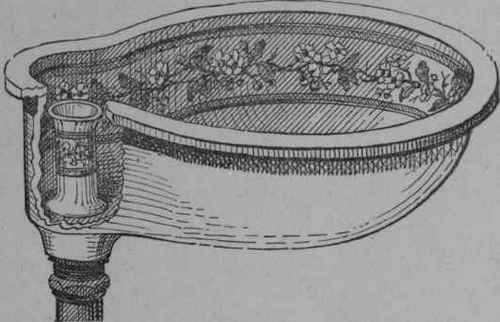
Fig. 52. - Decorated Porcelain Stand-pipe Basin.
Fig. 52 represents a porcelain stand-pipe basin decorated in color.
No better form of flush tank could possibly be devised than a properly constructed bath-tub. This should be made on the principle of the wash-basin already described, and, where economy is not a consideration of importance, the tub may be made also of the same material. A bath-tub of solid white enameled or glazed earthenware, with a white earthenware stand-pipe in its niche thus operated, forms a plumbing fixture very near the ideal of perfection. Its great thickness renders it practically indestructible, and its glazed surface keeps it perfectly impervious to dirt, maintaining it in a clean condition without scrubbing or burnishing.
Continue to:


My Books

