


Thorough Ventilation. Part 3
Description
This section is from the book "Improved Plumbing Appliances", by J. Pickering Putnam. Also available from Amazon: Improved Plumbing Appliances.
Thorough Ventilation. Part 3
III. - Removal of solid deposits through water flushing.
In order to obtain a direct comparison of the value of a thorough water and of a thorough air flushing, the same pipes tested as already described under the air current, and containing identically the same deposits, were next tested under a good water flush. They were attached to a properly constructed lavatory, as shown in Fig. 12, and cold water was discharged through them in the usual manner. Although the deposits were dry and hard, they were almost entirely removed after ten discharges. After fifteen discharges the amount of deposit left on both pipes was less than half a gram. When the substances were soft, on the application of the test, they were removed at once and entirely by a single discharge.
From the above-described tests we have found that the water flushing was infinitely more rapid and thorough in its cleansing power than the air flush. Now there is nothing to prevent every lavatory from being so constructed as to properly flush the waste-pipes at each discharge. In fact, there are a great many reasons to recommend it.
Hence, special trap and branch waste vent-piping is, lor the purpose of removing solid deposits, not only inefficient, but also entirely unnecessary.
We come finally to the fourth consideration.
IV. - Self-ventilation of traps and branch waste-pipes.
But supposing it had been shown that special trap ventilation were necessary instead of the reverse, it would still be superfluous to apply the special vent-pipe, because the ventilation in proper plumbing is thoroughly accomplished without it, and in several ways.
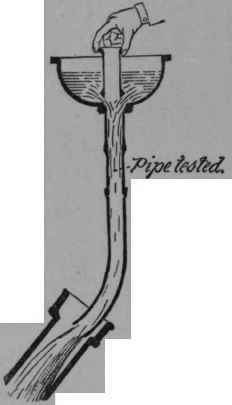
Fig. 12. - Scouring Pipes by Water Flushing.
If our main stacks of pipes are open above and below, and are thoroughly aired, the branch wastes will be ventilated, in the first place, by the well-known law of the diffusion of gases.
In the second place, a movement of fluids up or down the main stack creates in the branches a suction strong enough sometimes even to destroy the water-seal of ordinary traps.
This suction, be it strong or feeble, always produces an interchange of air in the branches.
Finally, a third and still more important way in which natural aeration is produced is by the usage of the fixture itself. Every time the water is discharged, a column of pure air is drawn from the room into the waste-pipe after the water column. Most people have observed how the air follows the water, and is drawn through it in the form of an inverted cone or funnel, generally with a loud sucking noise. When the fixture is properly constructed, with an outlet large enough to fill the waste-pipe "full bore," a column of air equal to the size of the water column is drawn after it, completely filling the waste-pipe with pure air from the room. In short, ample air follows every discharge to accomplish all that the soil-pipe air of the trap-vent could do in the interval between the usages of the fixture. The pure air from the room could not possibly be rendered so foul in the interval as the soil-pipe air would be before it entered. This is equally true whether the fixture be used often or seldom, provided it be properly constructed and set, and whether the branch waste-pipe be long or short.
Thus the special trap-vent is superfluous for scouring, not only because the traps may be fully vented without it, but also because a good water flushing accomplishes all and infinitely more than the air can do.
Removal by aeration of gaseous impurities.
The chief difference between the main soil-pipe and the small branch wastes in relation to venting is that the foul air in the former CANNOT, and in the latter CAN, in good plumbing, be thoroughly changed by flushing and diffusion.
Hence, in the main wastes, special venting is necessary to remove gaseous impurities, and in the small branch wastes it is not. What has already been said in regard to the capacity for the removal of solid impurities from the smaller waste-pipes of a good water flush, holds with still greater force in relation to gaseous impurity. The lighter gases are instantly removed by the water stream and replaced by pure air from the room, and this substitution is as much more desirable than the substitution of soil-pipe air, as is the former richer in oxygen and freer from injurious elements than the latter.
The writer is at the present time at work in laying out the plumbing system of a large apartment house in which most of the lavatories are placed over each other and in such a position that the distance from their traps to the main ventilated soil-pipe is not over eighteen or twenty inches, as shown in Fig. 13. These short branch wastes are powerfully flushed at each usage of the fixtures by a stream of water filling them full bore, and discharging at the rate of nearly half a gallon a second. Traps are used which cannot by any possibility be siphoned out, nor even have their seals seriously lowered by the use 01 water-closets and other fixtures above.
Yet the building laws of some cities rigidly require every one of these traps and dwarf branch wastes to be ventilated by an independent branch to the roof, a distance of more than a hundred feet from the lowest one. There being over a hundred lavatory traps in this building, this law, if enforced, would cost the owner nearly a thousand dollars for the privilege of seriously endangering, through evapora tion, the water-seal of every trap which is not kept constantly in use throughout the hotel.
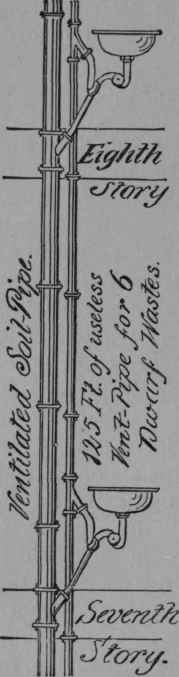
Fig. 13.
Continue to:


My Books

