


An Ignorant Way Of Dealing With A Kitchen-Boiler
Description
This section is from the book "Plumbing Problems", by The Sanitary Engineer. Also available from Amazon: Plumbing Problems, or Questions, Answers and Descriptions Relating to House Drainage and Plumbing.
An Ignorant Way Of Dealing With A Kitchen-Boiler
Q. I put in a square boiler, holding about 25 to 30 gallons, in a country place, where it has to be filled with water from the top by the pailful. Now, the cold water passes through pipe No. 2 and through the water-back, and is heated and passes through pipe No. 3 to the sink. What is the reason that when the cock is open steam comes out for a minute or two and then the water comes out half-stream, and the water-hammer commences and acts on the boiler? What is the reason of this water-hammer, and how can it be stopped? and can the pressure be made greater?
This is the way the pipe runs. There is 1/2-inch 2 A A lead pipe. Don't you think there is water enough in the boiler to make it come out full stream into the sink?
A. The ignorance of the first principles of what is necessary to secure a hot-water supply for plumbing fixtures expressed in this letter and sketch is astonishing. Water is run from a tank into a water-back, and no provision is made for a return-pipe for the water to find its way back again to the tank when it becomes hot. The result is, you make steam in the water-back when there is sufficient heat in the range. This pressure, presumably, finds vent (backward) through the pipe No. 2 periodically and spasmodically, and with all the other symptoms of internal convulsions. When you open the cock at the sink the steam finds vent in that direction, the water following from the tank into the water-back. This condenses what little steam there is left, and a vacuum is formed, drawing water, air, or anything present in the pipes into the water-back, with all the phenomena of water-hammer or shock following.
It is a good thing the tank (or boiler) had to be filled through an open cover, for had it been a closed boiler it is more than likely we would have to chronicle the death of a servant girl or two, or may be a plumber.
Make a connection as shown by our dotted lines at No. 4, and see if it improves the condition of your apparatus. The water in the boiler must not be allowed to fall below the upper end of this opening. It will be understood that the dotted lines are added by us. The original drawing and description makes no provision even for the ordinary circulation to and from water-back and boilers.
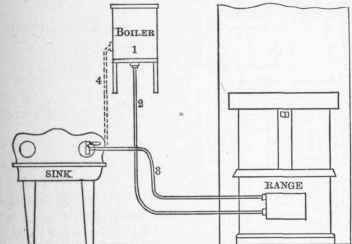
Figure 105.
Continue to:


My Books

