


Automatic Cistern-Filters
Description
This section is from the book "Plumbing Problems", by The Sanitary Engineer. Also available from Amazon: Plumbing Problems, or Questions, Answers and Descriptions Relating to House Drainage and Plumbing.
Automatic Cistern-Filters
"Wherever rain-water is the main-supply for family use, some means of cutting off decaying dirt from the roof, so as not to foul the cistern, should be the first consideration, that we may have water for use as pure as the rainfall, uncontaminated by rotting leaves, shingles, road-dust, etc., the amount of which is only known to those who have cleaned out a cistern or a filter after one or more years' use.
"There are many ways of doing this. The most simple and inexpensive I saw in use in Norfolk, Va. It consisted of a loose elbow-joint at the end of the leader, made to turn in or out of the cistern connecting-pipe (at ground line). The rule was to keep the cistern cut off from the roof, until the rain had washed it, and the gutters cleaned before letting the water in. At first thought this would seem all that could be desired; but, like all the rest of the cut-off systems, it is not only wasteful of water, but unpleasant to attend to, as it must always be done in the wet; and when water is scarce, few people would be willing to give so large a share out of every shower for washing their roof, etc., or go out in the rain, especially on a stormy night, to turn the pipe in.
"So the question was, How to have good water without loss or trouble? This was the problem I had to solve for myself two years ago, when I built the present filter, which has worked well ever since without the least loss or trouble; and, believing it a step in advance of anything of the kind, I send you the plan and section, in answer to one of your correspondents (I think Dr. J. S. Billings), who called attention to the great need of some ' automatic cut-off for a cistern.' Its simple construction and working will be best understood by referring to the sketches. Figure 74 shows the plan and Figure 75 the section. The plan is like a long, square box (sunk in the ground), with a sloping bottom and a centre partition or trap, F, dividing it in two parts - the cut-off and a filterer. The part C next the house in Figure 74 is the cut-off, and receives the water direct from the roof through the inlet-pipe D, while the other part, B, is filled with clean-washed sand, with a layer of gravel and stones at the bottom, as shown at I, Figure 75, which is the top of the sand, J being the gravel and K the stone. By referring to the section, Figure 75, it will be seen that the partition, or trap, F, is raised one inch from the flagstone bottom L, while the top is above the top of the overflow-pipe E, which is also shown on the plan, M (Figure 75) being the ground line, H the water line, and A the outlet to the cistern, so that all the water that enters the cistern must pass under and up through the sand; while any dirt that would sink is kept away from trap and filter by the steep slope of the bottom and collected at N. Also, anything that would float can be seen and removed, if not carried away by the overflow. While the water remaining in this part is not only of value for the garden, being tempered and at hand, but every pailful taken out is, in fact, washing the filter by just that amount of clean water being drawn downward through the sand, washing any settlement back into the cut-off, which, if emptied and cleaned out, by throwing clean water in the filter, a thorough inspection can be had without removing or renewing the sand. This inspection and cleaning costs but little labor, as there is nothing to decay, and so foul the water, in its construction.
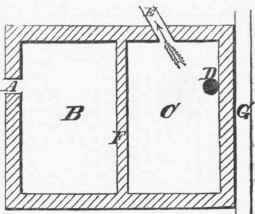
Figure 74.

Figure 75
"For convenience and economy of construction, materials were chosen that are the most easily obtained in any village, and that would only require rough labor to build up. The bottom is formed of one flagstone, four inches thick, five feet long by four feet broad, set with a slope to the house of six inches. On this the four walls are built, four inches thick, and up to just above the ground, all laid in cement, and well coated with Portland cement on both sides (the inside floated smooth). The trap (partition) is also formed of a flagstone (in one piece), two and one-half inches thick by four feet broad and four feet high, built in the side walls and raised up one inch from the bottom. The overflow and cistern outlet-pipes are of vitrified and glazed stoneware, built in the walls, with their openings protected with wire cages against insects, while the lid is formed of matched floor-boards, made light, to be easily removed for inspection, etc.
"The filter holds five and one-half barrels of sand, etc., which is washed clean before putting in, placing the stones on bottom, then the gravel - about half a barrel of each. It costs complete about $16."
Q. The cistern-filter represented in you issue of April 1, 1881, is just what I have been looking for, and I think will meet the requirements of those living in the country who depend upon cistern-water. Would it not be better to make the pipes of cast-iron, rather than of vitrified stoneware - as the former would be less likely to crack or break if they should happen to freeze? How would it do to put a faucet or valve near the bottom of reservoir C, and connect it with a pipe so that the filter could be emptied by allowing water to soak away into the ground?
A. We referred the above to Mr. F. S. Copley, who designed the filter in question, and he sends this reply:
"I do not think iron would be as good as stoneware, as the pipes are empty. The iron would rust and discolor the water, and spoil it for laundry use; and last winter's frosts have not broken or cracked mine, although in wet ground. As to putting a valve or faucet in the bottom of cut-off, I think the dirt (road-dust alone) would choke and fill the pipe up in a season, to say nothing of the loss of so much tempered water, which every florist too well knows the value of to waste, especially when enriched with road-dust, etc."
Continue to:


My Books

