


Collapse Of A Boiler
Description
This section is from the book "Plumbing Problems", by The Sanitary Engineer. Also available from Amazon: Plumbing Problems, or Questions, Answers and Descriptions Relating to House Drainage and Plumbing.
Collapse Of A Boiler
Q. In drawing the water from plumbing fixtures, arranged as follows, or similar to Figure 112, the boiler collapsed. Was the syphon enough to do it, or could there have been another cause?
The circumstances were as follows: The main pipe from street to tank was shut off; then a hot fire was removed from the range; all the water was then drawn from the tank through the faucets in the sink; a 1/2-inch hose was attached to the sediment-cock, and the cock opened; then the drip D in the hot-water pipe in the cellar was opened, from which some water flowed. Hearing a peculiar noise, on going to the kitchen, the boiler was found to have collapsed.
Could there have been any pressure in the boiler to have forced the water out of the drip and hose also? Or was not the boiler strong enough to resist the power of the syphon, which would have existed until the water lying in the hot-water pipe was drawn into the boiler?
The fall is as given in the diagram. Shall have an air-cock placed in top of boiler when it is replaced.
A. The syphon action was sufficient to collapse the boiler, and probably did so in this case.
When you drew the water from the boiler and pipe through the sink connections you still left the pipes and boiler nearly half-full, as indicated by the dotted line a, but when you attached the hose you made the long leg of a syphon, which for the height of six feet, as you show, and say three feet added for the height of water in the boiler and connections, gave you, we will say, a pull of four pounds per square inch. Against this you had a column of water raised in your hot and cold pipes alongside of the boiler by, we will say again, the "pull of the long leg of the syphon." Assuming the latter distance to be nearly equal to the other, which, it appears from your diagram, you may safely assume, you had an atmospheric pressure of three pounds per square inch, or what would produce it. You opened your hose, or the long leg of the syphon, first, and air did not enter through your sink-cocks, as they must have been closed. Had you opened the cock D first (the short leg of the syphon), you probably would not have had the collapse, as the small quantity of water it contained would have run out. When you did open it air entered by it, and made the noise you mention. Had the sink-cock been left open the whole trouble would have been avoided.
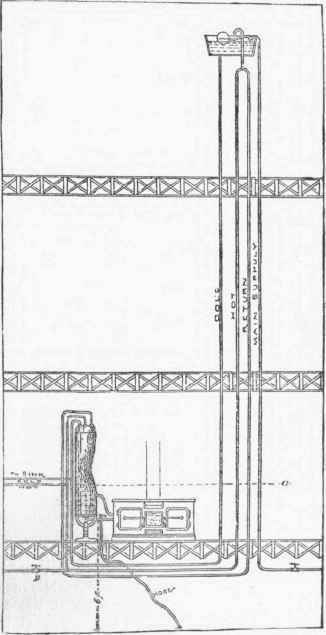
Figure 112.
Continue to:


My Books

