


Fitting Basins To Marble Slabs
Description
This section is from the book "Plumbing Problems", by The Sanitary Engineer. Also available from Amazon: Plumbing Problems, or Questions, Answers and Descriptions Relating to House Drainage and Plumbing.
Fitting Basins To Marble Slabs
Q. Will you explain the usual method adopted in New York to fit a basin to marble slabs?
A. The following, from the articles by "Sanitas" on "Plumbing Practice," in Volume IV. of the Sanitary Engineer, gives the information:
"The practice in this city (New York), and I believe in many parts of this country, is to fasten the bowl to the slab by what are called basin-clamps. (See Figure 70.)
Figure 71 shows the underside of the slab, which contains three holes, into which the heads of the screws are inserted and molten lead poured in, which, on cooling, holds the bolt firmly, as will be seen by noticing the shape of the hole in Figure 72.
"he edges of the bowl are held tightly to the slab by screwing up the nut, so that the clamp is held securely in its place. I should mention here that the edges of the earthenware basins are not perfectly true and level, and in all properly-executed work these edges should be rubbed down smooth and even. The bowls are then set'in plaster of Paris, which is mixed to about the consistency of molasses, and poured around the underside of the slab, adhering about the portion against which the edges of the basin are to rest. When properly done this makes a neat and water-tight joint. "In some parts of the country the old practice of setting basins on a wooden shelf or top is still observed, notably in and around Boston.
"The carpenter is required to construct a frame-work, into which a hole is cut for the bowl to .set in. The edges of this wood-work are countersunk to receive the flange of the basin, plaster is spread over the flange of the bowl, and the marble slab is set in place. When the frames are well made and perfectly plumb, this arrangement does very well, until the wood begins to decay, when the basin will be apt to settle, and seams will be opened between the edges of the bowl and the slab, through which the spatterings of water will run and hasten the decay of the wood-work."

Figure 71.

Figure 70.
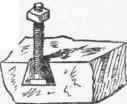
Figure 72.
Continue to:


My Books

