


The Location Of Fresh-Air Inlets In Cities
Description
This section is from the book "Plumbing Problems", by The Sanitary Engineer. Also available from Amazon: Plumbing Problems, or Questions, Answers and Descriptions Relating to House Drainage and Plumbing.
The Location Of Fresh-Air Inlets In Cities
The following suggestions by L. M. Hooper, C. E., of New York, regarding the location of fresh-air inlets, are of interest:
"It seems to the writer that the location of the mouth or opening of the fresh-air inlet does not receive the attention due it. If the fresh-air inlet is an aid to the more thorough ventilation and purification of the waste-pipes, which is now generally admitted, its mouth should be so placed as to be always free from the danger of becoming choked.

Figure 35.

Figure 36.
"It is a fact, patent to all who have had occasion to use these inlets, that when they are run to a receiver or brick box in the sidewalk as shown in Figure 35, they soon become clogged and completely stopped up, and hence are worse than useless, as they give a false sense of security. When the fresh-air pipe is run to any point inside the stoop line, it is usually terminated by a 'return-bend,' cowl or grating inside of a stoop or house, and there is little danger of its becoming choked, except from snow, ice, etc.
" In most cases, however, it is impossible to carry it to a safe distance from the house without taking it beyond the stoop line to some point on the sidewalk.

Figure 37.
" When carried to the sidewalk the arrangement shown in Figure 35 is resorted to and the receiver (A) is sure to close up and thus become inoperative. These receivers are difficult to clean, and seldom or never are cleaned.

Figure 38.
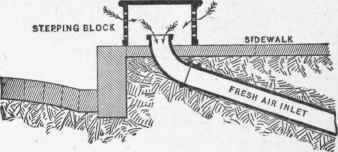
Figure 39.
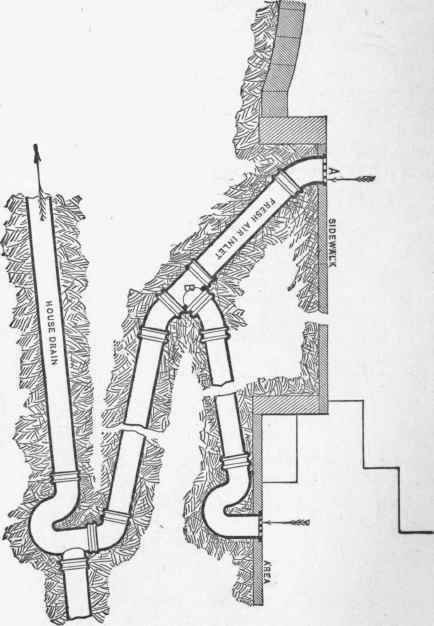
Figure 40.
"There are three general methods by which fresh-air inlets may be made self-cleansing:
"First - By keeping dirt out. This may be done by terminating the pipe under a perforated tie-post or carriage-block, as shown in Figures 38 and 39, or by extending it flush with the curb, as shown in Figure 36.
"Second - By giving to the pipe an inclination considerably greater than the angle of repose for dirt - say a little over 1 to 1 - the dirt falling in will slide down into the house-drain. The mouth should be flush with the sidewalk, as in Figure 37. If arranged as in Figure 35, it will fill up no matter what the inclination is. When sufficient fall cannot be obtained from the curb to the house-trap to use the above method, the third method may be resorted to - i. e., cleansing by water.
"Third - By cutting a small groove a few feet long on each side of the opening and parallel to the curb the wash of the sidewalk may be utilized to keep the pipe clean, or the water from the area may be carried into the fresh-air inlet, as shown in Figure 40. The fresh-air pipe from the opening to the point where the area-drain joins it should have sufficient fall to carry the dirt down to this point - i. e., from A to B, Figure 40. From B, the fall need not be greater than one-quarter of an inch in one foot.
"If none of the above expedients are resorted to, it will be found convenient for cleaning to end the pipe as shown in Figures 37 and 40, as to clean it, it is only necessary to pour a pail of water into it. When arranged as in Figure 35, it is difficult to clean; even when the grating is removed and the accumulated dirt removed it is difficult to wash out the pipe itself."
During 1881, at our request Mr. W. G. Elliot, C.e., made sketches of various methods of arranging fresh-air inlets to house-drains. We give here several of them, with his description.
Figure 41, showing the inlet at the curb with a 6 x 12-inch cast-iron grating to protect it, can be seen in operation in many places, among which may be mentioned several houses on the south-east corner of Sixty-second Street and Madison Avenue. This method is extensively practiced by one of our largest plumbers, and seems to give universal satisfaction.
Arrangement Figure 42 is quite common. The inlet should be located as far from basement-windows as possible, and not extend more than a few inches above the ground. The reverse action, however, takes place very rarely, if ever, and then only on a very hot summer day. A case of this kind can be seen at 125 West Forty-third Street.

Figures 41, 42, 43.
Figure 43 is found at 31 East Fifty-seventh Street. There are many disadvantages in the construction. Being carried up through the front wall of the building, it cannot well be over two or three inches in diameter, while to be effective in any case it should be the full size of the soil-pipe. In addition to this, its top is so nearly on a level with the top of the soil-pipe that the difference in the temperature of the air in the two must be very considerable to create a decided action. Beside these objections it has not even economy to recommend its adoption. Arrangement Figure 44 is very common and effective. Examples can be found at Nos. 51 and 53 West Forty-second Street, and 26 East Twenty-second Street. It is second only to that of Figure 41.
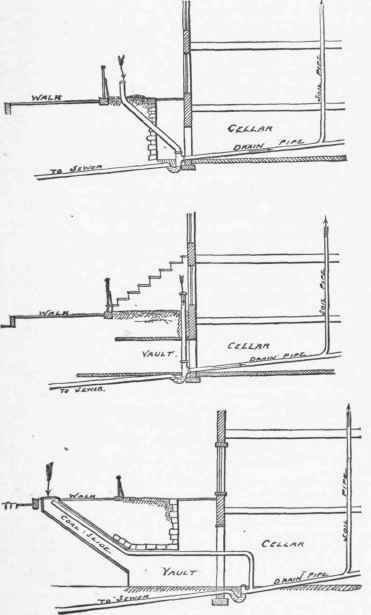
Figures 44, 45, 46.
Figure 45 has been found but in few cases, one of which still exists at 105 West Forty-third Street, where the inlet-pipe opened in the corner of the area against the adjoining stoop, and hardly more than eighteen inches from the basement windows.
It was probably so placed from motives of economy, as it would have cost several dollars more to properly extend it, and the plumber must do the best he can under such circumstances.
A recent innovation in the location of inlets has been found only at 11 and 13 Waverly Place (Figure 46). The pipe extends from the trap along the side of the coal-slide near its top to within a foot of the cover, where it turns into the side wall of the coal-slide, and terminates in the side of a small gully provided with an iron grating, as in Figure 41. In plan, this grating is beside the coal-slide cover, and within a few inches of it. The arrangement would seem to be objectionable from its liability to obstruction by coal-dust, etc., from the frequent dumping and shoveling of coal necessary in a large building, but this is simply conjecture.
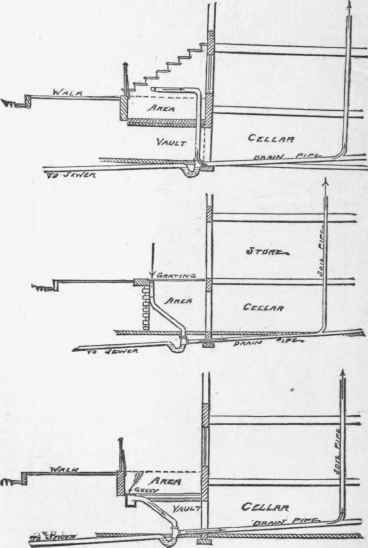
Figure 47, 48, 49.
Figure 47 is employed in a number of instances, among which can be cited 310 Madison Avenue and 11 East Forty-fourth Street. Another was found at 18 West Fifty-seventh Street. There seems to be no especial advantage or disadvantage in its application more than a mere alternative where no other arrangement is found as economical under peculiar circumstances.
Figure 48 was adopted in the case of an apartment-house, with stores beneath, at Eighty-second Street and Tenth Avenue, where it was introduced after the completion of the building, and where a large amount of blasting would have been required to extend it to the curbstone.
On being tested some weeks ago, after having been in operation several months, it was found that the draught was inward and strong enough to draw in the flame of a candle held near it, and extinguish it The current was not reversed even for an instant when two water-closets were simultaneously discharged into the soil-pipe. A similar arrangement can be seen at 49 Wall Street.
Several cases of the arrangement shown in Fig. 49 have been seen, although no particular case can be cited. When the gully is located in the extreme corner of the area it would seem to offer all the advantages of Figure 44, the yard-washings and rain-water keeping it clean and free from obstruction.
With regard to the action of these air-inlets, there can be little doubt of their utility.
Popular opinion of them took its usual course, and the fact that they were new was for a long time sufficient to condemn them. Their rapid increase in number, however, proves conclusively that they are not only becoming popular with the better and more experienced plumbers, but that they rarely, if ever, give offense either to the occupants in the houses or passers in the street. Many have been tested by the writer, but have never been found doing their work improperly except in one or two cases where they had been connected on the wrong side of the trap, and were freely ventilating the sewers.
Continue to:


My Books

